
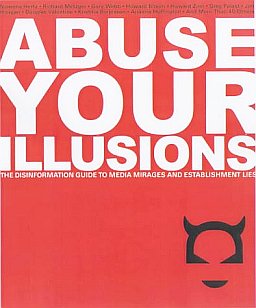
Russ Kick (ed)
New York, The Disinformation Company, 2003, 350pp,
$24.95 / £17.99 (available in the UK from Counter Productions and Turnaround Distribution)
ISBN 0-9713942-4-5
This is the third compilation of essays from Disinformation, and, unlike the first two, nearly all the essays in this anthology have been written specifically for this publication, with some being adapted from chapters in books and only the odd one or two being taken from the Internet. However, like the first two volumes, this has articles that will amuse, infuriate, bore and amaze readers.
The first chunk of the book is titled ‘Media Mirages’ and consists of a short selection from frontline journalists such as Greg Palast and Jim Hougan on how the US media empires constrain what is written and published in US newspapers and magazines. There will be little here that is totally unfamiliar to those interested in this subject but the articles are a worthy read none the less.
Following on from those, there are a larger number of articles dealing with issues which for some inexplicable reason have not risen to the top of the pile when it came to editorial decisions as to what was newsworthy. This takes in such scandals as the Belgian paedophile trials, the Kwangju (South Korea) uprising of 1980, US Biochemical weapons, the mysterious deaths of numerous biowarfare specialists (Dr David Kelly is not exactly unique when it comes to mysterious deaths in this area) and my favourite, Jakob S. Boeskov’s spectacular spoof weapon (which purportedly fired ID chips into people in crowds) which he exhibited at a Chinese Arms Fair to much acclaim and interest.
The third tranche of articles covers the operations of international capitalism and national governments: including an exposé of the conditions that black workers have to endure even now in De Beer’s South African Diamond mines; sexual harassment and rape in the US military; the CIA’s radiation weapons programme and experiments on humans and other abuses of power.
The fourth sequence of items covers terrorism and tyranny. No surprises here over the focus being the current US government’s (and its partners in crime) war on civil liberties and the event that triggered everything off, 9/11. Russ Kick here presents a fairly comprehensive piece, which should, if nothing else, make readers question the received wisdom on this.
Hidden History is the theme for the fifth section. One very topical item is Ovidio Diaz-Espino’s wonderful piece about the building of the Panama Canal (instead of one through Nicaragua, as has recently been mooted) and the way Panama became a separate country (originally it was part of Columbia). This is followed by what I suspect will be the most contentious article in the whole book: James Bacque’s ‘A Truth so Terrible’ which is about what he claims were US and French death camps set up immediately after WWII for German POW’s. His books, which haven’t quite made it to the US bookshops, make the case that upwards of a million German POWs died through being deliberately starved and refused health care. Interestingly he says that this didn’t happen in areas under British or Canadian control. The one thing which would establish his case, some indication of what happened to all the bodies, he doesn’t provide here. (Case not proved, Mr Bacque!) The last item in this section was a real eye opener, dealing, as it does, with the first generation of US female astronauts. The ones who were tested, trained and then unceremoniously dumped in favour of an all-male program, in the 1960s.
The final two sections cover health and religion. Fluoridation is wheeled out once again and Lilly is pilloried for its attitude to Prozac, and the way it ignored evidence that it could lead to suicide amongst those using it. Thomas Szasz wraps this section up with another piece on suicide and how it shouldn’t necessarily be seen, as a sign of mental illness. The essays on religion are fun. An ex-priest dissects the belief that ‘Jesus Christ’ (assuming he even existed) rose from the dead; Howard Bloom shows the extent to which western publishers are being frightened off publishing material critical of Islam (even when some of that material is taken from Islamic sources); Jonathan Levy exposes all manner of scandals surrounding the supposed visions of the B.V.M. at Medjugorje in Croatia, including the obligatory Catholic paedophile priests; Paul Krassner weighs in against the Scientologists and Richard Abanes reveals how racist the Mormon Church was until very recently.
So there you have a mixed bag of goodies. Many of the articles are well sourced, the writing is uniformly excellent and the few pieces that will get up your nose are more than balanced by many more that are genuinely original or that reveal aspects of present society or the past that you probably were unaware of.