
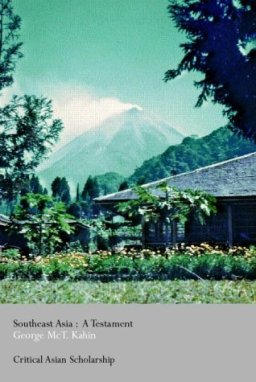
George McT. Kahin
London: RoutledgeCurzon, 2003, £17.95, p/b
The late George Kahin was a pioneering US scholar of Southeast Asia in the post WW2 era. This memoir describes some of his travels in the 1945-70 period, when he behaved rather like a CIA officer (for which he was occasionally mistaken), talking to the rising movers and shakers in the region and returning to the United States with his knowledge, his role in various controversies and his understanding of them.
Three overriding themes emerge. The first is the powerlessness of formal American diplomats in the region against the military and the CIA. The second is the inability of the military and the CIA to use the available information to make good decisions. The third is the innocence of Kahin himself. Kahin is described in the foreword as a New Deal liberal, who saw himself as a man of the left, but this didn’t prepare him for the reality of US foreign policy.
I wanted this book mainly to see how much an official scholar’s view of US activity in the area had been informed by the work of people like Peter Dale Scott. On the evidence of this, the depressing answer is not at all. He does not seem to have grasped the scale of the covert operations in the region. The CIA flits in and out of the picture but he is apparently unaware of the US role, for example, in the slaughter after the overthrow of Sukarno in Indonesia, or of the the CIA’s role in the Vietnam War. There are odd flashes when he seems to getting there. On p. 156 he acknowledges that he may have been ‘naive’ in reassuring President Sukarno of Indonesia in 1963 that Guy Pauker, formerly of RAND, was not CIA. (Two years later Pauker was involved in the coup which overthrew Sukarno. On this see Peter Dale Scott’s essay in Lobster 20.) But this does not lead him to examine the evidence of US involvement in that coup.
Kahin’s innocence is understandable when he is describing his travels in the region in the 1950s: the CIA was still, more or less, a secret organisation; but a lot of information has been produced since then and his ignorance in the late 1990s when he wrote this is difficult to comprehend or excuse.
Crucially, he accepts the received view that JFK and LBJ were the same: he is apparently unaware of JFK’s plan to pull the US out of Vietnam.
‘Nor is there any reasons to suppose that things would have been any different had Kennedy not been killed, for he was every bit as rigid a Cold Warrior as Johnson.’ (p. 188)
This simply is not true and the fact that it is stated here by someone of Kahin’s standing and experience is further depressing evidence that the knowledge of the period acquired by the Kennedy assassination researchers has yet to make its way into mainstream American scholarship.