
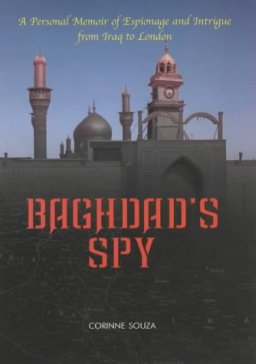
Corinne Souza
Edinburgh/London: Mainstream, 2003, £15.99, h/b
This is an important and interesting book but rather hard to describe because it contains so much. At its heart is Souza’s father, an Iraqi Anglophile, who became SIS’s agent in Iraq, and later in London. Using her firsthand knowledge supplemented by her father’s papers, Souza has created a classic of the espionage genre: I know of no better account of the experience, the mechanics and the feel of being a spy, of a life led under cover. To this she adds another dimension: the impact of her father’s life on the lives of her and her mother. Before reading Souza in Lobster it had never occurred to me to wonder how this works: how do children learn not to blow daddy’s cover? (With difficulty.) What levels of deceit are required? (Many.) How many friends are sacrificed? (Many.)
There are quite detailed portraits of three of her father’s SIS case officers. Two are identified, one remains under a pseudonym; two were the kind of urbane, civilised people we are led to believe work for Her Majesty’s Secret Service; one, the late Alexis Forte, was an obnoxious Russian racist. There is much incidental detail on SIS methods in London in the 1970s and 80s, a good deal of which is new, I think, though Souza is careful not to name any SIS personnel not already identified.
At the centre of the story the urbane civilised SIS people are replaced by Forte and other white supremacists. Souza infers that SIS recruitment policy changed in the mid 1970s, possibly in response to the perceived threat from the British left, and the new intake were less sophisticated, less cosmopolitan, more brutal – and less competent. Her father and the new brutalists running him fell out and SIS took to harassing him and his family. (This is discussed elsewhere in this issue.)
The final short section of the book is Souza’s account of her life as a young adult, working as a parliamentary lobbyist in London in the 1980s; and, after her father’s death, trying to sort out his affairs, get SIS to pay her mother the pension she was due and resist SIS attempts to get her to spy for them in Parliament. She formed an unlikely long-distance alliance with the left-wing Labour MP the late Bob Cryer who, like her, was interested in the corruption of the parliamentary lobbying system. They never met. Just before their first arranged meeting he died in a car-crash. Another interesting and – for the state – timely death.
That is a crude summary of the book’s main threads. There is much more than that. It is also a daughter’s homage to a father; and the complex personal odyssey of an intelligent woman with an Iraqi father and an English mother in a family dominated by her father’s infatuation with a benevolent imperial ‘Britain’ which was largely fantasy. It is full of fascinating fragments: the Masons in Iraq; how the British state did and didn’t help British exporters; how SIS cruised the Arab community in London; spookery at Westminster; how the British foreign policy establishment saw the rest of the world; etc.
It has two faults: one major – there is no index; one minor – the main title, chosen by the publisher, is seriously misleading: Corinne Souza’s father wasn’t Baghdad’s spy, he was Her Majesty’s spy, the truest of true blues.