
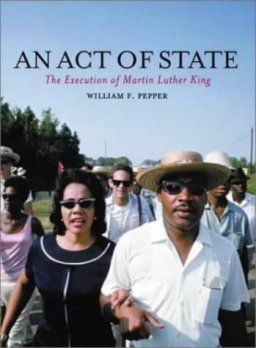
An Act of State: The Execution of Martin Luther King
William Pepper
London: Verso, 2003, £17, h/b
William Pepper has solved the King assassination. He hasn’t quite got enough to name the shooter but he has laid bare the conspiracy. It has taken him 20 years. Is there a comparable piece of research by an individual? I cannot think of one.
Some of this material was presented in greater detail in Pepper’s first book on the case, Orders to Kill (reviewed in Lobster 32). This new account briefly reruns that and adds much new information and an account of the successful civil trial Pepper brought against one of the conspirators after a protracted legal struggle.
Pepper’s thesis starts by demonstrating that there was a conspiracy involving personnel from Memphis Police Department, the US Army and local organised crime. King was shot by a Memphis policeman, in a conspiracy with the mob. Cash from the local mob concealed under vegetables, guns being moved about and hidden in a small diner – this feels small-time, local. But the provision of various false identities for Ray and his control in the months before the assassination were not the work of a redneck gang in Mississippi: this was the federal state.
And it appears that the state did not trust the Memphis cop-mob job to deliver. As the fatal shot was fired, says Pepper, there was an Army team, two men, with King literally in their sights, waiting for the order to fire. Just in case; belt and braces. For many people this is going to take a lot more swallowing than the Memphis mafia and the cops. But the truth is what the truth is.
It gets harder to swallow. Pepper has found apparent links to Dallas and Jack Ruby! After the assassination a young and FBI agent went to inspect a car, a white Mustang, which they thought might have been involved in the assassination. This is quite odd. Pepper doesn’t state that it was the white Mustang driven by Ray. The real thing or a copy, Wilson and a colleague went to the abandoned car and, says Wilson, as he opened the car door an envelope fell out onto the ground. Wilson, one of a very small minority of black men in the FBI (for no explicable reason) concealed the envelope and its contents from the other FBI officer on the search and never turned it over. He kept it until 1997, when he contacted Pepper. Among the paper in the envelope:
‘One piece came from a 1963 Dallas, Texas directory. It was part of a page, which had been torn out. The telephone numbers on the page included those of H. L. Hunt, but more significantly, in handwriting at the top of the page, was the name “Raul”, the letter “J” and a Dallas telephone number which turned out to be the phone number of the Vegas Club which at that time was run by Jack Ruby, the killer of Lee Harvey Oswald.’
(‘Raul’ is the name of the man who directed or ‘handled’ James Early Ray in the months leading up to the shooting. Pepper tracked him down.)
Alarm bells began to ring reading that: surely this is disinformation; it’s just too neat and tidy. Even if the FBI man is telling the truth about squirrelling the document away for 30 years, he’s been concealing something that had been left, to be found by the FBI, to lead them into a total no-go area. It is hard to imagine anything more likely to cool the investigative jets of the FBI and the American state in 1968 than a connection to the events on Dealey Plaza.
Pepper takes this material seriously and goes in search of people who were in the Vegas Club club in 1963 – and finds them! Or does he? Do we believe someone, who, looking at photographs, claims to remember Ray’s handler Raul with Jack Ruby thirty years before?
Sensibly, Pepper left this particular trail out of the case he made to a civil jury in 1999 when he brought suit against the owner of a diner who had confessed to involvement in the conspiracy. The evidence of conspiracy laid out in his two books was put to a jury – which accepted his thesis and found for Pepper – an event barely noticed by the Anglo-American media.
I suspect a jury would not find for Pepper in a criminal trial. Some of the key evidence is statements from former soldiers who would not repeat them in court. Some is hearsay. A good deal is elderly people remembering events over 30 years before. You wouldn’t have to be Perry Mason to make a mess of it and create a lot of reasonable doubt.
Please notice the use of ‘personnel from’ the various agencies above. The involvement of those agencies, as agencies, has not been proved. There is no official paper: indeed, the Pentagon has denied that the Army unit Pepper claims was involved existed in 1968. We don’t know how high up the chain of command within the military the knowledge went.
Within this account of the unmasking of the conspiracy is another big story – maybe a bigger story – of the US military’s involvement in domestic counter-subversion in the 1960s. Little appears to known about this but, if Pepper’s information is correct, there were sections of the US military who had decided by 1968 that the domestic situation could not be left to the politicians and sanctioned the murder of the leading black opponent of their war in Vietnam.
There’s a bigger story yet: the growth of the power of the US military in post-war America. It is easy to lose sight of quite how startling was Dwight Eisenhower’s farewell presidential address. A US president, a former Commander-in-Chief, warns America about the power of the military-industrial complex? On network television? Then Kennedy had to face down the military over Cuba. No wonder Kennedy let John Frankenheimer use the White House to shoot his movie about a military coup, 7 Days in May.
Finally: readers of a delicate ideological disposition should note that Pepper is a gloriously unreconstructed lefty and there are a couple of chapters about Martin Luther King’s life and politics which only those on the left will enjoy.