
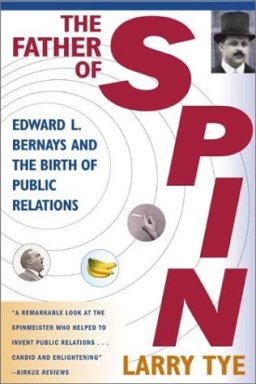
Larry Tye
New York: Owl Books, 2002, pb $16.00
ISBN 0 8050 6789 2
If Edward Bernays hadn’t existed, Edward Bernays would have invented him. And in fact this is more or less what happened.
This is the long-awaited paperback edition of the first full-length biography of Bernays, who, like President Harry Truman, added his middle initial for effect. Drawing on sundry individual memories and Bernays’ own private papers, Tye paints a vivid portrait of the man who perfected the art of persuading people to buy things that they didn’t really want. Bernays revolutionised PR by drawing on the techniques of psychoanalysis that had been invented by his uncle, Sigmund Freud (who regarded his nephew with a mix of admiration and horror). The story that results is of natural interest to anyone who is concerned with the way in which reality can be stage-managed.
The 1929 ‘Torches of Freedom’ campaign for Lucky Strikes was just the beginning. Bernays increased sales for his client by breaking the taboo on women smoking, thus tapping into the dormant female market. Cigarettes, said Bernays, are phallic symbols, and so he sold addiction as empowerment by linking smoking to the emancipation movement. Later, when American Tobacco worried that the cigarette’s famous green pack would hamper sales by clashing with women’s outfits, Bernays launched an audacious (and successful) campaign to establish green as the fashion colour of choice, badgering dyers and dressmakers to change the way women dressed. At the same time, he was advising AT on how to discredit the early medical reports on tobacco’s effects, hiding his wife’s own cigarettes, and publicising health insurance. The word ‘cynicism’ seems awfully inadequate.
From there, it was only a short step to helping reelect President Calvin Coolidge. Before long, Bernays was helping Israel to lobby the US military and recasting India as a worthy recipient of $1bn-worth of aid. He became the propaganda mastermind in overthrowing Guatemala’s elected government on behalf of the United Fruit Company (who were worried that the country’s socialist regime would harm profits).
Mind you, Bernays did later turn down an attempt to hire him made by presidential hopeful Richard Nixon, showing that the bottom of even the deepest barrel can be scraped eventually. But by then, the road that led to 1991’s fictitious tales of baby-killing Iraqi soldiers (peddled by PR agents Hill and Knowlton on behalf of wealthy Kuwaitis who wanted the US to attack Iraq), was not only paved, but red-carpeted.
Tye’s account (written in a subdued manner that belies the great effort that has obviously gone into the book) is perhaps more of an advent calendar than a portrait: a series of glimpses of scenes that might add up to a whole, or perhaps are just symbols of that whole. Here is Bernays as a young man, striving to escape from his overbearing father (Tye lets the Freudian irony speak for itself); here the ‘Father of Public Relations’, aged 100, is accepting a silver bowl as an award and then walking off-stage wearing it as a hat. Anything to defy convention.
But here is Bernays callously knifing colleagues over trivial incidents, and treating secretaries like slaves – and then mounting mini-PR campaigns to protect his reputation after sacking them. And here he is, sitting in a meeting and covering slip after slip of paper with ideas, only to crunch them into balls and throw them on the floor until they are ankle-deep, his colleagues silently aware that this is simply Bernays’s way of demonstrating how productive he is. One is left with the irrevocable impression of a man who just didn’t have the courage to be himself, until he achieved a sort of oblivion by becoming a semi-mythical figure. In telling his appalling, monstrous, beautiful story in such detail, Tye has done the world a service.
Bernays was unable to bear the thought of mortality, and it’s possible that he lived so long – he died in 1995, bright and alert to the last, aged 103 – simply because he wouldn’t let himself die. His century is the story of the century that he helped shape. At the end, sitting alone in his apartment like a latter-day Citizen Kane, his pockets stuffed full of the M&Ms that he munched while talking to the TV, rewriting his self-aggrandising autobiography and telling the same boastful stories over and over to the occasional guests to whom he couldn’t allow himself to feel close, Bernays was the inadequate man who had overcome his self-doubt and thereby remade Western humanity in his own alienated image. It was the biggest act of psychological displacement in history, and it’s difficult to decide whether you love him, or want to dig him up and stake him.