
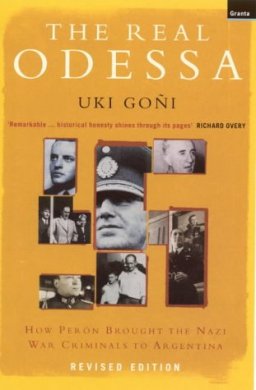
The Real Odessa: How Peron Brought the Nazi War Criminals to Argentina
Uki Goni
London: Granta Books, 2002, £20
If there was a category of work called Detective History, Uki Goni really ought to be awarded Book of the Year. Undeterred by the shredding and incineration of key documents, rebuffs from the supporters of Peron and Menem and general heaviness (Goni currently lives in Dublin some distance from his native Argentina), thanks to his endeavours we now have evidence of the scale of the post-1945 fascist diaspora.
In many respects, by piecing together its impressive narrative from disparate fragments, The Real Odessa resembles Dreamer of the Day, Kevin Coogan’s analysis of the life and times of Francis Parker Yockey, reviewed in Lobster 39. Goni has established what actually happened in Argentine and parts of Europe in 1945-1950. He has done so by rummaging through the passenger lists of every ship or plane that arrived in South America from selected European destinations during this period and has then cross referenced it with details of who issued and who received Red Cross passports and travel documents enabling them to make such a journey. His conclusion? The Vatican did it. The operation was enormous and the Holy See was the only body with sufficient connections to do such a thing. But what Goni fails to answer is why the Vatican in undertook such a task.
The starting point of the mass migration between Europe and Argentina after 1945 is the catastrophic defeat of Germany and its allies at Stalingrad in January 1943. Up until this point, despite its many misgivings and without ever explicitly endorsing the venture, the Vatican had been prepared to go along with Hitler’s Crusade Against Bolshevism. Pope Pius XII clearly hoped that it would rid Europe of what Rome regarded as the greater evil of Communism prior to a return to more civilised ways of conducting international affairs. The great gain for the Holy See it was hoped would be the establishment of traditional catholic states in the Ukraine, Belarus and elsewhere.
The defeat inflicted on the Third Reich at Stalingrad and the passing into captivity of significant numbers of combatants from Roumania, Hungary and Italy, clearly changed perceptions of the likely outcome of events in the east. Evidence of the urgent consultations and special pleadings between the Vatican and the regimes above can be found in several works, most notably Ratlines where Aarons and Loftus quote a Monsignor Tardini, briefing the Pope in May 1943:
‘…there is ground for fearing (a) that the war will end in a predominantly Russian victory in Europe and (b) that the result will be a rapid diffusion of Communism in a great part of continental Europe and the destruction there of European civilisation and Christian culture.’
The need to either prevent this outcome, or make preparations for the best possible alternatives in the event of it coming to pass, clearly began around this time. A number of figures in Germany were reaching similar conclusions at the same time.
The same month that Tardini briefed Pius XII the Abwehr chief in Spain, von Faupel, made a secret visit to Argentina where he met the Commander-in-Chief of the Argentine army, von der Becke, an officer of German origin, and the former Argentine military attaché to Italy, Colonel Peron. The German Embassy in Buenos Aires began channelling funds to selected local newspapers. A month later von der Becke and Peron led a military coup that seized power in Argentina with the support and acclaim of the newspapers funded by the German embassy. Although at this stage using Argentina as a combination of a safe house and bank vault by the Nazi elite may not have been fully thought out, it is at least likely that some cognizance of the desirability of this in the longer term was recognised. As was causing some annoying developments and distractions on the same continent as the USA.(1)
Secret peace talks
It is also known, though not widely recorded, that at the same time that the coup in Buenos Aires took place, secret peace talks were held between the USSR and Germany. (It is tempting, perhaps, to see the Argentine coup as a fall-back position if the talks failed.) Liddell Hart records that Ribbentrop and Molotov met for discussions on the eastern front. The Germans played a clever hand. They agreed to peace if the Soviets accepted a chain of independent (although completely German orientated) states between the Baltic and the Black Sea: Estonia, Lithuania, Belarus and the Ukraine. In other words Ribbentrop proposed a solution likely to find favour with both the Vatican and the catholic allies of the Reich. The Soviets rejected this. They wanted a return to the 1939/1941 frontiers. Joachim Fest says that later peace discussions took place in Stockholm in September 1943. These proved equally abortive. By then the Soviets were insisting on their 1914 borders: i.e. with the Catholic east Poland, Belarus, Ukraine etc. left securely under communist control. (2)
With no progress at ending the war and further Axis reversals now common, a dismayed Vatican sought solace elsewhere. They approached Britain, via a Father Dragonovic of the Croatian Red Cross, in January 1944, seeking support for what was called a Danube Confederation. This was actually a recasting of Intermarium, a project that the Vatican, and, to a certain extent, British Intelligence, had tinkered with since the 20s. This produced little actual success. Two British-backed attempts to install pro-western clericalist governments in Poland and Slovakia before the arrival of the Red Army failed later in 1944. In any event the cessation of diplomatic activity led in May 1944 to the Pavelic regime in Croatia shifting assets worth millions, both legitimate and stolen, to Switzerland. A formal German recognition of the likelihood of impending defeat finally emerged on August 10th 1944 when, after the successful British and US landings in France (and, one should note, the collapse of the German opposition’s efforts to kill Hitler), Martin Borman convened and chaired a conference at Strassburg to supervise the mass shifting of capital overseas:
‘……so that after the defeat a strong new Reich can be built.’
The routes selected for this ran via Switzerland. (3) Estimates for the actual amounts shifted by Borman et al vary but a figure of £150,000,000 in 1945 prices over the next 9 months is generally agreed on. The mechanisms for doing this included setting up hundreds of companies and corporations with offices in Argentina and/or Spain and using these to receive substantial sums of money via newly opened bank accounts in Buenos Aires. Some of these accounts were in the name of the Eva Duarte the actress, mistress and later wife of Colonel Peron. Additional instalments came as late as April 1945 via the sensational robbery of the Reichsbank. The bulk of the money taken from the Reichsbank vaults was never recovered and at least £3,000,000 of it (in 1945 prices) was last heard of in the possession of Otto Skorzeny. (4)
The Vatican’s suggestion therefore in 1943/44 of a Danube Confederation should be seen as an attempt to stop Soviet intrusion into traditional Catholic areas of east and central Europe once it became clear, after September 1943, that no peace would be possible between the Soviet Union and Nazi Germany. The subsequent transfer of assets abroad by Croatia, Germany and others in 1944/45 was undertaken once the Danube Confederation and other peace feelers had fizzled out, and the worst case scenario, a Soviet victory, looked likely. For some this may have just been an excuse in salting away loot for a lengthy personal exile. But it is also clear from the minutes that survive of Borman’s conference that a conscious political effort to establish a Fourth Reich overseas, in Argentina, was being pursued and that the funds involved were considerable. The disappearance of Borman in May 1945 and the continuing surrender of German U-boats in Buenos Aires, some as late as August 1945, confirmed both Borman’s central role in organising these events and the use of Argentina as a base for fresh fascist activity.
Peron emerges
Peron emerged as the undisputed ruler of Argentina in October 1945 and was formally elected President in February 1946. His campaign received substantial funding from a number of banks and was coordinated by Ludwig Freude, regarded as the mastermind behind the Borman-Skorzeny money laundering schemes. Peron’s biggest single backer was one Fritz Mandl, an Austrian arms manufacturer.
At first it was not obvious in 1945-1946 that a major Nazi diaspora was either underway or envisaged. Coincidentally during this period the USA did not have a fully formed policy regarding post-war Europe. Much of the initiative in this respect remained with the British whose most prominent role was in Greece. As it had since the 30s, the UK strongly supported Intermarium. This meant the remains of the pro-Nazi Slovak government led by Ferdinand Durcansky and their efforts to cause a right wing coup in Czechoslovakia, Pavelic and his ministers attempting reinstatement in Croatia, various figures from the Horthy regime in Hungary and a range of groups from the Baltic states.
Gehlen
The most significant sign of an emerging US interest in Europe was the reappearance of Reinhard Gehlen, formerly the head of German military intelligence on the Russian front, in Munich in July 1946. Gehlen received enormous US financial support on the basis of his supposed access to an extensive network of anti-communist activists stretching from the Elbe to the Urals. Little proof of this materialised. In 1942 Gehlen had been unable to predict the time and place of the Soviet counter-attack at Stalingrad.(5) In his new role running a major US-funded spy organisation, Gehl-en produced numerous reports claiming a Soviet invasion of the west was imminent, that the Soviets were building a fleet of flying wing jet fighters, that the Soviets were planning a huge submarine fleet to starve Europe into submission etc, heightening the tension between the two power blocs, and also giving Germany an essential role as a geographical balancing point in the midst of this struggle.
The Real Odessa, Goni credibly shows, began in June 1947 when Eva Peron carried out a state visit to Spain and the Vatican. She was received by Pius XII who confirmed that the Peron regime which had no internal domestic communist opposition to speak of and was 8000 miles from the Soviet Union, was now considered an essential bulwark against Communism. It seems reasonable to take this as meaning that Peron and Argentina were acting on behalf of the Vatican and others as the hosts for anti-communist forces until the time was deemed right for their use in Europe. This view is strengthened when we note that, 12 days after Eva Peron’s Papal audience, Argentina suddenly issued an entry visa to Ante Pavelic, the former dictator of Croatia. Simultaneously the US dropped efforts to bring Pavelic to justice.
With this process formally started, 1947 and 1948 saw covert, extensive and successful efforts to extricate substantial numbers of Croatian, Hungarian and Slovakian rightists – in many cases fascists – to safety in Argentina. (6) These groups were the essential building blocks of Intermarium, a point not stressed sufficiently in Goni’s book.(7) Amongst them could be found Durcansky, former President of Intermarium, an August 1947 arrival, whose coup in Czechoslovakia duly spluttered out a month later. Once in Buenos Aires Durcansky emerged as a major theoretician, providing, with Leon Degrelle, (8) the intellectual material for Peron’s Third
Position philosophy that appeared in late 1947. This closely resembled, in its most compact form, the Intermarium rallying call of ‘Europe for the Europeans, without Russia and the Americans’, and provided the template that Oswald Mosley, Yockey and others would rework over the coming decades. The Third Position quickly spawned its own journal Der Weg, the funding for which came from Ludwig Freude who had backed Peron’s campaign.
At this time, in the late 40s, it was both hoped and expected by those promoting the Intermarium/Peronist world view that the vehicle for realising their goals would be the outbreak of another world war. This was predicted in March 1948 by Gehlen, who also announced at this point the diabolical role of Borman, as a Soviet agent, in masterminding these developments.
International events failed to follow this timetable. To be sure the February 1948 communist seizure of power in Czechoslovakia pointed in the direction of further European conflict. However it was followed by the June 1948 Stalin-Tito split. A few weeks after this Tito survived (quite easily) an attempted British-Croatian Pavelic coup in Belgrade. If the Soviet-Yugo-slav split, which Gehlen and others had evidently been unable to predict, complicated matters considerably, the Berlin blockade (from July 1948) likewise failed to evolve into a shooting war. Indeed the Soviets maintained a position consistently through the Cold War that the other side should shoot first, thus indicating, if nothing else did, that they had no plans to act aggressively against the west. Logical and dispassionate views were hardly in the ascendancy at this point. For the USA WW3 remained imminent and this required a policy of using all possible anti-communist assets.
Even though each episode in the diplomatic and political conflict between the Soviet Union and the USA in Europe failed to actually produce a war, at or after each particular incident the USA veered increasingly toward using fascist or Nazi activists. When, for instance, the Soviet blockade of Berlin started, the US released Otto Skorzeny from detention. This was part of a larger operation, related to and in parallel with the evacuation of Intermarium refugees to Argentina, in which the USA and Peron sought to benefit from the mass recruitment of impressive teams of ex-Third Reich specialists. For Peron this was undertaken by Herbert Helferich, Hitler’s former Minister of Works, who combed Europe for technicians who could help Argentina rise to great power status whilst continuing their pre-1945 research. Among these could be found the Focke-Wulf design team, headed by Kurt Tank, and Reimar Horten, the flying-wing expert.
The high point
This period seemed to mark a high point in the status of the Peron regime feted by the Vatican, launching a global political philosophy, indulging in mass recruitment to boost its own arms and economy and acting as a general off-shore base where various Axis/Third Reich war criminals et al could bide their time until their services were needed once again in the great conflagration to come. Actually Peron made little use of the talent being deliberately collected in Argentina. One consistently gets the impression that the Real Odessa was really about getting various tainted assets together in one place at a convenient distance from post-war Europe (and out of reach of the USSR) until the time was ripe to use them again. Peron’s actions in the aviation field support this view. Emile Dewoitine, a key industrialist in the Vichy regime wanted by De Gaulle as a war criminal, was an early arrival in Argentina via Spain. He duly built a prototype jet fighter, the IA 27, for the Argentine air force. A year later, however, Peron signed a deal with the UK for a batch of jet fighters. Similarly the Kurt Tank design team spent their time in Argentina between 1948 and 1953 producing some examples of their Focke Wulf Ta1 83 design from 1944/45. But instead of ordering this Peron equipped the Argentine air force with cheap, surplus US aircraft instead. Mixed amongst the genuine-ish German specialists were also a number of confidence tricksters and cranks. Other daft projects in circulation in Buenos Aires included a cobalt bomb (of German design) that would allow Argentina to rival the USA and Soviet Union.
As time ticked by it became clear that it would be unlikely the Intermarium refugees would return in triumph to Europe in the near future. The Berlin blockade ended in May 1949 without having caused a major war. At this point the number of arrivals in Argentina slackened. The most prominent in 1949/50 were Otto Skorzeny, Josef Mengele and Adolf Eichmann. (9)
Skorzeny, ostensibly in Buenos Aires as a police instructor, seems to have taken on the role of organising the activities of the ex-Third Reich types. In order to do this he split the Borman money with Peron. A report from 1950 says Skorzeny succeeded in recovering 25% of the amount originally moved to South America in 1944/45.
Goni’s account more or less ends at this point. The scope of his book is to set down who organised the extensive evacuation of fascists and rightists from Europe after 1945 and who the evacuees were. A postscript ought to be added. It is clear that very large amounts of money and valuables were transferred to Argentina by Axis and German concerns and individuals in 1944/45 in an operation organised by Martin Borman and that Otto Skorzeny arrived in Buenos Aires in 1949 to retrieve this. But was this part of a much bigger picture?
The bigger picture
The evidence suggests that it was and that it ultimately included an attempt by the remains of the Third Reich to back a non-aligned movement that, throughout the 50s and 60s, attempted to operate as a balance between East and West, thereby helping the emergence (it was hoped) of a united independent Germany. Clues to this strategy can be found in the movements of, and close relationship between, Otto Skorzeny and Hjalmar Schacht. (10)
In July 1951 Schacht, (11) only just cleared by the last of a series of denazification trials and appeals, was invited by President Sukarno to overhaul the finances of Indonesia. He travelled to Djakarta via Egypt. Here he met privately with the army officers who would later overthrow King Farouk. He also stopped in India, which he visited at the suggestion of Nehru. At this point the Korean war was expected to escalate into a general east-west conflict, an alarming prospect for nations such as India and Indonesia. Both were governed by nationalistic political figures (12) who had struggled in the very recent past against colonial government and both sought for their newly independent nations financial assistance without ties binding them to either Washington or Moscow. In these circumstances a German banker of some standing with financial resources of his own had its attractions. A similar outlook, with the addition of strongly anti-British and anti-Jewish sentiments, also governed the Egyptian army officers Schacht met.
The prospect that Germany might indeed have a major international role again flickered into life in a slightly different way in March 1952. The Soviets proposed a reunification of Germany provided that the new state was both neutral and non-aligned. Essentially this was a replica of the peace settlement that the USSR had already reached with Finland (1949) and would agree for Austria in 1955. In 1952 the Soviet proposal wasn’t taken seriously, though it was supported by many rightists, chiming neatly with their own proclivities at the Malmo International (1951), with the Intermarium diaspora and in the developing Skorzeny/ Schacht perambulations.
Following his international tour, Schacht reappeared in May 1952 addressing a major gathering of German, Spanish and Hispanic business figures in Madrid. He launched his own export bank a month later. By July 1952 he was discussing the economic situation in Iran and issuing a Plan for Iran with Mossadegh. This coincided with the officers he had met in Egypt the previous year overthrowing King Farouk and demanding an end to British hegemony in the area. The USA did not regard this as problematic. The issue for Washington was to prevent the Egyptian nationalists, led by Naguib, Nasser and Sadat, (13) from drifting into the Soviet orbit. The solution to this danger was to install some congenial anti-Soviet advisers in Cairo. Allen Dulles, head of the CIA, turned for help to Reinhard Gehlen. Gehlen recommended Skorzeny as head of the mission. Skorzeny was uncertain but was swayed to accept after conversations with Schacht. He arrived in Cairo in time to attend the grand victory parade organised by the coup leaders in January 1953. Within a few months he would be joined by hundreds of ex-Third Reich officials including Otto Remer (leader of the recently banned Socialist Reich Party), Johann von Leers (former chief propagandists to Josef Goebbels) and Hans Rudel (like Remer a figure in the SRP). Both Rudel and von Leers arrived in Egypt via Argentina. The scale of the Nazi relocation from Buenos Aires to Cairo, and its triumphant anti-British orientation, was denounced in the House of Commons by Prime Minister Winston Churchill in May 1953.
Bandung
The notion that there could be a non-aligned movement, a world grouping linked neither to capitalism nor communism, was not necessarily a cynical fascist tactic. The trail from Intermarium via Peron and his Third Position to the Malmo International seems clear enough. But there is some evidence that it stretched further to the April 1955 Bandung Conference. According to David Guyatt, the Borman/Skorzeny monies in Argentina were transferred to the Philippines and Indonesia in 1954.(14) Both these countries had sought or would seek the help of Hjalmar Schacht in restructuring their economies. Guyatt claims President Sukarno wanted to use the Borman/ Skorzeny money to start an International Non-Aligned Bank as an alternative to the traditional hegemony of Wall Street and the City of London and that this was discussed in secret at Bandung. Though this seems plausible there is no proof. Whatever the situation, the Bandung Conference, (the key players at which were Egypt, India, Indonesia, the Philippines and Communist China) did not result in any striking changes of direction on the international scene.
After 1945 the ultra-right camouflaged its position by embracing the language of neutrality and non-alignment. It tried to play the USA and USSR off against each other and sought various alliances with nationalist movements in the third world. It is clear that the Intermarium exiles and Peron adhered to these policies in the belief that there would be a global war against communism in which their role would be considerable. When these assumptions proved to be wrong, their influence, always rather limited, gradually waned. After reaching a peak in Argentina circa 1947/48, the failure of either the Berlin blockade or the Korean war to lead to the crisis they expected left them as under-employed and expensive advisors in a not particularly wealthy country. The travels of Schacht in the early 50s, the switch to Egypt as a preferred base, the shifting of funds away from Buenos Aires, and the timing and membership of the Bandung Conference suggest an effort on their part to recapture momentum.
The Non Aligned Movement was eclipsed by other alliances (CENTO, SEATO etc) dominated by the western and eastern blocs. As time went by the number and diversity of newly independent nations made it increasingly difficult to find common ground. Subsequent gatherings at Belgrade (1961, hosted by Tito) and Cairo (1964, hosted by Nasser) amounted to little and showed no sign of developing in directions favourable to the ultra-right. (15)
With their efforts to secure an anti-communist base in Argentina going nowhere, the Catholic Church tired of Peron. He was toppled in a coup in September 1955 by army officers acting in defence of Catholic Christianity, ostensibly because he had tried to change the divorce laws in Argentina. Durcansky, surely a figure who demands a detailed biography, left Buenos Aires at the same time, reestablishing himself and his group in Canada where they played a major role in the Anti-Bolshevik Bloc of Nations for many years.
It would not be until the advent of the current Pope, John Paul II, and the coming to power of Reagan and Thatcher, that the concerted roll-back of communism was pursued in much the way that the Intermarium exiles, Peron, Skorzeny, Durcansky, Pavelic, Horthy etc. would have wished. Goni points out that the surviving beneficiaries of the Real Odessa were then able to return home, in some cases even being appointed to significant positions by newly independent states such as Croatia. It is ironic, to put it mildly, that the boundary today between the catholic states of eastern Europe and Russia rests along the same lines that Ribbentrop proposed in 1943 and that Ludendorff and Hindenburg imposed on the Soviet Union in 1918/19.
For many years after 1945 a common term of ridicule used by some on the left to scoff at political opponents, deride their opposition and rubbish their supposed reactionary views, was to quote the same words used derisively by Stalin at Potsdam: ‘The Pope? How many divisions does he have?’ One has to say on the basis of Goni’s book, and developments in eastern and central Europe since 1990, quite a few.
Notes
1 A similar pro-German coup, intended as one in a domino effect series, took place in Bolivia in December 1943 and was planned by Peron who was in constant contact with Berlin throughout.
2 The Soviet motive for entertaining these discussions appears to have been a belief that at any time the USA and UK would conclude their own peace with Germany prior to switching sides and attacking the USSR.
3 A significant pro-Nazi Swiss banking figure was Francois Genoud (1915-1996) who features in both Kevin Coogan and Martin Lee’s The Beast Awakes. Genoud ran the Arab Commercial Bank (employing Hjalmar Schacht as a consultant) from the 50s and actively supported the Popular Front for the Liberation of Palestine, Carlos the Jackal etc. He also held the publishing rights to Mein Kampf.
4 Skorzeny (1908-1975) was an Austrian SS officer with responsibility in 1943/44 for running agents in neutral countries, such as Argentina.
5 In his Special Tasks ((London: Warner, 1995) p. 158, Pavel Sudoplatov says that Gehlen was fed (and believed ) deliberately misleading information by the Soviets. Various contemporaries of Gehlen were openly contemptuous of his claims post 1945 but, being in disgrace themselves, their views were not taken seriously at the time by either the US or the UK.
6 In July 1944 Peron allowed the German embassy in Buenos Aires to receive 8000 blank Argentine passports and 100,000 blank Argentine identity cards. It would appear that similar numbers of documents were later issued to refugees from the Intermarium fold by both the Vatican and the Red Cross.
7 If there is a single criticism that could be made of The Real Odessa it is that Goni should have read Stephen Dorril’s chapter on Intermarium in his MI6:50 Years of Special Operations.
8 Leon Degrelle (1906-1994) ran the Rexist Party (a right wing catholic grouping) which participated in coalition governments in Belgium in the 30s. He later became an SS General, reaching Argentina via Spain in 1945, and becoming a major figure on the European right until his death.
9 Mengele (a Bavarian) and Eichmann (an Austrian travelling on a Vatican passport) continued the catholic link.
10 Skorzeny was married to a young woman who was either the niece of, or regarded as the niece of, Schacht. Sources differ on this.
11 Despite his advancing years Schacht (1877-1970) maintained a very active role as an international financial adviser until at least the early 60s. His activities re: front companies and organisations were closely monitored by the US Treasury Dept.
12 Sukarno had been pro-Japanese 1942-1945 and Nehru was imprisoned for much of the war by the British. Many nationalist leaders in the East held strongly anti-European and pro-Axis views.
13 Nasser and Sadat ran a pro-German officers group in the Egyptian army in 1941/1942 that planned, but failed to carry out, a coup that would have allowed Rommel a quick entry to Cairo and Alexandria. Sadat’s brother also translated Mein Kampf into Arabic.
14 See David Guyatt’s web site < www.deepblacklies.co.uk >.
15 The only person to my knowledge who still talks of the Non Aligned Movement as if it had some weight in international affairs is Yasser Arafat.