
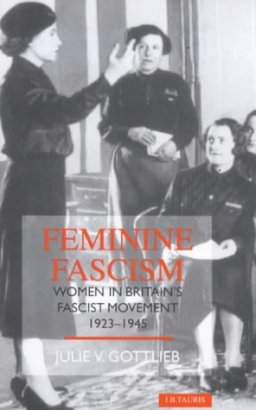
Feminine Fascism: Women in Britain’s Fascist Movement 1923-1945
Julie Gottlieb,
London: I.B. Tauris, 2000, £39.50
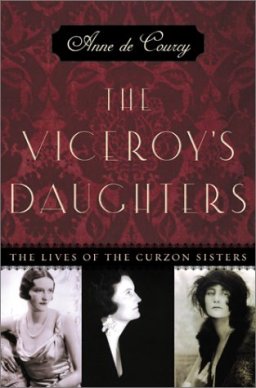
The Viceroy’s Daughters
Anne de Courcy
London: Weidenfeld and Nicolson, £20.00
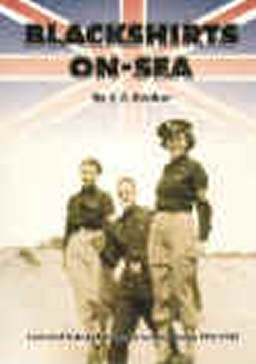
Blackshirts on-Sea
J. S. Booker
London: Brockinday Publications, 1999, £18.00
Fascism is generally regarded as a fiercely masculine political movement committed to excluding women from the worlds of politics and work and confining them to the home. The validity of this view with regard to Oswald Mosley’s British Union of Fascists (BUF) was first called into question by Martin Durham in his Women and Fascism, published in 1998 and now it has been laid to rest with Julie Gottlieb’s Feminine Fascism. What we confront in the BUF is a movement that involved ‘gangs of militant British fascist women’, including a number of former suffragettes, in service to the Leader. The BUF provided fascist women with ‘a forum in which to express feminine concerns’ and actively encouraged women’s involvement in political activity. Where the Nazis proposed excluding women from political life, the BUF regularly stood women candidates in local and parliamentary elections. Something like a quarter of Mosley’s supporters were women and they became increasingly important during the BUF’s peace campaign of 1938-40.
What this did not add up to was any support for women’s liberation or feminism. The movement was run on traditional sexist lines, with a Women’s Section headed by Mosley’s doting mother, Lady Mosley, directing women members into ‘traditional female tasks from canvassing and spreading the word to being made responsible for keeping branch premises in orderly condition’. The limits to Mosley’s support for equality were shown when the former suffragette, Mary Richardson, tried to secure equal pay for women officials in the movement, and was promptly expelled.
Women’s political activity was encouraged, but subordinate to and under the direction of a resolutely male leadership. Men and women had their separate spheres, but these were ostensibly regarded as of equal worth, of equal importance. In fact, it is clear that women were considered subordinate, ancillary. While fascist men embraced a cult of violence, fascist women were expected to embrace a complementary cult of beauty and fitness. Moreover, as Gottlieb points out, on crucial issues such as birth control, eugenics, sterilisation and abortion, ‘it was men who dictated opinion’. One important area of equality worth acknowledging is that fascist women were every bit as anti-Semitic and racist as fascist men.
As well as examining women’s participation in the BUF, Gottlieb also considers the movement as ‘a cult in veneration of one man’, the Leader Oswald Mosley. She focuses on the extent to which ‘his renowned sex appeal heightened female interest in the BUF”. There is no doubt that many of the movement’s women members absolutely idolised Mosley; but so did many of the men. Nevertheless, she sees his success with women as allowing him ‘to synthesise a politics of provocation with one of sexual excitation’ and she writes of fascism flourishing in ‘a sexually charged atmosphere’. This is somewhat over the top, not least because the BUF hardly flourished, being left high and dry by the failure of the British economy to suffer a comparable collapse to Germany. To carry on her sexual analogy, politically Mosley turned out to be a complete wanker, rather than a great lover.
While Gottlieb arguably makes too much of Mosley’s sex appeal as a factor in street politics, his sexual activities among women from his own upper class background are of considerable political interest.
Anne de Courcy’s recent book on Lord Curzon’s three daughters, Cynthia (Cimmie), Alexandra (Baba) and Irene throw some interesting light in this direction. Although she does not make the point, it seems clear that Mosley’s election to Parliament in 1918, aged only 22, owed considerably less to his somewhat undistinguished war record than it did to the entree into the world of high politics provided by his affairs with a number of well connected married women. His marriage to Lord Curzon’s daughter, Cimmie, consolidated his position within the country’s governing elite. Impatience for preferment led to his defection from the Conservatives to the Labour Party where he was welcomed with open arms. Both he and his wife became Labour MPs and in 1929 he became a junior minister in the Labour government.
Mosley did not allow his membership of the Labour Party to interfere with his playboy life-style, a life-style that included a succession of affairs with upper class women, much to the distress of his long suffering wife. On one celebrated occasion he confessed nearly everything to her, revealing affairs with most of her friends, but wisely keeping quiet about her stepmother and her sister, Irene. Much more serious than these casual affairs was the relationship he entered into with the young Diana Mitford, then married to Brian Guinness. While Cimmie was never to really embrace fascism, Diana was, if anything, a more fervent convert than Mosley himself.
Cimmie’s premature death, according to some accounts, left Mosley mortified, overcome with guilt. He attempted to contact her through spiritualist mediums and erected an elaborate tomb of pink marble in her memory. This grief did not stop him beginning an affair with her younger sister, Baba, within weeks of her death. De Courcy does not spare him much sympathy:
‘Domination and sexuality were an intrinsic part of his being. Even his politics were sexualised, with their macho symbols of uniform, marching and insistence on virile youth – to this unremitting sexual adventurer, the thought that he was sleeping with his wife’s sister must have added an agreeable touch of forbidden fruit with its frisson of incest.'(1)
Baba was married to Edward ‘Fruity’ Metcalfe, the friend and companion of the Prince of Wales, later Edward VIII and later still the Duke of Windsor. She was so taken with Mosley that her friends began calling her ‘Baba Blackshirt’. While Mosley combined his affair with her with his affair with Diana Mitford, she found time for affairs with Count Grandi, the Italian ambassador, and later with the British Foreign Secretary, Lord Halifax, although de Courcy suggests that the latter relationship remained platonic. Clearly the sexual politics of the British governing elite in this period can do with further investigation.
Mosley eventually married Diana Mitford in secret in Berlin in October 1936. Those present at the ceremony included Hitler and Goebbels. The secrecy attending this event has generally been put down to his chivalrous desire to protect Diana. That such an unashamed Nazi and Hitler lover as Diana ever needed protection was always dubious and now it is absolutely clear that Mosley’s motives were less elevated: he did not want Baba to know!
Later, when Mosley was interned, Baba, still obsessed by him, did her best, acting through Lord Halifax, to secure his release or at least an improvement in his conditions. It is really quite astonishing that in September 1941, Halifax, by now ambassador to Washin-ton, on a visit to London, arranged a dinner party where Baba could meet Churchill and appeal to him directly. Churchill was also receiving representations from the Mitfords, long standing family friends, in particular from Diana’s brother Tom, another unrepentant Nazi and serving Army officer. On 23 December Halifax wrote to Baba reporting some success: Churchill had convened a special meeting of the War Cabinet to get agreement that Mosley should be imprisoned with his wife in married quarters at Holloway.
De Courcy ascribes Churchill’s conduct not just to upper class networking, but to his principled opposition to internment without trial. It has to be said that this opposition did not extend to the likes of Gandhi and the leaders of the Congress Party. Moreover, Churchill’s enquiries to the Viceroy of India, Lord Wavell, as to why Gandhi was still alive suggest that he felt most strongly with regard to people of his own class and race.
J. A. Booker’s Blackshirts On Sea, subtitled A Pictorial history of the Mosley Summer Camps 1933-1938, is a distasteful exercise in Blackshirt nostalgia, a Mosley scrapbook – there are no less than 76 photographs of the great charlatan – for incurable admirers. Mosley’s natural holiday environment was Antibes and one can only sympathise with the decline in political fortunes that compelled his attendance at such events. Given the sort of man he was, his distaste for the BUF’s East End rank and file is best demonstrated by the fact that he never had sexual relations with any of their wives or daughters. The volume is a photographic record of Mosley engaged very self-consciously in political slumming. In his memoir of his father, Nicholas Mosley provides an amusing account of one of these camps:
‘We all went off to have a ceremonial swim in the sea. But there was a very low tide, and the shallow water seemed to go on for ever; and it seemed to be protocol, as it might be with royalty, that no one should immerse themselves until my father had immersed himself first. But there was not enough water to allow him to do this; we seemed to be proceeding across the English Channel like the children of Israel through the Red Sea. Eventually my father flopped down in a foot or two of water; we all flopped down; then he laughed; we all laughed.'(2)
This is handily symbolic of the fate of the BUF itself. Without economic collapse to carry it to power, the movement embraced an unsuccessful pogromist anti-Semitism, campaigned for a deal with Hitler’s Germany, and really only had any hope of coming to power if Britain was defeated or occupied. A long walk through shallow water ending in a flop – although no one was laughing.
Notes
- Anne de Courcy is also the author of a biography of Edith, Marchioness of Londonderry, Circe, published in 1997, which shows quite conclusively that Michael Collins was romantically involved with the wife of one of the Ulster Unionist leaders at the time of the Treaty negotiations.
- Nicholas Mosley, Rules of the Game – Beyond the Pale, London 1994, p. 392. The Booker volume provides a photographic record of this episode.