
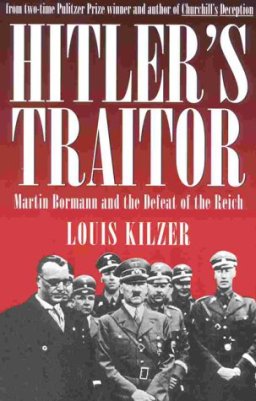
Louis Kilzer
Presidio Press, U.S., 2000, £18.99 (1)
Louis Kilzer has won two Pulitzer Prizes and is the chief investigative writer of the Denver Rocky Mountain News. A couple of chapters into this book it became clear why Kenneth de Courcy sold so many newsletters in the American Mid-West. A low point – or a high point, depending on one’s politics – is reached on p.164 when Kilzer blames the Germans for surrendering at Stalingrad. The author clearly believes this was a bad thing and goes to ingenious lengths – via selective quotations – to show that the big bogey figure of 1939/45 was Winston Churchill….duping Roosevelt….duping Stalin…….pointlessly intransigent toward Hitler etc.
Kilzer’s theory that Bormann was a Communist agent has actually been around since the early 1950s. (2) No evidence has ever been produced to substantiate this view. His book is basically a study of the ‘Red Orchestra’, an area already covered in detail. The author shows that this was, indeed, a very big spy ring. (The CIA were still investigating its activities well into the 1970s, believing that portions of it had survived various Gestapo crack-downs and had gone on to become embedded in the new pro-NATO West German state.) Kilzer reasons that because the intelligence provided by the Orchestra to the Soviets was so good, so detailed and so close to the commands issuing from Hitler’s HQ, the source of this must have been Bormann, playing the role of a diabolical secret agent. Well – maybe. Equally a small number of other German suspects could have been the source of this.
Equally, again, the claims made by Sudoplatov could be accurate: i.e. the best ‘Red Orchestra’ material came from London where long term Soviet agents (in this case John Cairncross) had access to ENIGMA. Cairncross/ Philby etc got the material from ENIGMA and gave it to the Soviets. Because – obscurely – the Soviets didn’t know the details of the origins of ENIGMA they thought that the information was coming direct from the German High Command rather than from London.(3)
There may, of course, still be something in what Kilzer says.
But what is not clear is what difference any of his claims would have made if either (a) they had been known about at the time, or (b) if they were proved correct now. Contrary to the author’s views it was never likely after Stalingrad (and not very likely either after the reversal before Moscow in late 1941) that Germany would win the war in the East. What was always likely, whatever contemporary intelligence provided or confirmed, was that the Soviets would defeat the NSDAP regime with shear weight of numbers.
The book provides little to substantiate its claims. It also fails to deal with the alleged post-1945 travels of Bormann; or, rather, the strong belief that he got out of Berlin and reached South America (or in this case Moscow). The dispute about this continues. To be sure, the skull and bones retrieved in 1972 in Berlin turned out to have Bormann’s DNA. But, as Milton Shulman pointed out in the Sunday Times, the skull had a form of dental surgery not available in 1945 and not known from Bormann’s personal records (4) In 1944/45 Bormann created the funding mechanisms for the Peron regime in Argentina and the possibility that Bormann hid there, died there, and was subsequently reburied in Berlin, seems worth investigating
Like many recent works on the 1939-45 war this book’s conclusions are already challenged by documents coming into the public domain. Kilzer says that the only other suspect for the role of highly placed ace Soviet agent in Hitler’s HQ was Heinrich Muller, a close colleague of Bormann’s. Muller, like Bormann, ‘disappeared’ in Berlin in May 1945. It was thought he had headed east and had been secretly working for the Soviets for some time. Ironically the latest papers on his case show him in U.S. custody in 1947, before being ‘released’.(5)
Notes
- Available in the UK from Midland Counties Books, Leicester (01455 233747).
- Werner Naumann a minor functionary, thought dead in May 1945 (like Bormann) was discovered by British Intelligence in West Germany in early 1953 organising the infiltration of Nazi’s into the coalition partners in Adenauer’s government. Naumann claimed at the time that Bormann was alive and well in Moscow – but produced no evidence of this.
- See Pavel Sudoplatov, Special Tasks, (London: Warner books, 1995), pp.139/143.
- The Sunday Times 5 September 1999. Shulman, now drama critic of the Evening Standard, worked in British Intelligence 1939-1945.
- The Daily Telegraph 3 April 2001