
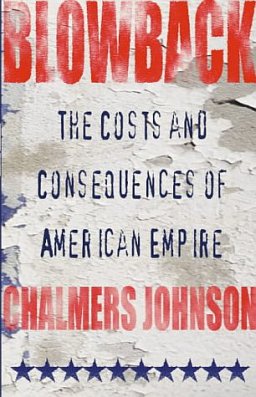
Blowback: the cost and consequences of American Empire
Chalmers Johnson
London, Little, Brown and Company, 2000, £18.99 (hb)
Unholy Wars: Afghanistan, America and International Terrorism
John Cooley
London, Pluto Press, London, 2000, £12.99 (pb)
It has recently been revealed that the CIA inadvertently helped to create Soviet chemical and biological weapons by convincing the Soviets that they – the Americans – had such capabilities when they didn’t.(1) The theory was that the Soviets would waste a lot of money going down dead ends. Alas the U.S. belief that these weapons were not really capable of practical development proved to be false. The subsequent Soviet chemical and biological weapons were ‘blowback’ from U.S. activities.
Creating blowback is one of the things the CIA – no, let’s be fair: the U.S. military and intelligence agencies in general – are good at.
AP reported on 6 January that the suspects in a series of bombings by Muslim extremists in Manila had been trained in Afghanistan. A similar group, trained in the same place, is said to have bombed the world trade centre in New York..
The Times of India reported in March: (2)
‘The Central Intelligence Agency (CIA) worked in tandem with Pakistan to create the “monster” that is today Afghanistan’s ruling Taliban, a leading U.S. expert on South Asia said here.’
‘”I warned them that we were creating a monster”, Selig Harrison from the Woodrow Wilson International Centre for Scholars said at the conference here last week on “Terrorism and Regional Security: Managing the Challenges in Asia”.’
‘…….Harrison said: “The CIA made a historic mistake in encouraging Islamic groups from all over the world to come to Afghanistan. The U.S. provided $3 billion for building up these Islamic groups, and it accepted Pakistan’s demand that they should decide how this money should be spent. “‘
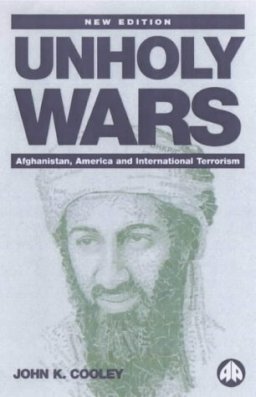 For years now stories like this have flickered on the edge of my consciousness: interesting enough to get me to skim the headline and the first para, but not interesting enough to get me to read any more. So, for me, Cooley’s Unholy Wars was a blast, that wonderful thing – a book in which most of the material is new. Cooley tells in great detail the story of that U.S. operation with Pakistan, in which a bunch of gung-ho American anti-Soviets, at enormous expense, created an anti-Soviet Jihad in Afghanistan. Those involved believe they had a major hand in bringing down the Soviet empire (which is debatable); but none of them seem to have considered what to do with their Islamic army once the Soviets had left Afghanistan; and none of them seem to have anticipated the ensuing massive blowback – heroin, terrorism, the Taliban – they have unleashed. (My guess would be they probably think that hey, it’s a price worth paying for the destruction of the Evil Empire; and anyway, who give’s a fuck about a bunch of towel-heads any way?)
Cooley is an ABC correspondent – but as so often happens with U.S. foreign policy, merely reporting what went on makes him sound like a radical.
Chalmers Johnson’s Blowback covers a much wider field of post-war American imperial history in less detail: Afghanistan gets a handful of pages as an example of the phenomenon. Johnson covers post-war U.S. relations with Japan, the Koreas, Taiwan and China. Johnson presents himself as a mainstream academic but in American terms he is on the liberal-left.. Here’s a flavour:
‘There was……….far more symmetry between the postwar policies of the Soviet Union and the United States than most Americans are willing recognise.’ (p.21)
‘At about the same time in February 1948 when the Communist Party of Czechoslovakia was carrying out a coup d’état in Prague, rightwing forces in the southern half of divided Korea, then under the control of the United States, were slaughtering at least thirty thousand dissident peasants on the island of Cheju.’ (p.97)
‘The Department of Defense programme “foreign internal defense” amounts to little more than instruction in state terrorism.’ (p.73)
‘The IMF……is staffed primarily with holders of Ph.D’s in economics from American universities, who are both illiterate about and contemptuous of cultures that do not conform to what they call the “American way of Life.”‘ (p.80)
‘….the IMF is essentially a covert arm of the U.S. Treasury.’ (p.210)
‘…….the enrichment of East Asia under the cover of the Cold War was surely the most important, least analyzed development in world politics during the second half of the twentieth century. It remains to this day intellectually indigestible in the United States.’ (p.183)
‘ “……globalization”, an isoteric term for what in the nineteenth century was simply called imperialism’ (p.205)
‘Globalization seems to boil down to the spread of poverty to every country except the United States.” (p.214)
And so on. A terrific book; well written, and about as good an introduction as I could imagine to one of the bits of the American empire most of us Europeans know little about.
Notes
- Reported in Philadelphia Inquirer, March 9, 2001 at http://inq.philly.com/content/inquirer/2001/03/09/national/NUKES10.htm. See also, for example, Daily Telegraph, 12 March, Ben Fenton, ‘U.S. blunder “triggered global germ bomb race”‘.
- http://www.timesofindia.com/070301/07euro1.htm