
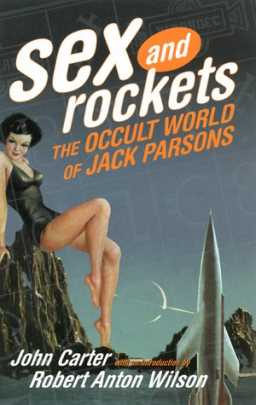
John Carter.
Feral House, Portland (USA), 1999. Available in the UK from Counter Productions, P0 Box 556, London SE5 ORL , £15.99 plus £1.50p pp.
The March Fortean Times launched this in some style, aping the book’s 1950s SF cover and giving it a respectful five page review. With the film rights sold and preparations for a major feature underway, this seems in keeping with the general hype surrounding the subject. Carter’s work is one of a slew of biographies of minor figures that have appeared in recent months, people who in their lifetimes would have liked either a major role or an influential niche but in most cases never quite made it. And, despite a fair effort, Parsons’ life is definitely in this category.
His claim to fame was brief. Around 1935 he began working on rocketry in the desert beyond Los Angeles. Professionally he was a protege of Theodore von Karman, the great Hungarian-Jewish aerodynamicist. (1) Outside of working hours he mixed freely with many enthusiasts of the rising science fiction genre: Bradbury, Heinlein, van Vogt and Philip K Dick all met or knew him. In August 1941 he invented and claimed a patent on a small rocket that could be strapped to a conventional propeller driven aircraft to assist take-off from either an aircraft carrier or a small airstrip. By 1944 he had moved, with von Karman, to the Guggenheim Aeronautical Laboratory at the Californian Institute of Technology. (2) Despite what Carter says, though, Parson’s rockets were no big deal. The Germans got there as early as 1937; and, of course, it was the Peenemunde boys who later produced the V2 and went on to run the Apollo programme. When von Braun and his colleagues arrived under Operation Paperclip in 1945 demand for Parsons’ services quickly subsided.
Parsons’ other great passion was the occult. He was greatly taken with Aleister Crowley. Crowley’s outfit, the OTO, which originated in Germany and had ultra-right wing political predilections. Two of its founders, Reuss and Traenker, feature in Nick Goodrick-Clarke’s The Occult Roots of the Nazism. (3) In 1912 they asked Crowley to run a British branch of the group, and suggested he assume ‘world leadership’ of the outfit in 1925. It is hard to say why or how the OTO ended up with a branch in California, though we could note that Crowley was in the US in 1915-1917 working for German propaganda, under George Viereck, (4) and may have left some adherents behind when he quit the country. In any event by 1941 Parsons had become its leader, establishing with like minded followers a proto-beatnik communal life in a huge rambling mansion. This raised a few eyebrows locally and led to FBI and LAPD enquiries. These concluded that Parsons ran
‘….an organisation dedicated to religious and philosophical speculation, with respectable members such as a Pasadena bank president, doctors, lawyers and Hollywood actors.’
Well – maybe. Clearly the FBI and LAPD must have missed the group sex, extravagant drug consumption and general mumbo-jumbo of the cult.
Carter quotes from extensive correspondence between Crowley – by then living in reduced circumstances in a bed and breakfast hotel in Hastings – and Parsons which indicates that Parsons did, indeed, have some standing these circles. (5)
In August 1945 with Parson’s scientific reputation at a peak and his leadership of the US OTO unchallenged, L. Ron. Hubbard appeared on the scene. Within 12 months he had caused rifts within the group and had almost wrecked Parsons financially. At this point Hubbard abruptly left the scene (with Parsons’ wife) resurfacing, in some triumph, several years later at the helm of the Church of Scientology. Carter points out that Hubbard was in the US Navy at the point he joined the OTO and had attended ‘training for military government’ at the Naval School of Military Government earlier in the 1940s. He was awaiting a ‘medical discharge’ from the US Navy when he met Parsons. This was quickly confirmed after he joined the OTO.
There are a number of possible leads here; unfortunately Carter pursues none of them. Hubbard could have been an unbalanced destructive figure who happened to bump into Parsons and his colleagues with predictable consequences. He could have been a simple confidence trickster. Equally he could have been a spook ensuring that Parsons was (a) investigated at close range, (b) financially ruined and (c) eased out of rocket research. Or he could have been a combination of all three. L. Fletcher Prouty says in the book that he thinks Hubbard’s service records may have been ‘sheep dipped’. Whatever the history of this episode, Parsons, post-Hubbard, attracted further FBI investigations. As a result his security clearance was withdrawn (1948) but reinstated (1949) so that he could work for the Hughes Corporation; withdrawn again (1950) and reinstated again (1952) so that he could work on classified investigations for US Naval Ordnance.
In June 1952 he died in an explosion at his home laboratory. He was about to go and work in Israel. He claimed just before his death to have invented powerful new explosives. Given the statements elsewhere about Parsons’ liking for drugs and preference for working at home with unstable chemicals, the speculation in the book that his death might not have been an accident is unconvincing
Where does this leave us? If the book cannot establish that Parsons is quite the scientific figure claimed, or that he was a victim of any conspiracy, what Carter does show is that all the ingredients of contemporary ‘New Age’ culture can be found in the US west coast in the 1940s: interest in eastern mysticism, rejection of contemporary sexual and social arrangements, experimenting with drugs, fringe artistic endeavours, and the pursuit of novel technology. (6)
Parsons’ second wife, Cameron, kept the torch burning in the style her deceased partner might have wished, maintaining a career on the fringes of Hollywood down to the 1980s: mixing with biker gangs, artists, a film appearance with Dennis Hopper etc. (7)
It would be reasonable to see all this as part of the anti-establishment wave that hit Europe in the 1960s. Ironically one of the things the hippy generation ‘rediscovered’ was the life and times of Aleister Crowley, via the popular 1971 paperback reprint of John Symonds’ biography, in which a reference or two to Parsons (and L. Ron Hubbard) can be found, thus bringing the wheel full circle. (8)
So – a useful addition to the minor figures biography shelf in the library, but ultimately a book in which most lines of enquiry are left unpursued.
Notes
- Von Karman (1881-1963) had quite a career, from ballistics research in Austria-Hungary to the RAND Corporation and a big role in NATO in the 1950s. He is referred to – outside official obituaries etc – as a ‘dilettante’ who kept a substantial residence in Hollywood and, at one stage, dated Jayne Mansfield. I seem to recollect that at the time of her death (1967 – decapitated in a car crash) it was suggested that Mansfield had been dabbling in the occult.
- This later became the NASA Jet Propulsion Laboratory – hence the view in the book that Parsons had a role (of some kind ) in the US space programme.
- Reuss was also a German secret agent. The OTO were regarded as an espionage ring in many parts of Europe. Crowley and his group were expelled from France in 1929 as a result of this.
- Viereck (1884-1962) can be found in Coogan’s Dreamer of the Day (reviewed in Lobster 39) which describes his literary soireés and interest in scientific and (ultra-right) political matters. He was bisexual and an opium user, as was Crowley. Viereck had also used Roger Casement for pro-German propaganda, Casement later being denounced for his homosexuality. Viereck was the author a study of WW1 propaganda, Spreading the Germs of Hate (London: Duckworth, 1931). This had a foreword by Colonel Edward House who looms large in the conspiracy theories about the New World Order.
- Crowley was declared a bankrupt in 1935 and there may have been an idea that Parsons should succeed him in running the OTO.
- Note, too, that California regularly reports the highest single number of UFO incidents in the world, as well as having (with the US south-west) a high concentration of secret military and research bases. See also the new biography of Krishnamurti, resident guru to many in Hollywood from the 1920s.
- She was also in Kenneth Anger’s inscrutable ‘Inauguration of the Pleasure Dome’.
- Symonds’ book was originally published a couple of years after Crowley’s death and lacks, in the style of the times, either an index or footnotes. It remains a good guide, though. The darker side of the hippie/occult/libertarian trend – the Manson killings and various fringe cults (the Church of Satan etc) – remains under-explored.