
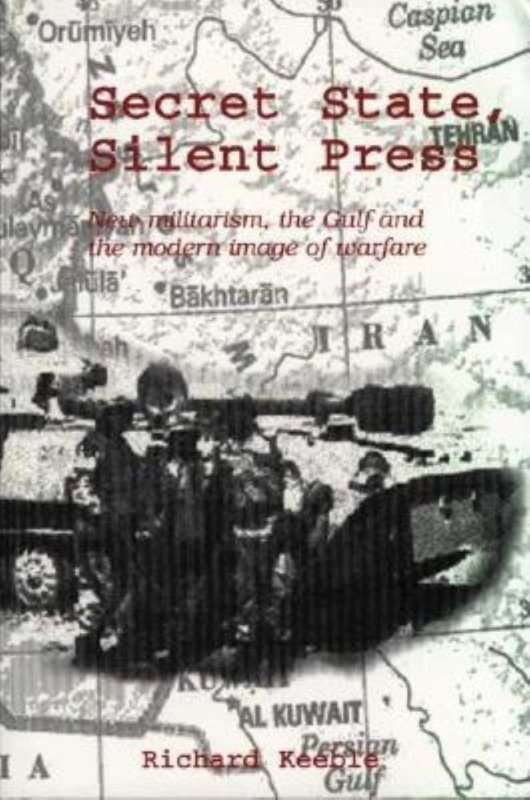
Richard Keeble
University of Luton Press, Luton, 1997, £14.95
Richard Keeble – a former journalist and now Course Director of the BA in Journalism degree at City University, London – makes his stance clear in the first chapter of this well researched study:
There was no Gulf war of 1991…It was nothing less than a series of massacres…a walkover, a rout. A barbaric slaughter buried beneath the fiction of heroic warfare. (p.5)
Keeble goes on to argue that the ‘war’ had little to do with protecting Saudi Arabia or removing Saddam Hussein but was instead a manifestation of what he calls ‘new militarism’. Whereas previous modern conflicts had involved most of the populace in what was by convention referred to as the war effort, the trend over the last few decades has been to lessen popular involvement. Conscripts have been replaced by volunteers. New technology is replacing the human element. More significantly, over the years any democratic input into military actions has been effectively removed. The essence of ‘new militarism’ is, in effect, the manufacture of
short….spectacular wars….to reinforce the power of the political and economic elites and the marginalisation of the mass of the public. (pp.7-8)
Central to this approach is the concept and portrayal of war as a media event, and Keeble convincingly demonstrates that the military has attempted to control and manipulate the popular image of war. He argues that the Gulf conflict was the culmination of a process that began with the Falklands war during which the media were for the most part not only willing to follow the Ministry of Defence line but also prepared to impose self-censorship in the cause of the ‘national interest’. (Photographs of dead bodies were thought to be inappropriate by most newspaper editors and consequently remained unpublished.)
In the run up to the Gulf conflict, extensive use was made of the media to demonise Saddam Hussein as either a new Hitler, or a madman; or, ideally, a combination of both. (It is interesting to note that before transforming Saddam into a ‘bad guy’, the same media had favourably compared him to Thatcher during the 1980s when he was privatising Iraq’s economy. [p.60]) At the same time the collapse of Communism had the Western elites searching around for a new enemy. ‘Arabs’ and ‘Islamic fundamentalists’ were deemed to fit the bill, and Saddam was held up as the prime example of the worst of all that these groups represented.
The background to the Iraqi invasion of Kuwait was effectively ignored by the media, the complexities of that particular area of Middle East political history being reduced to a ‘sudden “naked act of aggression”…’ by Saddam. (p.82) The activities and influence of Britain and America in the region over the years were rarely mentioned. Instead America was cast as the plucky defender of the New World Order, coming to the rescue of a vulnerable state.
During the ensuing conflict, great control was placed over journalists. Few were allowed any contact with the troops or allowed to witness any combat. Keeble describes how the military sought to manipulate how its activities were perceived by the public. Briefings from the White House were ‘tested’ in the morning when no cameras were allowed and the fine-tuned for later briefings which would find their way onto evening news bulletins.The propaganda lessons of Vietnam had been fully absorbed and the media were used (in the vast majority of cases quite willingly) to report and promote exactly what the military wanted them to report and promote.
One key element was the promotion of the conflict as ‘…quick, clean, cool and victorious.’ (p.150) The killing of Iraqi conscripts and civilians was for the most part either marginalised or redefined as inevitable collateral damage and, instead, the successful use of an ‘exciting’ new generation of weapon technology underpinned the majority of the reporting of the conflict.
This is an invaluable book. Keeble makes use of a wide range of sources to demonstrate how closely the attitudes and beliefs of reporters and pundits mirrors that of the political and military establishment. The crucial propaganda function of the press was achieved not through any mass conspiracy to deceive the public but through ‘an ideology of news reporting that incorporates a set of routines, constraint, expectations – and myths.’ (p.200)
Let a journalist have the final word. Roy Greenslade (a former editor of the Mirror), in his foreword to the book, admits that it makes uncomfortable reading for journalists and goes on to say that
…only by understanding how easily we were lured into accepting the word of the political and military elite can we hope not to repeat the exercise.
He wrote those words in 1997. Two years later the exercise was repeated, this time in Kosovo. Slobodan Milosevic was compared to Hitler and the received wisdom was that NATO was engaged in a humane and just war. However there are signs that some journalists at least are now beginning not only to question what happened in the last big military operation of the last century but also to examine more rigorously their part in aiding and abetting it.(1)
Note
- See, for example, John Simpson’s review of Michael Ignatieff’s book Virtual War – ‘We were suckered’ in the New Statesman 3 April 2000, pp. 53-54