
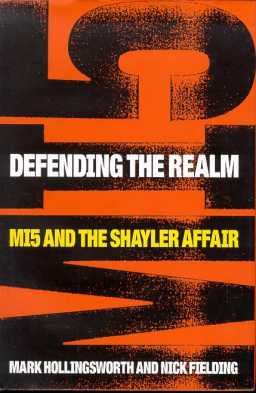
Mark Hollingsworth and Nick Fielding
Andre Deutsch, London, 1999 £17.99
At one level this whole Shayler affair is quite odd. For Shayler is the quintessential, contemporary, football-mad, New Labour-oriented, a-political technocrat – someone who can use the word ‘modern’ without blushing and putting it in scare quotes. (Shayler’s complaints about MI5 can be seen in his submission to the Cabinet Office Review of the security and intelligence services, printed here as appendix 2: they are almost entirely bureaucratic and technical.) In a recent column of his in Punch – issue 93 in the present, post Al Fayed, takeover series – he comments on the hypocrisy of his persecution while the former SIS officer with the pseudonym Alan Judd, gets access to the diary of early MI6 chief Mansfield Cummings:
‘I know Alan Judd’s real name, but I can’t reveal it. He formerly worked in the secretariat or, in normal language, the MI6 chief’s private office. He has had privileged access to MI6 records and is lining his own pockets as a result’ (emphasis added).
Shayler is not some closet socialist, a Philip Agee of the 1990s; and I for one am still unclear as to why he blew the whistle in the way he did.
But never mind: thanks to Shayler’s information we have an insider account of MI5’s recent activities. The authors have compiled a quick sketch of MI5’s history up to the 1980s and a much more detailed account of the period since the fall of the Berlin Wall. A great deal of this is new: Shayler is, as the authors say, the most important whistle-blower from the secret Whitehall world. His account is unprecedented in its scope and detail.
This is also the best extant exposition of what we might call the politics of intelligence in the 1990s, from the creation of the Intelligence and Security Committee through to the collapse of the Labour Party: from feisty words and talk of action in opposition to the forelock-tugging we now see. The authors point out that, while Shayler was sitting in a French jail at HMG’s behest, the House of Commons had its first debate on the work of the Intelligence and Security Committee which had produced its third report that summer. Neither the report nor the debate mentioned Shayler’s name!
There are also accounts here of turf wars with the Metropolitan Special Branch over control of terrorism; of MI5 bureaucratic politics at the highest levels; and a great deal of technical information about MI5’s methods and activities. This book is a huge breach of the Official Secrets Act. Yet although the manuscript was submitted to the D-notice Committee, the authors note in their introduction that, ‘the authorities [only] asked us to make some small changes to the contents of the manuscript.’ So why the persecution of Shayler if so many of his revelations are allowed to be published? Something is going on here which I don’t see.