
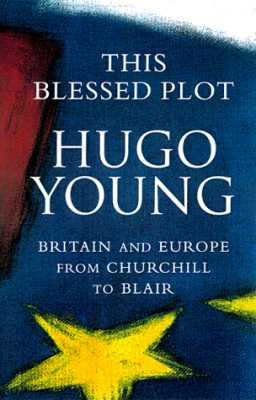
Hugo Young
Macmillan, 1998, £20
I cannot stand Hugo Young. He is a long-winded, pompous arsehole whose columns in the Guardian are mostly a waste of paper and ink. But he has his uses, notably as a mouthpiece for the Foreign Office. In this book he has revealed in infinitely greater detail than before the way the British Foreign Office conspired – yes: conspired – to get Britain into the EEC/EC/EU.
This is a book the like of which the Europhobes and skeptics can hardly have dreamed would ever get written by a Europhile insider like Young – but here it is, chapter and verse on how it was done and by whom. The book shows that in almost all particulars the Eurosceptics have been correct in their accounts of what was going on – who was doing what, why and to whom; and in their analysis of the economic consequences of membership of the EEC/EC/EU.
In summary: a small group at the centre of the British state, fronted by a disparate group of politicians, few of whom had any real idea of what was at stake, have pushed British membership of the EEC/EC/EU regardless of the economic consequences; and have accomplished this by stealth and lying. Young, of course, can’t quite bring himself to write of lying and he gives us a variety of euphemisms.
- ‘deceptive reassurance’ (p. 293)
- ‘conspiracy of silence’ (p. 251)
- ‘near-duplicity’ (p. 249)
- ‘disguising’ (p. 248)
- ‘Ministers did not lie but they avoided telling the whole truth.'(p. 247)
‘Disguising’, for example, comes in this sentence. ‘This disguising was part of an intensely political process. Only by sweetening the truth about national sovereignty, apparently, could popular support be kept in line’ (emphasis added).
Inside this book is a striking essay on the relative power within Whitehall of the big departments. We tend to assume these days that the Treasury carries the biggest stick. Not so. Young shows that the Treasury opposed UK entry into the EEC/EC/EU at every stage: the costs were too high. But entry proceeded. There is still an ‘establishment’ and its core remains the Foreign Office and the City. Britain remains locked in their imperial fantasies.
In writing this book Young has been given access to secret Foreign Office papers, including an in-house history of the negotiations with the EEC. He and his colleagues at the Foreign Office have thus driven a coach and horses through the Official Secrets Act. Somewhere, I suspect, someone on the Eurosceptic side of the argument will be putting this to the relevant authorities. Chances of there being a prosecution? Nil, I should think.
This is a very important book. As Tony Frewin would say, mandatory reading for all grades.