
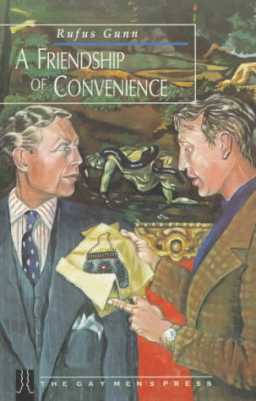
Rufus Gunn
Swaffham: The Gay Men’s Press, London, 1997, £8.95 pb
This is an intriguing and highly readable mix of fact and fiction, likely to be of interest to students of parapolitics and film buffs alike. Set in 1956, the book explores the wary friendship of the newly knighted Anthony Blunt and the black-listed American film director Joseph Losey, who at this time had not yet achieved auteur status and was working on potboilers under a variety of pseudonyms.
A chance meeting between the two comes to the attention of MI5, and Blunt is instructed to befriend Losey and monitor his activities on behalf of the American intelligence services. In doing so, he comes to admire Losey’s principled political views and his refusal to name names, unlike many of his compatriots. As their friendship develops, the book explores the different characters of the two men, one cautiously leading a double life on both a political and sexual level, the other endeavouring to remain open and true to his beliefs. A further level of irony is provided by the fact that Blunt and Losey share the same political creed, although a heated exchange does occur towards the end of the book as Blunt struggles to justify his continued faith in Stalinism.
The underlying threat of McCarthyism is constantly present, and the book skilfully portrays the strain under which that blacklisted filmmakers such as Losey were forced to live. The homosexual milieu of the period is also atmospherically and sympathetically drawn, with fleeting mentions of Cecil Beaton, Michael Redgrave, Truman Capote, and others. Vita Sackville-West merits a sub-plot of her own. Of particular interest, however, is the theory put forward concerning the Montagu of Beaulieu sex ‘scandal’, in which the Earl and two of his friends were jailed for gross indecency. Some commentators have argued that the trio were set up, especially as the other participants in the indecent activity were allowed to go free after turning Queen’s Evidence. Gunn goes along with this, but also suggests that Montagu was imprisoned partly as a sop to the USA, who wanted the Foreign Office to make an example of someone in the aftermath of the Burgess and Maclean defection, and partly because Anthony Eden was convinced that Montagu had seduced his son whilst they were both at Eton.
The book ends with Losey surveying the smouldering ruins of Nettlefold Studios, supposedly torched by the CIA in an attempt to demonstrate to the FBI that it could carry out acts of sabotage with the best of them, and also to warn Losey that he was still under their surveillance. (This is one of the author’s several touches of artistic license – the Studios continued to operate until 1961 and were demolished shortly afterwards.) The incident, which supposedly destroyed the negative of one of his films – another touch of artistic license: Losey made a number of films at Nettlefold Studios, but none of his negatives were destroyed – inspires Losey to defy the enemy and release his new film, Time Without Pity, under his own name. In reality the latter film was a turning point in his career. Following its release, Losey established an international reputation as a stylish film maker; although by the end of his career, as Gunn points out, ‘…critics on the Left complained increasingly of a lack of engagement on his part.’ Blunt, of course, continued his double life until the revelations of 1979.
A Friendship of Convenience is well worth seeking out. It offers some intriguing speculations on life and society in mid-fifties Britain, and its central conceit – the convenient, if unlikely, friendship of the title – is sympathetically portrayed. Although very much a work of fiction, the research that has obviously gone into its writing gives almost all of its assertions a convincing aura of truth.
Postscript: Anthony Blunt and Joseph Losey were born and died within a few months of each other. Anthony Blunt also appears to have been the inspiration for the main protagonist of John Banville’s novel The Untouchable (Picador, 1997)