
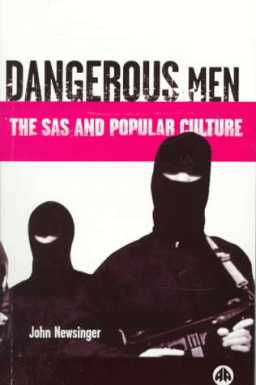
John Newsinger
Pluto Press, 1997
£35.00 h.b., £10.99 p.b.
This book has four sections. The first 38 pages is a brief history of the regiment from WW2 foundation, through various colonial roles — Yemen, Malaya, Indonesia etc. — to its peripheral role in the Gulf War. This provides the backdrop for the other three sections. The first, the SAS-as-autobiography, runs from the early post-WW2 examples, through to the recent wave of SAS tales of derring-do. The second, ‘Celebrating the SAS’, discusses the flood of books, feature and TV films, multi-part magazines, keep-fit manuals and videos in the 80s and 90s about the regiment. The final section describes the regiment in fiction. These are clearly and simply written and full of fascinating details. The scale of the material produced on the subject was a revelation.
The author’s thesis, familiar to those who have read his pieces in Lobster 30 and 32 and , is that while the SAS have been of little military consequence — how little of significance the SAS have actually done is illustrated by Newsinger’s ability to produce a pretty fair summary in only 38 pages — the regiment
‘had become the last symbol of British national virility…..the incredible explosion of popular interest in the SAS in the 1980s and 1990s constitutes a significant cultural phenomenon: a massive assertion of British masculinity in a troubled and dangerous world….the fascination with the SAS, with “men behaving militarily”, can be usefully seen as part of the male backlash against feminism and the women’s movement….. it also constitutes an intervention in the contemporary crisis over British national identity …race and nation were vindicated by the exploits of the soldier heroes, white supermen…. even the disastrous Brave Two Zero patrol during the Gulf War was transformed into a triumph of British masculinity over the brutal Iraqis….a revived popular militarism that does not sustain empire but compensates for its loss’ pp. 3, 139-143
Newsinger notes the difference between the SAS’s roles in the 50s, 60s and 70s, where there was no public triumphalism, and their role in the 1980s.
‘The Britain of Clement Attlee, Harold Macmillan and Harold Wilson did not need soldier heroes. This changed in the 1980s when the SAS found themselves enlisted as Thatcher’s Praetorian Guard, their exploits, both past and present, exploited as part of the Conservative Party’s ideological offensive against the post-1945 political and social settlement.’ (p. 3)
He notes the ‘interesting cultural difference between Britain and the United States that there has been no American equivalent of the remarkable SAS phenomenon that has manifested itself in Britain.’ (p. 55) But the difference here is that the U.S. still has vast armed forces, and can actually use military power with relative impunity. Britain cannot. All Britain could muster during the Gulf War was one tank regiment and a handful of Tornado aircraft which crashed with alarming regularity while doing low-level bombing missions for which they were not designed.
This current British focus on little groups of ‘dangerous men’ is nothing new. Throughout the 1950s and 60s British popular culture presented World War Two as won by superior British know-how (bouncing bombs), and little bands of brave warriors (the Battle of Britain pilots – ‘the few’ – commandos, frogmen). I can still remember as a child seeing films such as Ill Met By Moon-light, The Dam Busters, and Cockleshell Heroes, as well as endless comics which peddled this theme. Today’s obsession with the SAS continues the idea that conflicts are resolved, wars won, by little groups of specialists and not by military and industrial power (neither of which Britain has any more). Newsinger’s thesis about the psycho-political uses to which the SAS was put under Thatcher, is undoubtedly correct, it’s just that he has underplayed the extent to which it was built on an older theme in our society. That quibble aside, this is excellent.