
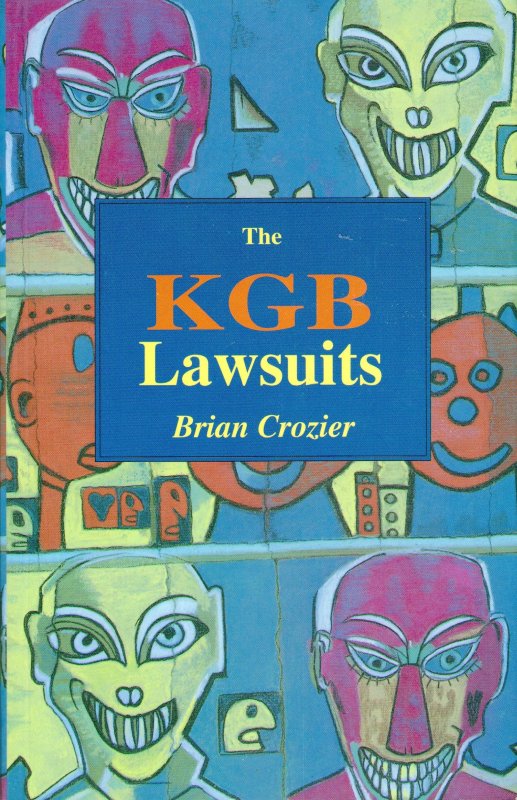
Brian Crozier
Foreword by Sir James Goldsmith
The Claridge Press, London, 1995, £12.95
One of the odd things about the James Goldsmith Referendum Party gambit in the recent election is the way the mass media collectively chose not to refer back to the last great Goldsmith campaign – his hunt for the Red Menace in the late 1970s.(1) Then as now Goldsmith saw himself as the saviour of the nation and put his money where his mouth was.(2) He funded some of Brian Crozier’s operations, created Now! magazine, giving a platform to Crozier and other former IRD wallahs,(3) and set up the famous libel fund to enable the poverty-stricken British Right to sue their wealthier opponents on the Left. (That last bit about the Left is a joke, by the way.) Like Crozier, Goldsmith was then obsessed with an alleged enormous Soviet disinformation offensive against the West. In this book Crozier reworks in much greater detail some of the sections of his memoir, Free Agent, describing three lawsuits in which he was involved which concerned alleged Soviet influence in Der Spiegel, the Institute for Policy Studies (IPS) in the United States, and the Greek newspaper Ethnos. In all three cases Crozier and a large team of researchers, with financial support from Goldsmith and additional aid from a large cast of (chiefly US) intelligence officers, tried to find proof of KGB influence that would satisfy a court.
This is far too long to describe and I would merely summarise it thus. In the Spiegel and Ethnos cases it seems pretty clear that the Soviet state was involved. The KGB did run disinformation through Der Spiegel denigrating Franz Josef Strauss which helped prevent him becoming president of the German Republic. (And a bloody good thing, too, you might think, given Strauss’s politics and the delicate state of the cold war at the time. Psy warrior Crozier’s obsession with this case is surely an example of the biter bit.) It is also clear that the Soviet state did run disinformation through Ethnos – though Crozier’s team failed to show that anything more substantial had taken place. In the IPS case, which takes up more than half the book, the Crozier case was unproven, and in my view unlikely.
IPS really did irritate the new cold warriors who gathered round the broken down old movie actor in Washington. There it was, in the middle of Washington, full of lefties, talking openly with Soviet embassy personnel, supporting Cuba and the Sandinistas, quite unimpressed by the anti-Soviet propaganda offensive of the late 1970s and 80s. The Crozier research team showed, without great difficulty, that the IPS was funded by American lefties, some of them CPUSA members, past and present. They also knew that the CPUSA was funded by the Soviet government. But they never managed to quite produce a ‘smoking gun’ of KGB involvement. Given that IPS regularly invited Soviet personnel to its meetings, and was running the kind of lines the Soviets wanted anyway, KGB involvement looks deeply improbable.
In the attempt to nail the IPS, Crozier runs a load of bullshit at the reader. He recycles the old canard that Richard Welch, the CIA station chief in Athens, was murdered as a result of being identified in CounterSpy. He even describes John Kennedy as being killed by a member of the Fair Play for Cuba Committee, Lee Harvey Oswald, who was ‘trained in Russia and with a Russian wife’! Crozier must know this is baloney and it undermines his case.
Crozier simply cannot believe that there is an independent left. He can’t get past this step: IPS follows Soviet – i.e anti-American – foreign policy lines, therefore IPS is being run by the KGB. Crozier cannot believe that IPS, like generations of lefties before them, were unable to recognise what the Soviet regime was. But such people did exist in the seventies and eighties. I’ve met American lefties, serious people, who could not bring themselves to admit the Soviet Union was as bad as it was said. (Not least because of who said it…..) Daniel Ortega in Nicaragua recently admitted that the Sandinistas believed in the Soviet system and Soviet power and thought.
The odd thing is Crozier keeps providing information to support this thesis. He quotes what now seem astonishingly naive comments about the Soviet Union from Philip Agee, and Phil Kelly, who led the UK campaign against Agee’s deportation.(4) But in the mid-1970s such views were commonplace on the non-Trotskyist British left.
I rather enjoyed this book. The account of the Crozier gang’s sleuthing is interesting, but its real importance, like Crozier’s memoir from which it sprang, lies not in the tales of Soviet disinformation but in the account it provides of Crozier’s network of the 1980s.
Notes
- Although the major media sneered at Goldsmith’s campaign from the off, it worked. All three major political parties ended up by promising a referendum on a single currency – the sole aim of the Referendum Party.
- Some of this is included in the collection of his speeches and articles from the period, Counter Culture, privately published, distributed by W. H. Allen, London 1985. It is unclear to me, if qua food manufacturer and seller, the origins of his Cavenham empire, Goldsmith intended the pun in the title.
- This, I would guess, was the purpose of setting the magazine up in the first place.
- The quotations might be fraudulent. If so, sorry Phil and Phil.