
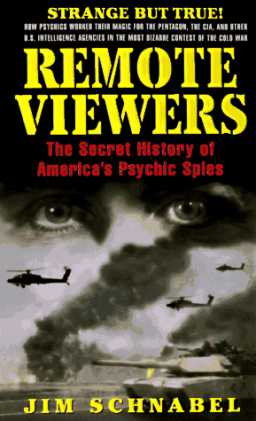
Remote Viewers: The Secret History of America’s Psychic Spies
Jim Schnabel
Dell (USA) 1997, $5.99
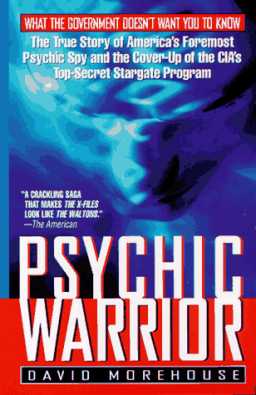
Psychic Warrior
David Morehouse
Michael Joseph, London, 1996, £16.99
I approached the Jim Schnabel book with some caution. A number of people, including Armen Victorian, are intensely suspicious of Schnabel’s activities in the UFO/paranormal fields: some suspect him of being a CIA asset. On this I am an agnostic. But whatever Schnabel’s role, he has written a very good book. (An opinion Victorian shares, incidentally.) If this book (along with his Channel 4 TV programme on the same subject) is part of some CIA disinformation operation in tandem with the official disclosure (and official rubbishing) of the Remote Viewing program, it’s too clever for me.
After interviewing most of the people concerned, Schnabel has written a straightforward history of the program from its origins in the early 1970s at SRI, through its travels as various military and intelligence outfits were found willing to cough up the small amount of money required to keep the unit – never more than a dozen people in all – operational. That was a constant struggle, for as well as the general scepticism of most of the military and intelligence people who knew of the unit, there was outright hostility from some, not least from Christians in the military who thought it the devil’s work.
It is a fascinating story. As Schnabel demonstrated himself on the TV programme on this subject, with a little training most people seem able to do elementary remote viewing. How, no-one seems to know. But the problem with RV as an intelligence-gathering tool is its unreliability. Even the most gifted RVers were never reliable enough for those above them in the military-intelligence chain to be willing to act on their information. Again and again Schnabel reports instances in which the RVers’ intelligence was spot on but not used. This lack of operational utility was the reason the unit was finally closed despite the network of people in the military and intelligence services, with some political support in Congress, who had kept it going for nearly fifteen years.
 A handful of the better Remote Viewers were able to to do what was known as Extended Remote Viewing – leave their bodies and travel through space and time. As this point you may get a sense of how odd this story is: US military personnel were being paid to do what used to be called astral projection back in the 1970s. Little wonder the unit was eventually shut down! Schnabel, so hostile to the crop circle enthusiasts and those claiming to have been abducted by aliens in his previous two books, reports out-of-body space and time travel as if it is nothing remarkable.
David Morehouse joined the remote viewing unit towards the end of its life and is briefly mentioned – and attacked – by Schnabel. (And there have been some very ugly – and to me inexplicable – personal attacks on Morehouse by Schnabel on the Internet.) Morehouse’s book is an autobiography, his RV experiences and his life as a soldier leading up to his joining the unit. It’s an entertaining read, notable for lengthy accounts of Extended Remote Viewing – astral travelling – but its accuracy has been challenged by others connected to the RV unit who have claimed that in writing a ‘pop’ version, Morehouse has conflated the abilities and experiences of several members of the unit into his own. Morehouse portrays himself as a would-be whistle-blower, appalled by US deception over the Lockerbie bombing and the Gulf War (both of which he remote viewed, of course).
The Schnabel book is the important one, but until it appears in the UK, Morehouse’s account – however imaginative it eventually turns out to be – will give a flavour of this most peculiar military adventure.