
Davina Miller
Cassell, London, 1996, £11.50
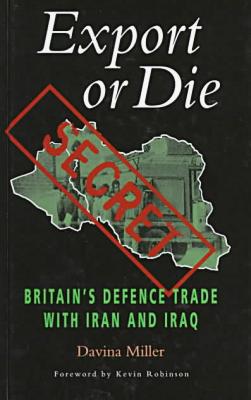
Dr Miller’s books uses the plethora of information uncovered during the course of the Scott Inquiry, as well as plenty not used during its long sessions and deliberations, to provide detailed analyses of government policy towards the sale of defence-related and dual-use equipment to Iran and Iraq during and after the Gulf War. The argument rests on five propositions.
First, British defence-related exports are driven by a general desire to export what is produced. Second, government support for the export of arms and dual-use goods is motivated by the search, traditional to foreign policy, for trade and influence – in this case in the Gulf, long an area of strategic concern to the British state. Third, Britain does sometimes refuse arms transfers on political grounds, usually related to anxiety about the proliferation of nuclear, biological or chemical weapons. Fourth, willingness to supply defence goods is seen as the price of access to a wider, civilian market. Finally, there is no British arms export policy: decisions in this field are subordinated to considerations of commercial interest and national security, as well as to obligations arising from membership of international organizations such as COCOM.
In criticism it has to be said that some part of this book are hard going (especially the chapter on ‘Decision-making for British arms exports’). The author admits right at the start that the study began life as a Ph.D. thesis. At times this shows. The density of the material, while impressive, does now and again generate a feeling of information overload on the part of the reader. Did the publisher rush things, hoping to capitalise on the topicality of the Scott Report? A few revisions with the interested lay reader in mind might have led to a rather more accessible product.
All this is a pity because the overall effect is lucid, penetrating and convincing. The five propositions are supported by plenty of documentation. It is very hard to dissent from the author’s conclusion, namely, that policy was driven from the centre: all departments shared Margaret Thatcher’s well-known commitment to the sale of defence-related exports. The idea was to enhance the wealth and influence of ‘UK Plc’, even though there might be differences between (and within) Ministries over particular issues.
Miller’s understanding of the role played by the centre allows her to establish an interpretative framework which enables students of this murky business to make sense of episodes not satisfactorily resolved by Scott. Two examples are the BMARC and Supergun affairs. Interviewing key witnesses and using well-informed newspaper material as well as (in the case of BMARC) a US court report, Miller argues convincingly that HMG was well-acquainted with events as they developed. Scott, meanwhile, dependent on oral and written testimony supplied by Ministers and civil servants, provides some interesting information but in each case fails to build a coherent picture of what actually happened.
As far as BMARC was concerned there was ‘no evidence’ that the government knew of covert defence sales to Iraq (maybe because, as Scott himself notes, some relevant files and papers had gone missing.) Investigating Supergun, Scott asks us to believe that twelve officials, some in SIS, sat on information provided by a British company which believed it was making missile parts for Iraq. This was in June 1988. No action was taken until late in 1989. All this at a time when SIS was known to be concerned about Sadam Hussein’s efforts to develop a capability in weapons of mass destruction. It is hard to believe that Whitehall could have been this inept, and to her credit Miller does not. She points out that the Foreign Secretary and the Prime Minister would have been informed, on the basis of the former’s responsibility for SIS and the latter’s interest in intelligence affairs, not to mention her ‘specific interest in Iraq’s activities’.(1)
All the same, a careful reading of the Scott Report does support Miller’s general if not specific conclusions. Sir Richard does show, for example, that Thatcher, along with the Foreign and Commonwealth Office, the Department of Trade and Industry, and the Ministry of Defence, knew all about the bank-rolling of defence exports to Iraq. This was done through the ‘defence allocation’, set up by the Export Credits Guarantee Department (ECGD) to facilitate Iraqi purchases of military-related equipment back in September 1985.(2) The allocation was increased in December 1985 but its existence was not disclosed until an ‘oblique reference’ to it was made by ECGD in a memorandum to the Trade and Industry Select Committee on 6 November 1991 – despite a number of highly detailed and informed questions in the House relating to this matter during the intervening years.(3) The defence allocation, like the implications of an SIS report date 30 November 1987 (which the Prime Minister initialled(4)) flew in the face of the famous ‘Howe Guidelines’, which were supposed to govern trade with Iran and Iraq, although Thatcher continued to tell Parliament that these remained in force.(5)
Unlike Miller, Scott failed to develop such information and make it the foundation of an analysis and critique of State policy. But then Scott is the product of the legal system, and like a good lawyer he stuck to his brief; and this was not to produce a case for the prosecution. So although his recommendations deserve Opposition support, and despite the unearthing of invaluable material, Sir Richard was never going to bring down the Government. Neither (of course) is Export or Die. But its sober style belies conclusions which undermine the Government’s version of events, go beyond Scott and provide support for the sombre and disturbing accusations made, courageously, by Gerald James.(6)
Notes
- Miller p. 165
- Inquiry D2.120
- Inquiry D2.111
- See Inquiry G12.30. The Report summarised the involvement of the British machine tools industry in the Iraqi production of munitions. It even referred to ‘Churchill Matrix’ (sic). The Interdepartmental Committee set up with FO, MoD and DTI representatives to review export license applications and test them against the Howe Guidelines, would in Scott’s view, have refused licenses or the export of machine tools if it had known about the contents of the SIS document. Meanwhile the Defence Intelligence Staff did know about the 30 November 1987 document and expressed misgivings about its implications. These were not taken seriously enough to lead the government to stop or at least curtail the trade.
- See Inquiry D4.30.
- See his In the Public Interest (London, Little Brown, 1995; revised edition published by Warner Books, 1996)