
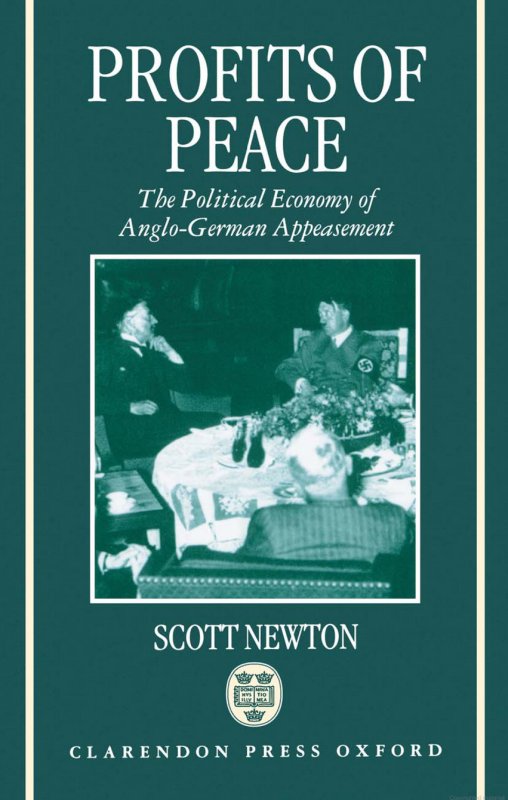
Scott Newton,
Clarendon Press, Oxford, 1996, £30
This is the book Newton was working on which produced the spin-off pieces published in Lobster: ‘The economic background to appeasement and the search for Anglo-German detente before and during WW2’ in Lobster 20, and ‘The Who’s Who of Appeasement’ in Lobster 22.
As those essays showed, Newton writes well and clearly; and the book has been nicely produced. Newton is that relative rarity, an historian who is economically literate; and the result here is a mix of economics, history, politics – and even a dash of parapolitics – so seamless it made me wonder again how anybody ever took seriously historians who don’t know economics.
Newton shows that appeasement was a rational attempt by the Chamberlain wing of the Tory Party to rejig the post-Versailles world in a way which would keep Germany a member of the international, liberal (economically liberal) world.
‘Between 1921 and 1940 the dominant alliance in Britain was founded on a coalition between a ruling élite centred on the Treasury, the Bank of England, and the City of London and an expanding middle class … this hegemonic group, based at the popular and the political level on a fusion between the Conservative and pre-1914 Liberal parties, was committed to the defence of free enterprise and the limited state against the internal threat of socialism and the external menace of Bolshevism… and to work for the construction of a liberal international trade and payments system in which sterling would be the leading reserve currency.’
And thus,
‘The policy of appeasement followed naturally from the politico-economic priorities of inter-war British governments. Nazi Germany, with a foreign economic policy based on exchange controls and on barter agreements, was constructing an increasingly autarkic system of trade and payments in central Europe. From 1933 onward British banks and manufacturers were threatened with the loss of access to markets they had been able to penetrate after the German collapse in 1918. At the same time the City, which had provided a significant amount of reconstruction and above all short-term credits to the Weimar Republic, became anxious lest the deterioration of Germany’s foreign exchange position led to the repudiation of all debts and in so doing undermined the stability of some leading financial houses such as Schroder’s and Kleinwort’s.’
These two quotes are from Newton’s own summary in the introduction which I originally intended in reproducing in full. Alas, I don’t have the space. If these two quotations give a flavour of the book, and most of its central thesis, what they don’t do is convey is its breadth. For example, towards the end, it includes the most thorough account yet of the so-called ‘peace plots’, the attempts by Lord Halifax, R. A. B. Butler and others to reach an accommodation with Germany (if not with Hitler) during – and after – the ‘phoney war’.
Some sense of the new synthesis Newton has achieved is conveyed by this paragraph on p. 74:
‘Outside the government, belief that the German menace would fade if the Versailles Treaty was revised was shared by members of the Anglo-German Fellowship, some of whom were connected to the political establishment via membership of the RIIA. One such was Robert Brand, colleague of Frank Tiarks on the Joint Committee of Short-Term Creditors by virtue of his role as chairman of Lazards, itself a corporate member of the Fellowship. Another was Lord Lothian, a governor of the National Bank of Scotland and a member of the Council of the RIIA In the press the leading advocate of Anglo-German rapprochement was The Times, whose editor, Geoffrey Dawson, as himself a frequent participant in Round Table meetings held at Cliveden, home of Lord Waldorf Astor, chairman of the Council of the RIIA and proprietor of the newspaper, and his wife Nancy, a Conservative MP.’
I am not an expert on this period but Newton’s book made it intelligible to me for the first time. I think it’s wonderful stuff; a major piece of work. But then my economic and political views are similar to Newton’s. It will be interesting to see how the academic journals and the broadsheet newspapers, many of whom are still linked to the City-Foreign Office networks Newton exposes in this book, respond to this major broadside against the orthodoxies of that period – and this one.