

Is the picture on the right that of the old Spycatcher himself, Peter Wright? It has been used as if it is three times, in the Sunday Times on 12 July 1987 and 16 October 1988; and more recently, the version shown, heavily cropped to illustrate Wright’s obituary in the Independent, 28 April 1995. It was taken in 1952, and the original caption was ‘Peter Wright from Kenya’. It accompanied the story of the expulsion of ‘Peter Wright’ from Kenya by the British colonial authorities and it shows ‘Peter Wright’ arriving back in Britain, by plane. But this ‘Peter Wright’ was, according to The Times, 10 November 1952, ‘a professor of history in Cawnpore from 1937 to 1939. During the war he was in the intelligence service, and was Press censor at Delhi’. He was expelled by the colonial authorites in Kenya for being too friendly with members of Jomo Kenyatta’s Kenya Africa Union (KAU). (The Times 19 November 1952; see also 27 November 1952)
The late John Stonehouse MP wrote of this ‘Peter Wright’ in his book Prohibited Immigrant (The Bodley Head 1960):
‘Peter Wright was brilliant, and a sincere believer in democracy for Africans. In is spare time from his job as a master at a Nairobi school, he advised the KAU on the lay-out of policy documents…. within a few weeks Wright lost his job……found his way to India where he became a college principle.’ (p. 34)
But there is nothing on this in Spycatcher in which, though there is little on 1952, by inference he was working as a technical expert for the British government in the UK, and just beginning to work on secondment with MI5. According to Wright’s autobiography, and everything else that has appeared about him, this can’t be him. Wright was a boffin, one of the men in white coats in the scientific civil service. He never had experience in the field or of running agents. It is improbable that MI5 (presumably) would have chosen someone like Wright for the job, presumably, of penetrating the KAU. And if this ‘Peter Wright’ was an agent for MI5, say, why would the Kenyan authorities have expelled him? ‘Wright’, surely, on being harassed, would simply have said, ‘Call the office.’
It might be coincidence; that the media who called the photographic library asked for ‘Peter Wright’ got the wrong one – but one close enough for the mistake to be possible.
On the other hand, the more interesting possibility is that the two ‘Peter Wrights’ are one and the same. The Kenyan ‘Peter Wright’ is strikingly similar to the ‘spycatcher’ Peter Wright: bald; large, hooked nose; and even allowing for the gap between the 1952 picture and those we saw in the late eighties, the eyes, eyebrows and the ears seem similar. Though Wright became a fairly run-of-the-mill, right-wing, communist-obsessed conspiracy theorist, when younger he taught in the Workers Educational Association and voted Labour in 1945. (Spycatcher pp.30 and 31) He came from the middle class, and he suffered – he thought – at the hands of incompetent prats from the upper class (who – he believed – finally screwed him out of part of his pension.) Secondly, Wright’s autobiography says almost nothing about what he was doing in 1952 and does not preclude this being him. And thirdly, it is possible that, as Stonehouse tells us, having helped the KAU lay out their policy documents, the task of this ‘Peter Wright’ may have been accomplished and the expulsion was simply the authorities maintaining his cover as a liberal sympathiser.
It does not seem likely that this is a hitherto suppressed part of Wright’s career working for HMG, but damn, the photographs look close.
I, said the spy
In Gerald James’ In the Public Interest, discussed in the section on Scott in this issue in the books section, on pages 50 and 51 there is an extract from a memorandum written by G. K. Young in 1955 while he was SIS no. 2. This is as clear an exposition as I have seen of the view of the spy as society’s elite which underpins so many of John LeCarré’s novels.
In the press, in Parliament, in the United Nations, from the pulpit, there is a ceaseless talk about the rule of law, civilised relations between nations, the spread of democratic processes, self-determination and national sovereignty, respect for the rights of man and human dignity. The reality, as we all know, perfectly well, is quite the opposite and consists of an ever-increasing spread of lawlessness, disregard of international contract, cruelty and corruption. The nuclear stalemate is matched by a moral stalemate. It is the spy who has been called up to remedy the situation created by the deficiencies of ministers, diplomats, generals and priests.
Men’s minds are shaped, of course, by their environment and we spies, although we have our professional mystique, do perhaps live closer to the realities and hard facts of international relations than other practitioners of government. We are relatively free of the problems of status, of precedence, departmental attitudes and evasions of personal responsibility, which create the official cast of mind. We do not have to develop, like the Parliamentarians conditioned by a lifetime, the ability to produce the ready phrase, the smart reply and the flashing smile. And so it is not surprising these days that the spy finds himself the main guardian of intellectual integrity.’ (emphasis added)
This extract, be it noted, is the work of man who was in charge of the British end of the overthrow of the government of Iran, part of which, according to another of James’ revelations, was the assassination of ‘a key minister by sending him an exploding shaver’. (p. 45)
The Tony Smythe smear
In the aftermath of the Peter Wright/Colin Wallace revelations, Tony Smythe wrote to the Guardian on 2 February 1990, describing a smear campaign that had been run against him. Head of War Resisters International and the National Council for Civil Liberties, Smythe described how, when he became Director of Mind in 1973, an anonymous document was circulated to some of the charity’s most eminent supporters alleging that Smythe was some kind of communist agent. I wrote to Mr Smythe who kindly supplied me with part of the document.
The document looks like a pretty obvious bit of state (IRD?) disinformation, doctored with some clumsy spelling errors and typos to make it appear non-official: for example ‘legitimate’ for legitimate, ‘described’ for described and ‘conscious objector’ for conscientious objector. What struck me most forcibly re-reading the document is this on page 7.
‘Smythe was also involved with the International Confederation for Disarmament and Peace (ICDP). This started out as a non-Communist body established by Western intelligence services to counter the effects of the World Peace Council.’ (emphasis added)
ICDP was a kind of CND international of which I had never heard. The late Peggy Duff gives an account of it in her memoir Left, Left, Left (Allison and Busby, London 1971); though, curiously, it is not included in Clive Rose’s commodious Campaign’s Against Western Defence (RUSI, Macmillan, 1985). I asked Mr Smythe about this and he did ‘remember precisely how it was established which had nothing to do with the “Western intelligence services”‘, but agreed with the anonymous document that ‘the object of the exercise was to make life more difficult for the World Peace Council and its allies in the Eastern intelligence services. Non-alignment had some real meaning.’ (Letter, 18 January 1996)
In Peggy Duff’s account, part of the impetus for the formation of the ICDP came from two American sources, and if any of Lobster’s readers wish to pursue this curious story further down paranoia gulch, trying to spot the spook, start with Duff pages 237 and 240. The latter section begins: ‘A number of young people from peace movements and CNDs met that summer in a Quaker camp in New York in the United States called Camp Sunnybrook…..’
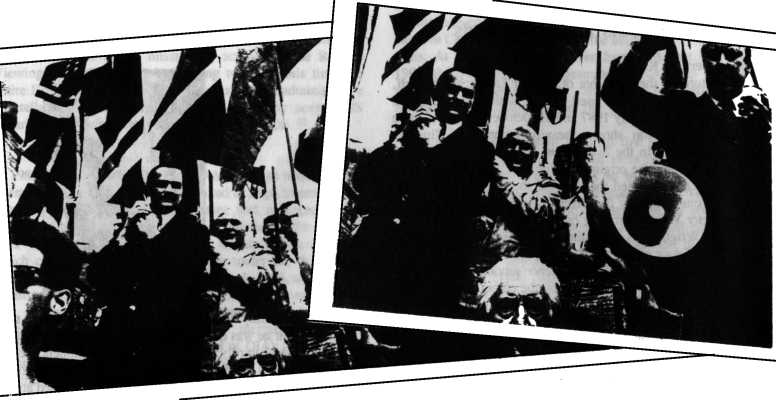
Picture on the right shows the same photograph, used in Searchlight, December 1995. Spotted by L. O’Hara.