
Official openings
We don’t have a Freedom of Information Act, and are not likely to get one from any of the British political parties. Imagine a conversation in the office of the new Labour Prime Minister in a year or three: ‘FOI? Too much trouble, too much aggro with Whitehall. As if we need any more, what with the economy, defence. Forget it.’ And down the agenda it will slide — if it ever really makes it onto the agenda in the first place. So we shall remain in the current situation with dribs and drabs of official information — all sanitised and ‘weeded’ — being doled out to the handfuls of people who are interested in this country’s history.
Top Secret: An Interim Guide to Recent Releases of Intelligence Records at the Public Record Office, by Louise Atherton, is rather a large drib — practically a torrent by UK standards. This has 17 sections, 31 pages, the sections consisting of an introductory essay followed by a guide to the relevant files. For example, three of the more interesting sounding sections are, ‘Arrangements for the Supply of Information from Reuter’s News Agency’, ‘The Post Office and the Secret Service’, and ‘Financing and the Secret Service’. The Reuter’s section tells us, for example, that in 1894 Lord Roseberry arranged that ‘Reuters would supply confidential reports from its agents on a global basis and would allow the Foreign Office to make use of the Agency to publish accurate information in foreign newspapers abroad.’ This relationship ended after two years (but was reopened later).
And 1894 is practically modern for these papers which cover only 1791 to 1909. Still, why should I be churlish?
From the Publications Department, Public Record Office, Chancery Lane, London WC2A 1LR, priced £3.25 plus 20% p and p in the UK. (No information stated on to whom cheques should be made payable. My guess would be to the Public Record Office.)
Also working in a similar vein is Roger J. Morgan. His service (see below) he informs me, is now computerised, and he ‘now covers both the January openings and the monthly New Lists.’
Steamshovel Press
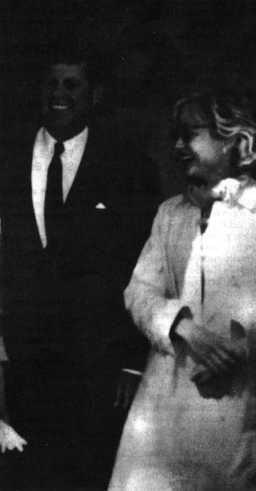
I lifted the picture from the front cover of Steamshovel Press Number Ten. It shows President Kennedy with the late Mary Meyer, in September 1963. Mary Pinchot Meyer was then separated from her husband, senior CIA officer Cord Meyer, one of the OSS members who became the first dominating clique within the Agency. (I’d never seen a picture of Mary Meyer before.) The picture illustrates the second part of a long essay entitled ‘The High and the Mighty: JFK, MPM, LSD and the CIA’, the first part of which appeared in Steamshovel Press Number Nine. The two pieces are a reworking of some of the information we have on that fuzzy, hearsay-laden area in which drugs (especially psychedelics), the intelligence agencies and mind control programmes overlapped.
In the second part the author, Greg Krupey, reminds us of the claims made by Timothy Leary in his memoir Flashbacks that Mary Meyer was part of a group of what the Krupey calls ‘psychedelic amazons’ — women in the Washington elite — who, having taken LSD, were turning on the (male) power elite of Washington. (Meyer, so the story goes, had JFK, of course.) ‘It was all going so well….. we had eight intelligent women turning on the most powerful men in Washington’ — Leary says Meyer said.
Because this story is a replay of one of the most enduring of old acid head fantasies — the ‘turning on the world’ idea — with a feminist spin, I have never really taken it seriously. The evidence is just Leary’s recounting of a conversation twenty years before, and I wouldn’t be willing to put speech marks around a single word of any conversation I had even five years ago, let alone twenty. Mind you, ‘The Prez is taking acid’ is a very striking conversation, so maybe he’d remember it.
Issue ten of Steamshovel runs the gamut from an account of some (taped) lectures given by Carroll Quigley in 1976, through to a piece of complete nonsense titled ‘Who Shaped History: Vampire or Gods’?, which shares a double page spread with an advert for ‘Mysteries of the crystal skulls revealed’. It also includes a letter from Jim Hougan (author of Spooks and Secret Agenda), who writes that ‘the parapolitical underground should consider whether or not it matters that they’ve got it right or wrong. If any conspiracy theory will do, then the Steamshovel Press should be regarded as a literary enterprise — like Fate or Granta. If, on the other hand, it seems important to distinguish between reality and fantasy, then I think it’s up to you to establish standards of reportage (footnotes etc.)’
Too true, but there are two obvious reasons why it isn’t possible for Steamshovel to do this. The first is that some of the audience for the magazine probably doesn’t want that kind of care and attention. There is certainly anecdotal evidence that while many — not all — of the people writing in these fields might share Hougan’s values, the readership isn’t so bothered. I’ve had comments from a couple of people working in the parapolitical catalogue business complaining about the kind of garbage they have to sell to make a living. (For example, the wilder end of the UFO thing.) The second reason is that there simply isn’t enough material around of that quality. It’s axiomatic: if there was, Steamshovel wouldn’t be printing rubbish about vampires. A Steamshovel Press operating at Hougan’s standards couldn’t appear quarterly as it now does. So the situation will remain as it is.
Steamshovel Press POB 23715, St. Louis, MO 63121. Four issues $20 in US, $26 overseas.
Nexus
A newish magazine. Contents? In one recent issue there were 6 different cures for cancer and/or AIDS; an account of sonic bloom (making giant plants); UFO bases in Australia; an apparently functioning anti-gravity craft produced in the UK in the sixties (with indistinct photograph); earth mysteries, ley lines, the global grid; and mind machines (including ‘ELF cocoon’, whatever that is). In the midst of which is a interesting, though very speculative, piece by former petroleum engineer, Joe Vialls, ‘The Global Oil Conspiracy’. (On Vialls see the epilogue to Tony Collins’, Open Secret.)
The most interesting thing about this magazine is that it isn’t produced in the USA, but Australia. Somehow — how? why? — the Australian cultural climate has produced the same curious, populist (yes) nexus of hidden history, conspiracy theories, suppressed cures and medicines, and ‘free’ energy devices hitherto only seen in the USA. How real most of it is, I have no idea. But for the most part the editor prints enough material, addresses and so forth, for anyone curious to write off and begin checking. Very odd – but also very interesting. Certainly this is now the best of its kind that I have seen.
NEXUS, PO Box 30, Mapleton, Queensland 4560, Australia.
Cold war history
Students of the cold war should take note of an extraordinary project being run by the Woodrow Wilson International Center for Scholars in Washington DC. The Cold War International History Project is attempting to keep track of, and summarise the results of, the opening of Soviet bloc archives on the cold war years. They are publishing digests of this information — and it is all free. Cold War International History Project, The Woodrow Wilson Centre, 1000 Jefferson Drive SW, Washington DC 20560, USA.
Prevailing Winds Research
PWR has a new, 60 page, 1994 catalogue/reader. Uniquely, Prevailing Winds offers reprints of articles, as well as books, magazines, audio and video tapes of tv programmes, radio programmes, speeches and conferences, in the fields of parapolitics, intelligence and assassination etc. A whizzer.
Prevailing Winds, PO Box 23511, Santa Barbara, CA 93121, USA.
Inside the USA the catalogue is $2.00 plus postage. Outside the USA, $5.00.
Dallas 63
This is subtitled the British forum for views and research into the assassination of President John F. Kennedy and is the first British publication on the issue since the Irwin/Burden Assassination Forum Newsletter of fond memory back in the pre-computer age. I have the fifth (Vol 2, number 1). Dallas 63 is nicely desk-topped (though not so wonderfully proof-read), bound, and 40 A4 pages in length. I didn’t find it very interesting but it’s hard to judge on one issue. By their very nature the quality of these specialist newsletters varies from issue to issue.
The journal is the work of the Dallas 63 group, a Livepool-based discussion and research group on the subject. Membership of the group (which includes four issues of the journal) is £10 pa (UK), £13 pa (overseas).
Secretary is John Rudd, 2 Wingrave Way, Liverpool, L11 2UB, UK.