
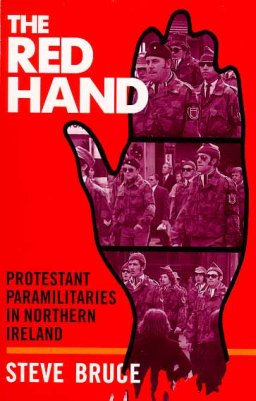
Steve Bruce
Oxford University Press, Oxford, 1992: £7.99
Red-handed
Just how difficult the ‘no collaboration’ line is to defend was illustrated by Colin Wallace in a long review of Steve Bruce’s book in the London Review of Books of 8 October 1992 (pp. 18-19). In it he ran through the major items of evidence against this ‘line’: the testimony of Fred Holroyd; the testimony of Albert Baker (Wallace recalled ‘the serious concern some of my colleagues at Army Headquarters in Lisburn and I felt in 1973 following the confession made by [Baker] who had operated as part of what was known as the UDA’s No 1 Assassination Team’); and the role of James Miller, the mid-1970s version of Brian Nelson. Take a bow MI5, for penetrating the UDA completely, twice getting an agent into the role of UDA ‘intelligence officer’.
Bruce, a Professor of Sociology at the University of Aberdeen, who had previously worked for over a decade at Queen’s University, Belfast, cautions the reader on p. 5 of his introduction ‘that this account… is still often little more than plausible speculation’. Unfortunately this very proper uncertainty is applied selectively. There are some things he is quite certain about, chiefly — if unsurprisingly — that those who have alleged state-Protestant paramilitary collaboration are wrong. Yes, Holroyd, Wallace and Baker, the crew that got rubbished in Urban, get it again from Bruce.
There are now three substantial non-republican accounts of the ‘war’: by Urban, Bruce and Martin Dillon. All three are based on anonymous sources: Urban’s chiefly on British military and intelligence sources, Dillon and Bruce on sources within the paramilitary organisations; all three reject or dismiss the allegations of Wallace, Baker and Holroyd; and all three declined to talk to the readily available Wallace or Holroyd while writing their books. (Baker is harder to get at, in prison.)
Bruce’s hostility towards Holroyd (and Wallace) is so irrational as to seriously undermine the status of the rest of his book. He writes (p. 203) ‘In the circumstance of claim and counter-claim, assessment of the evidence will hinge on our measure of the character of the witnesses’. This being so, he concludes that there must be doubts in Fred’s case — without ever meeting him — more doubts, apparently, than he feels about the testimony of his anonymous Protestant paramilitaries. The word of terrorists before an Army officer? This is a pretty eccentric decision on any terms.
Of Holroyd he writes (p. 203) ‘his entirely uncorroborated evidence is that of a man who has a very large axe to grind’. This is a gem. In the first place, Fred’s allegations are not ‘entirely uncorroborated’. Right at the beginning of the story Duncan Campbell of the New Statesman checked out much of it. In the second place, since Fred’s book was published, to my knowledge not a line of it has been refuted. And in the third place is it not ludicrous for a man writing a book about the actions of (mostly anonymous) Protestant paramilitaries to imply that Fred is in any way unusual in having ‘a very large axe to grind’? The sound of axes being ground is deafening in all three books.
Martin Dillon has his uses. On his say-so Urban dismisses Holroyd and Bruce dismisses Albert Baker. (pp. 211/2) Bruce gives a long quote from Dillon explaining how Baker’s allegations went from prison, out to the Provos, thence to Ken Livingstone and finally back to Baker again when Livingstone interviewed him in prison. So, argues Bruce (after Dillon), Ken Livingstone confirmed to Baker his own allegations. Nice theory, which Dillon (or Bruce) would have discovered to be false by ringing any of the people involved. In fact Ken Livingstone got onto Baker through his researcher at the time, Neil Grant, who was put on to Baker by a member of the Birmingham 6 campaign as a possible source — not on Protestant-state collaboration — but on the Kincora Boys Home story on which Grant was working at the time. This account of Dillon’s is simply a fiction.
Bruce’s animus against Wallace and Holroyd is bizarre. Despite having read Paul Foot’s book on Wallace, on p. 70 he states that Wallace ‘seems’ — seems! — ‘to have worked on intelligence matters and ‘black propaganda’ ‘, and then provides an inaccurate account of the Ulster Citizens Army (UCA) story. (On which see my piece in Lobster 14). Bruce has problems with the UCA. In his glossary of Protestant groupings at the beginning of the book he describes the UCA as ‘a completely fictitious left-wing loyalist paramilitary organization invented by British intelligence’. By p. 71 he has changed his mind and says ‘the British Army may not have been the inventor of the UCA.’ In fact, as the Information Policy briefing on the UCA reproduced in Lobster 14 showed, the UCA was quite definitely not the invention of ‘British intelligence’. It just looks like one.
His use of the term ‘British intelligence’ is revealing. Only those still ignorant of the spook dimension to recent history use that expression. Knowledge entails disaggregation. Bruce’s index includes a reference to a tiny Scottish Protestant group, the Young Cowdenbeath Volunteers, but no reference to MI5, MI6, the RUC Special Branch or Information Policy.
It’s not that the book isn’t interesting — it is. Like Dillon’s and Urban’s it contains many interesting bits and pieces, some of which may even be true. But since virtually all the sources are anonymous, mostly we can’t tell. And the British state’s forces, especially its clandestine forces, are almost completely missing from Bruce’s account.
How important are the spooks in this story? How can we tell? In the end the IRA is still there — so they are not all powerful. Finer discrimination than that? In 1987 James Miller, sometime UDA ‘intelligence officer’, told Barry Penrose that MI5 told him to encourage the UDA to call what became the 1974 UWC strike. (Penrose telephoned a rather startled MI5 officer who was Miller’s ‘handler’. He took an informative beat or two to work out who Penrose was.) But it seems certain to me that there would have been a UWC strike anyway. Miller’s testimony tells us more about MI5’s ambitions and political inclinations than it does about the UWC strike. But no matter what political, causal weight you attribute to the spooks in Northern Ireland, they ought to be in there somewhere.
In the end Bruce’s determination to exculpate the state’s forces from blame gets silly. Looking at the record of the Ulster Defence Regiment, he points out (p. 222) that in the 19 years of its existence ‘only 23 have been convicted of murder or manslaughter……. [and] the record of the UDR is exemplary when set against that of armies and police forces in Latin America’. 23 members of one regiment convicted? So how many not convicted but guilty? The figures are there: the UDR’s record was appalling. It was the sectarian outfit the republicans said it was. That’s why it got disbanded. But hell, why stop with Guatemala and Argentina? Why not add Stalin, or Hitler? Compared to the SS, it is true, the UDR was exemplary in its conduct.
He really does this, I kid you not. A Professor, too.
RR