
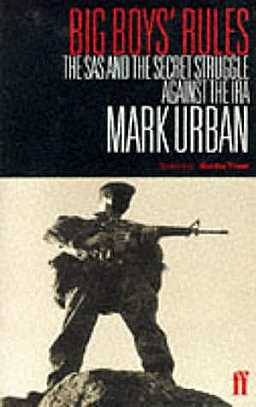
Mark Urban
Faber and Faber, London, 1992, £14.99
In recent months there has been the remarkable sight of the weight of the British state descending upon Channel 4 TV and the production company Box in retaliation for the Box/Channel 4 programme alleging military and intelligence collaboration between the British state and the Protestant paramilitaries in Northern Ireland. (See The Independent 29 July 1992 for an account, including reports of break-ins and threats.)
Denial of this collaboration is now the last redoubt still being defended by the British state. Almost anything else will be admitted but not that. But since the Ulster Defence Association have spent the last couple of years fly-posting Belfast with photocopied police and intelligence files on the IRA, and we have learned that the UDA’s ‘intelligence officer’ in the 1980s, Brian Nelson, was an Army Intelligence agent, this is a pretty stupid line to defend. Nonetheless this line is at the heart of both of the Bruce and Urban books.
Urban is an interesting figure. A sometime full-time soldier, now with the BBC, Urban affects not to be just the traditional defence correspondent, dependent on the droppings of the MOD press office. He notes in this book that while he was entitled to non-attributable briefings from the MOD, he chose not to have them while writing it. While non-attributable briefings are hardly a secret, the well-behaved media servant of the British state doesn’t generally mention them.
In the first and best section of the book, Urban takes as his starting point that a nation state can only legally declare war on another nation state. Hence the refusal of the British state to accept the description of IRA prisoners as ‘prisoners of war’: there is no war, only terrorism or crime. Hence also the difficulties involved in killing IRA/INLA personnel, at its most acute in the many ambushes carried out by the SAS and other special units in Northern Ireland (and Gibralter). Without a state of war, setting an ambush is just a conspiracy to murder. No declaration of war means killings are legally problematic unless certain special circumstances pertain. Hence, finally, the endless, laughable courtroom accounts — usually at inquests — from soldier ‘A’ et al of how the dead IRA or INLA suspect ‘moved his hand aggressively’, ‘seemed to be going for a gun’ etc etc.
On the first page of the preface Urban gives us ‘contest’ (twice), ‘conflict’ and ‘struggle’ — but not ‘war’. (Look at the subtitle of his book.) Surveying the work of the SAS and other special units, he acknowledges that they have been ambushing and murdering the IRA. What he refuses to acknowledge is the Protestant-state collaboration in such killing. While Urban simply omits James Millar and rejects without discussion the claims of Albert Baker, it is not possible to ignore Fred Holroyd. Having quoted endless off the record military and intelligence sources who support the state’s ‘line’, Urban declined to talk to Holroyd, the only British Army officer to date from that ‘war’ willing to be interviewed on the record. Instead he quotes Martin Dillon who ‘finds Holroyd an unreliable witness’. But Dillon didn’t talk to Holroyd either, while writing his book The Dirty War from which Urban took the quotation.
Hedging his bets as expertly as the MOD answering an inquisitive Labour MP, Urban concludes that his ‘own research has not produced any evidence to support the claim that the security forces colluded with loyalist death squads in any planned or systematic way’. What precisely does ‘planned or systematic’ mean? This is pretty poor and it gets worse when he dismisses Holroyd, Baker and Colin Wallace because they have ‘something to gain’ by making their allegations. The state (and its employees), we are apparently supposed to think, do not. This is insulting.