
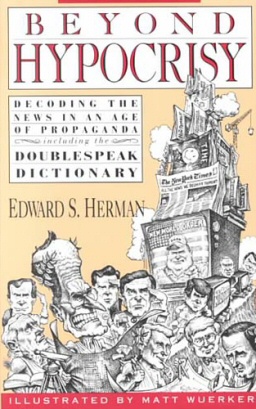
Edward S. Herman (with illustrations by Matt Wuerker)
South End Press, Boston, USA, 1992, $13.00 (USA).
The passing of the Bush regime is a good time to pause and express thanks to one of those American writers who have tenaciously dug out the reality behind the business-sponsored counter-revolution that has largely formed the politics of the past decade. In that time, Ed Herman has scoured beneath the public relations veneer of U.S foreign policy and become, sometimes in partnership with Noam Chomsky, the scourge of its conventional wisdom. In the early Reagan years we had an expose of the ‘Bulgarian plot to kill Pope John Paul II’ — a critical event in the winding up of the Second Cold War — and more recently The Terrorism Industry: the experts and institutions that shape our view of Terror, written with Jerry O’Sullivan (for Pantheon Books, New York, 1990) an examination of the think-tanks, intelligence agents and assorted media manipulators who have attempted to develop ‘terrorism’ as a more cogent focus of political loyalty than the tattered remnants of its predecessor, the ‘Soviet threat’
Beyond Hypocrisy is a guide to the Orwellian world of reality control through which most of us come to ‘understand’ the world around us. In part it is an updated summary of Herman’s previous analyses of the eighties, with the detailed references we have become used to. In part, in the book’s Doublespeak Dictionary, it is a lively, provocative and punchily-illustrated guide to the language of our age, drawing on the material which precedes it, but which also stands alone as an incisive counter to the accepted nostrums of political reaction.
A few examples will give its polemical flavour:
Money: Something that does the job for National Defense, but which is ‘not the answer’ to educational and social problems; money is quietly appropriated for the former, it is futilely ‘thrown at’ the latter.
Moderate: In domestic politics, a spokesperson and representative of the National Interest, or of the consensus — or of sponsors of Political Action Committees. In reference to the Third World, a Leader.
Another Hitler: Last year’s ‘moderate’, now threatening our interests.
Public diplomacy: The Reagan era name given to a large-scale government propaganda operation, which included massive disinformation and intimidation of the media, designed to manage public opinion. A part of this program was called Operation Truth.
Privatisation: Disposing of public sector assets at low prices and high sales commissions to powerful groups and individuals who generously supported the ruling party’s last election campaign. It provides short-run cash windfalls to the government while weakening its power and its cash flows in the years to come. In the Third World, a means of making valuable assets available to First World creditors and investors at fire sale prices in a situation of virtual state bankruptcy.
I read Beyond Hypocrisy just after rereading Christopher Lasch’s fine essay about the Congress for Cultural Freedom, written shortly after its CIA funding was exposed in 1967.(1) More than 20 years later, it still has much to commend it, including the following:
‘The modern state, among other things, is an engine of propaganda, alternately manufacturing crises and claiming to be the only instrument which can effectively deal with them. This propaganda, in order to be successful, demands the cooperation of writers, teachers, and artists not as paid propagandists or state-centred time-servers but as ‘free’ intellectuals capable of policing their own jurisdictions and of enforcing acceptable standards of responsibility within the various intellectual professions.’
Herman’s latest work is useful because it not only gives us some historical and conceptual purchase on these unfolding ‘crises’, but provides us with words we can use to cut through and expose them.
John Booth
- Christopher Lasch: ‘The Cultural Cold War: A Short History of the Congress for Cultural Freedom’, in Towards a New Past: Dissenting Essays in American History, ed. Barton J. Bernstein (Vintage Books, New York, 1969)