
This piece by Daniel Brandt began as a short letter commenting on my review of Right Woos Left by Chip Berlet (Lobster 23 p. 34). I wrote back and asked if he would like to expand it. And so he did, writing almost the whole thing at one long sitting.
Anyone who joined the U.S. New Left in 1967 and continued to define this event as a point of departure over the next 25 years is going to have some stories to tell. But only in the last couple of years has it become necessary to tell them. Something strange had happened to ‘progressive’ politics, and what’s left bears little resemblance to the issues that consumed us then. I’m doing pretty much the same thing with the same convictions, but someone seems to have moved the goalpost on me.
The Big One for me was 1967. In 1964 I licked stamps for Goldwater, but in 1967 I joined the tiny chapter of Students for a Democratic Society on campus. I walked in cold to one of their meetings after reading a book on U.S. involvement in Vietnam and walking out of my fraternity. They must have thought I was a spy, with my short hair and button-down clothes, but it didn’t matter because at the time SDS accepted everyone and I was wearing a strong suit of moral indignation over U.S. foreign policy. And I was eager to learn and ready to turn on. A year later we uncovered a spy, and were too naive and democratic to ask him to leave. We hated the war-monger, yet everyone was redeemable if presented with a little common sense. That was the New Left I remember; the positive energy and confidence were absolutely compelling. The grass and acid were just frosting on the cake.
Much has changed, but not everything. After driving up to San Francisco for the 1967 Stop the Draft week, my friends invited me along as they met with a JFK assassination researcher. Garrison’s investigation was big news, and I recall the hushed, paranoid atmosphere in a crowded restaurant. Today we know much more about the assassination than we did in 1967, and much more about CIA covert operations. The lowered voices still seem reasonable to me, and the questions they raised seem as vital now as they did then.
Other scenes have changed dramatically. David Horowitz was an editor of Ramparts in 1966, the only magazine that dared give issues like the CIA and the JFK assassination the coverage they deserved. In 1974 he persuaded the Ramparts book-keeper to help the Black Panther Party get its books in order. Apparently she stumbled onto evidence that the Panthers were involved in drugs and protection rackets in Oakland, and was soon found murdered, floating in the San Francisco Bay. Today Horowitz has defected to the hard Right, along with his long-time colleague Peter Collier; and if you want to keep up with anti-CIA conspiracy journalism these days, it is helpful to have a subscription to The Spotlight, published by the right-wing Liberty Lobby. But you had better be prepared to defend your choice of reading material to politically-correct leftists who are checking on your associates.
What’s going on here? In the first place, Horowitz isn’t completely mad. Yes, the Panthers were riddled with FBI agents and other dirty tricksters, but Huey Newton was living in a luxury Oakland penthouse in 1971, overlooking Lake Merritt, and I doubt that ‘security’ was the only reason. By 1978 I was living on the other side of the lake, and Newton was still considered politically correct as he returned from Cuba to stand trial for the shooting death of a prostitute and something about pistol-whipping his tailor. ‘Wait a minute’, I hesitated from my one-room dump, ‘I’ve never even met any tailors. Are we in the same movement?’ I can trace my confusion back to 1969, when women on campus began to feel that they were more oppressed than men. I could see their point, but at the time I was in the middle of a two-year federal prosecution for declining the all-male privilege of lying face-down in a Vietnam rice paddy, so some of their arguments were lost on me.
By 1971 it looked like I had escaped from my prison sentence when a higher court reversed my conviction for refusing induction. The Ninth Circuit ruled that my draft board’s punitive actions were illegal, and said that the district court also screwed up. My file, quite thick by then, was sent back to the draft board. They lost no time in ordering me to report for a pre-induction physical — the first step on the way to Vietnam. For some reason I was getting cynical, and was quite fed up with legal probems. So I stopped eating for ten days and showed up a pound underweight. The doctor could see from my records that when I refused induction more than two years earlier I had been fifteen pounds heavier, but he knew there was nothing he could do. Meanwhile I was almost hallucinating from hunger. ‘Would you like to drink a glass of water?’, he asked. ‘I’m not thirsty’, I replied. This saved American taxpayers many thousands of dollars in new prosecution costs.
My draft board left me alone after that because by mid-1971 the Selective Service System was collapsing due to massive resistance. The fact that the anti-draft forces won is the best-kept secret of the sixties. Journalists don’t get paid to write about it; you had to be in the middle of it to know what happened. Many hundreds of amateur draft counsellors like myself knew more about the law than any of the 4,000 draft boards, and many thousands of draft-age men practiced non-cooperation on one level or another. We simply overloaded the system, from local boards to the federal courts.
The next year I enrolled in grad school to study something the pipe-smoking professors called ‘Social Ethics’. One day Jesse Jackson came to speak to a small group of us in the department. I was interested in the issue of affirmative action, and wanted to determine if he thought the concept of ‘merit’ might play a role in a normative social ethic. I posited a hypothetical situation of a super-qualified white surgeon and black doctor just out of med school. ‘Which one should perform the critical brain surgery?’, I asked. But Jackson’s interest was political, not intellectual, and he wasn’t going to play: ‘There are lots of qualified black surgeons’, he replied. ‘Next question, please.’ That was my first clue that I was already out of the loop.
In 1975 I transferred to a Ph.D. program in Berkeley and took a part-time handyman job to support myself. I found myself carrying heavy boxes of copying paper up the stairs to the Women’s Affairs Office, and being told to change their light bulbs. These feminists were all cruising comfortably on a huge Ford Foundation grant, spinning out analyses based on sex divisions while playing their neo-Marxist cards whenever it was in their interests. I was a theoretical Marxist by then (in the sixties I never needed it), and felt I knew a thing or two. I pointed out the obvious, namely that sex divisions cut the class divisions in half again. This branded me as a troublemaker, which is terminal in graduate school. The smart ones see their mistake immediately, while the dumb ones spend ten years writing a dissertation and end up driving a cab. I dropped out of academia and several years later got into electronics. Jimmy Carter’s CETA job training program paid me minimum wage to attend tech school; these days it costs too much and wouldn’t be possible. Social and political theory was getting difficult to understand, while those little electrons were very reasonable.
A technically advanced leftist
By the time the microcomputer revolution came along I was technically ahead of every other leftist in the country. That isn’t saying much; ‘technically advanced leftist’ is a lot like ‘military intelligence.’ But I could design and build circuits and write software. With the microcomputer, something I had been trying to do the hard way was suddenly within reach the easy way. High-tech has been good to me. Over the ten years I’ve pursued my obsession, microcomputers have become more powerful and less expensive at the same rate that my project expanded.
To explain this obsession — there’s no other word for it — I have to return to 1967 again, the year I woke up. One day I noticed from a puff paragraph in our campus yearbook that University of Southern California trustee John McCone was a former CIA director. By 1969 I had done some research on him, which was published in a campus alternative paper I edited. Here was a multi-millionaire entrepreneur who was well-connected with corporate elites, and very conservative, with a CIA-on-campus issue thrown in for good measure. My story came and went, seniors graduated, and McCone stayed. By 1973 the CIA had overthrown Allende in Chile. McCone, as a director of ITT and friend of Richard Helms, was involved. He remained at USC. All the correct American Civil Liberties Union liberals on the Social Ethics faculty had nothing to say when I pressed them on the issue. This was before I moved to Berkeley — certainly this couldn’t happen there.
Now I was fundamentally upset, and started collecting investigative books and building a clipping file. Watergate was also in the news, and several of those players were former USC fraternity rats like me, only a few years older. I was beginning to develop an appreciation of the power structure. In fact, it was beginning to look like not only had my political instincts been accurate all along, but I was quite probably in the belly of the beast.
Over the next few years there were plenty of amazing CIA revelations on record, confirming that our most paranoid fantasies in the 1960s were underestimates. I began compiling a name index of Counterspy and Covert Action Information Bulletin using little pieces of paper. Someone had to track the beast. When I saw my first microcomputer in action in 1980 I knew instantly that I was doing it all wrong. Those clanking floppy disks were like lightning compared to my fingers sorting little pieces of paper. By 1982 I had moved to the Washington DC area, bought my own computer, written the software, and begun inputting my library. I was a refugee from California correctness, and I migrated to the information capital of the world. Fortunately it is also a high-tech area, which makes it easier to keep up with electronics and find technical work when I have to.
We eventually incorporated as Public Information Research (PIR). Ten years of inputting and five computers later, my database, NameBase has 130,000 citations and 62,000 names. Although we received our first grants recently (from the Funding Exchange and the C.S. Fund), we basically meet our expenses with income from sales — not to mention the nine technical jobs I’ve had since I came to the DC area. In other words, we are self-sufficient and answer to no one. NameBase exists from the purest of populist, anti-establishment impulses, and it is used by hundreds of journalists and reseachers all over the world.
David Wise, the dean of all CIA-tracking journalists, had written about McCone in The Invisible Government in 1964. Almost all of my research on McCone in 1969 had to be lifted from this book because there was nothing else to be found. I’ve finally come full circle. Wise is still churning out important books and says for the record that NameBase is ‘absolutely indispensable’. It’s too easy to forget that very little information about the secret state was available in the 1960s — we had to get by pretty much on instinct. But ironically, NameBase isn’t used that much on the U.S. Left. Even worse, I’ve spent far too much energy over the past few months defending PIR against charges of political incorrectness.
PC Does Not Mean Personal Computer
I’m not bitter yet but I’m getting touchy. Already I do things like cancel complimentary subscriptions because I get angry with the same Politically Correct line when it has nothing to do with investigating or challenging the establishment. Recently I sent a letter to an editor to correct the record about NameBase and express my opinions on his PC cover story. At the last minute I marked it ‘not for publication’, because I was worried that it would come back and bite me. Now it’s a month later and I’d rather get bitten than keep it bottled up. Editors don’t know what to do with people like me, and he wrote back to complain that mine was one of the strangest letters he had seen in some time. Like I said, I’m getting touchy.
Things seem strange from my perspective also. As soon as PIR got its tax-exempt status I filled out our first grant application. We have three other directors besides myself. Steve Baldrich, my best east coast friend, is a white male like me. (I don’t blame him, he was born that way.) He has a Ph.D. in English and is an excellent teacher, but the department needed a woman so he was laid off. Now he’s unemployed and probably wishes he had gotten into electronics when Jimmy Carter was paying for it. Martha Moran is an artist from a working-class background; she and Steve recently got married. Then there’s Dennis Brutus, a black professor and poet who is exiled from South Africa, where he broke stone with Nelson Mandela and was shot while trying to escape. Dennis likes what we’re doing and has an internationalist perspective on black struggle that makes the U.S. PC Left seem petty by comparison. Essentially the other three directors let me do my thing and I keep them informed, which works fine for all of us. I appreciate their support. We also have a Board of Advisors, people who let us use their name on our letter head. Legally we don’t need them and they have no formal say, but their support means a lot to us.
My first grant application was to a group called ‘Resist’, which was a name I recognized from the old days. I was an active member of ‘The Resistance’, a loose nation-wide collection of draft resisters who practiced conspicuous non-cooperation and were expecting to serve prison time for eventual felony convictions. ‘Resist’ was their adult support group. They didn’t face the same risks that draft-age men faced, but they stood with us in spirit. The new ‘Resist’ will remember their roots, I thought, and here’s an easy $600 for us. But by 1990 everything was strange, and I received a PC application form in the mail.
The tough question was this one: ‘Please be specific on the programs, coalition work and position of your group in relationship to the rights and concerns of each of the following: a) people of color, b) working class and poor people, c) women, including your position on reproductive rights and abortion rights, d) gay and lesbian rights/liberation, (e) disabled people, (f) older people.’ The next question was easier, because our Board of Directors looked okay: ‘What is the make-up/diversity of your group in terms of age, race, sexual preference, class, gender? Have you taken steps to increase the diversity?’
I went for honesty: ‘The Board of Directors has not taken any positions of this nature. Our work is technically specialized, and we would tend to defer to technical ability over considerations of class, race, and gender when considering a particular technical project. It seems apparent to us, however, that any effort to curtail U.S. covert activities in the Third World would be appreciated by more people of color and poor people around the world than existed in the entire U.S. population.’
After all, we boasted the largest collection of CIA names that was publically available anywhere in the world. Didn’t this count for something? Two weeks earlier we had helped provide the Washington Post with obscure information about the CIA’s involvement in the arrest of Nelson Mandela. Another point, perhaps?
No way. Not only did we not we end up with the $600, Resist apparently couldn’t believe what they were reading. Staff member Nancy Moniz wrote back to say that the page with these questions was missing, and would I please supply it? In other words, we aren’t unreasonable, we’re going to give you another chance to get your act together! At this point I wasn’t even touchy. I sent a copy of my copy of the supposedly missing page with a polite apology, and waited for the inevitable polite refusal of our application. If the same thing happened today, they’d get quite a long letter from me.
It wasn’t called PC in 1990, but by 1991 ‘Politically Correct’ had become a buzzword to describe a phenomenon that was happening on U.S. campuses. Critics like Dinesh D’Souza, funded by conservative foundations and think tanks, helped popularize the concept. Although I rarely agree with anything they write, I’ll give credit where it’s due. Because of them it now takes just two letters of the alphabet to describe something that’s real; and everyone I’ve talked to knows exactly what I mean, even if they see me as part of the problem. Anything that facilitates communication as thoroughly as this is a step forward.
The first hint of a PC crack within Public Information Research came in October 1990, when Chip Berlet resigned from our Board of Directors because he objected to the fact that Fletcher Prouty was also on the Board. We did not discuss the issue because I was putting in overtime on my technician job and wasn’t in the mood to call him back. I whipped out the white-out and removed Chip’s name from the letterhead and thanked him for his past support.
In July 1991, Martha Wenger resigned from our Board after reading something about Prouty in a leftist publication. Her final advice to me was to ‘think long and hard about working together with others who may be opposed to CIA covert operations, but whose political commitments are diametrically opposed to those of the progressive movement.’ (I first met Wenger and her husband Konrad Ege when our paths crossed while working on CounterSpy magazine, and think very highly of them. Wenger is an assistant to Joe Stork at the Middle East Research and Information Project, which does excellent work.)
Meanwhile Chip Berlet was starting to release early drafts of Right Woos Left, which received wide coverage in the left press beginning in early 1992. I still wasn’t into writing long letters, so Martha Wenger got the same polite white-out that Chip received the previous year. Then in January 1992, Holly Sklar resigned from our Board, stating that ‘I find Chip Berlet’s objection to sharing a board with Fletcher Prouty compelling, even more so at a time of increasing right wing efforts to build insidious alliances with often unwitting leftists.’ (In the same letter she enclosed a check for an update of NameBase, so it was clear that our work was not the issue. In fact, our work has never been the issue; everyone who uses NameBase swears by it, right or left. It’s just that we’re not PC.)
Sklar is best known for editing Trilateralism (South End Press, Boston, 1980) a fat volume on the Trilateral Commission. This book began as a classic of left power-structure research, and is now a staple on the populist, anti-elitist Right. In fact, the only inquiries we get at PIR these days on Trilateralism or Bilderberg are from right-wing researchers who are concerned about corruption and conspiracies from high places. Sklar is aware of this, but for her that means that the insidious Right is trying to sneak up on the Left, and we should exercise extreme caution. To me it means that the Right includes reasonable people with reasonable concerns. There doesn’t seem to be a middle way, but at least I wrote Sklar a letter defending my position.
Let’s Go Get Stone
It all pretty much hit the fan when Oliver Stone’s JFK was released in December 1991. Z Magazine had just run a Chip Berlet interview in which he bashed Prouty, the Christic Institute and dozens of others. Stone’s sin was to portray a ‘Mr X’ that was based on Prouty’s experiences in the Pentagon shortly before the JFK assassination. Stone had first approached Prouty for script assistance in July 1990.
Although Right Woos Left in its earlier drafts, as well as the Z Magazine interview, were in type before anyone saw the movie, Berlet was in position. He had the goods on Prouty, and Prouty’s prominence in the wake of JFK made the issue that much more topical. Everyone knew about Prouty and ‘Mr X’ by then, because one-time assassination author Robert Sam Anson had bashed Stone and Prouty in Esquire two months earlier. What you have to realize about assassination researchers is that they barely tolerate each other: it’s just one of those things. And what you have to realize about the Stone movie is that the long knives were out at least six months before it hit the screen. It’s enough to make you paranoid.
Berlet hand-delivered a letter to Stone dated January 16 1992, in which he called on him to ‘distance yourself publicly from attempts by racist, anti-Jewish and pro-fascist groups to use your film JFK as a vehicle to promote bigoted theories claiming Jewish control of U.S. foreign policy and the CIA…. You appear to have been mislead by JFK film advisor Fletcher Prouty regarding the extent of his cooperation with the Liberty Lobby and other neo-fascist operations created by Willis Carto. Willis Carto is infamous around the world as a leading Nazi-apologist. Fletcher Prouty and two other critics of the CIA, Mark Lane and Victor Marchetti, have forged deep and longstanding ties to the Liberty Lobby and other Carto groups.’
And so it goes. I’ve read Liberty Lobby’s Spotlight every week for six months now, and I find only infrequent hints of what Berlet is talking about. Of course this must mean that they’re only being sneakier than usual. (I signed up for another two years. Some of it is good NameBase material that the Left ignores. Spotlight is consistently anti-elitist and anti-CIA, they hate George Bush, and they staunchly opposed U.S. intervention in the Gulf.)
Another Berlet target is the Christic Institute, and anyone else who has ever been guilty of sharing information with the Lyndon LaRouche organization. I’ve been privately critical of Christic’s conspiracy theories myself. I won’t rehash this now, because the federal government is going after Christic with a vengeance and is turning it into a dead issue (and a dead organization). Christic eventually did some homework and had pretty much cleaned up their act by 1988, but by then their earlier legal offensive was already set in judicial concrete. Now it has collapsed on top of them. Berlet objects to any association with LaRouche on any level whatsoever; for him it’s a moral issue. He has spent much of his career tracking Main Enemy Lyndon LaRouche. In the late 1970s some LaRouchies were locked out of their office for non-payment of rent, and Berlet purchased several boxes of financial records from a janitor by posing as a paper recycler. He wrote it up and the Illinois State Attorney General launched an investigation of LaRouchian financial activities.
I don’t object to associations with LaRouche people, but I do feel that all associations should be open and acknowledged, because in some cases it has a bearing on our judgement of certain information offered by certain sources. In other words, Berlet’s concern is PC purity, while my concern is the quality and reliability of a particular piece of information. Often I’m unable to make this judgement, in which case the fact of the association itself is filed away for future reference and judgement is suspended. Berlet, on the other hand, makes an immediate judgement on the basis of the association itself, whether the information is useful or not. So if the LaRouche people were into Iran-contra before the mainstream press discovered it, and if they are uncannily well informed on certain other specific issues as well, this is irrelevant.
For Berlet, Fletcher Prouty’s main sin is that Liberty Lobby’s Noontide Press reprinted Prouty’s The Secret Team, first published by Prentice-Hall in 1973. The content of the book has never been an issue; everyone agrees that it is valuable. It makes no difference to Berlet whether the book is important or useful, or that Prouty’s latest book JFK: The CIA, Vietnam and the Plot to Assassinate John F. Kennedy (New York: Birch Lane Press, 1992), offers unique perspectives based on his own experiences in the Pentagon. And never mind that no one else offered to reprint Prouty’s book. Berlet’s point is that Prouty should not have given his good name to Liberty Lobby. And once he gave his name, everyone should avoid Prouty. If Public Information Research fails to avoid Prouty, then you should avoid PIR — and so on down the line. But this quickly becomes absurd, and while Berlet probably realises this he doesn’t have time to explain himself.
At least Holly Sklar tried to define where she would exit this reductio ad absurdum. She stated in her resignation letter that ‘I have no problem with NameBase being a research tool used across the political spectrum; I know Trilateralism, for example, is widely used on the right. But I think there’s a big difference between sometimes overlapping resources and overlapping boards.’ I don’t find this very convincing, particularly when dealing with informal advisory boards that have no legal power. If political identity is important to someone personally, then I can see Sklar’s point. But if the quality of the resources is as important as it ought to be, then Sklar has it backwards.
The debate became more pitched during the first half of 1992. First Joel Bleifuss of In These Times quoted an anonymous source who called Prouty a ‘Nazi crackpot’. Then Bleifuss bashed Stone for over-reaching with the JFK conspiracy. As this is the same Joel Bleifuss who has been plugging away at an elusive October Surprise story for five years now, he of course ended the same column by implying that it would be more reasonable for Stone to reach even further, by also incorporating more recent conspiracies! Then Berlet recruited the chief pundit from The Nation, Alexander Cockburn, who started sniping at Stone and Prouty and then proceeded to destroy his credibility by blithely defending the Magic Bullet theory. (Here’s someone who should stop writing long enough to read a few books now and then.)
Bill Schaap and Ellen Ray of Covert Action Information Bulletin and Lies Of Our Times, who played a role in getting Stone interested in the assassination in the first place, have endured some of Cockburn’s snipes in The Nation. They seem to be staying out of the fray, probably because some years ago Cockburn was on their advisory board. We’ve fallen out of touch in recent years (the war between CounterSpy and CAIB is another sad story), so I can only guess what they’re thinking lately.
I did try to interest Schaap in a response to Berlet from me and Carl Oglesby, but he never returned my call. That left me all bottled up until Lobster expressed an interest. It’s worth noting that this piece you’re reading could not get published in the U.S unless I defect to the Right, or I’m lucky enough to stumble across some mainstream editor who happens to think it’s cute, harmless, and topical.
Jeff Cohen and Marty Lee of FAIR (Fairness and Accuracy in Reporting), who in the 1970s researched the JFK assassination and ought to know better, both support Berlet. When I spoke with Lee, it was clear that he bought the Berlet line completely, but I have only second-hand information about Cohen’s current position. (Cohen and I belonged to the same group in Los Angeles in 1977 and 1981, working on the issue of police repression.) I’ve heard that In These Times staffers generally feel Berlet has gone too far, and Bleifuss is more or less holding his own out there in Chicago. In These Times even runs intelligent discussions of the PC issue on occasion. But judging from FAIR’s monthly publication Extra!, FAIR is increasingly in the PC camp. They devote more and more space to soft issues, while carefully paying ritual homage to the god of cultural diversity. As for Erwin Knoll, longtime editor of The Progressive, he is downright proud of his anti-conspiracism and recently ran Belet’s Right Woos Left as a cover story titled ‘Friendly Fascism.’ Knoll is the one who got my strange letter.
Maybe it will all go away soon; I hope so. Even Sara Diamond, a member of Berlet’s fan club, recognizes that the U.S. Left is talking to itself on this issue. ‘In part, its’s desperation,’ Berlet quotes her in The Progressive by way of explaining why leftists are easy prey for rightists. ‘We have, in fact, lost influence and become marginal.’ This is easily the most lucid observation that has yet emerged from the Berlet camp. However, the reason that they are increasingly marginal has somehow escaped them. It’s simply because the PC Left is becoming a privileged segment of society and frequently acts only to preserve their privileges.
That’s what I believe is really happening, but if the split deepens it will certainly be disguised with more elevated terminology. Already it seems that a distinction is evolving between the conspiracists and the structuralists. The former see specific historical events (e.g. the assassination of JFK) as probable determinants of other events (the war in Vietnam), while the latter view this as a naive challenge to the conventional left wisdom about infrastructure and economics as major determinants. The structuralists feel that it’s inconceivable that John Kennedy, who was initially a product of the System, changed his mind about the System once in office. And more amazingly, that the System would deal with it the way they did — real people with real names (if only we knew who they were!) deciding he was a threat to their private interests and successfully engineering a coup.
Besides Fletcher Prouty, who has long maintained this view, another Stone advisor was Major John M. Newman, a professor and former military intelligence officer, whose competence was demonstrated in JFK and Vietnam. As soon as it was published this year, structuralists like Noam Chomsky and Alexander Cockburn went scurrying back to the documents to try and refute him. But as Newman pointed out in a folksy talk on June 17, 1992, it’s finally unimportant whether you are ‘left wing, right wing, or from the middle of the bird.’ There are a number of ex-Cold Warrior analyst-academic types in the military who are taking a fresh look at recent history, he assured us, and that has to be healthy. If he’s telling the truth — and I have no reason to doubt him — then I have to agree.
Back to the real world of people behind the events. Personally, I don’t think the PC Left has any legitimate use for theory at all. I haven’t seen any for over ten years, and that makes me reasonably sceptical. When I requested the names of the Board of Directors from Political Research Associates, the group that sponsors Berlet, it looked like theory had nothing to do with anything. I discovered that their Board is less diverse than one might expect. For me this makes the situation transparent — these are people who have something to lose if populist conspiracism replaces political correctness. They are the System. They don’t need theory, they need protection. If theory provides protection, that’s when we’ll get theory.
Political Research Associates doesn’t list their Board on their letterhead because, as director Jean Hardisty explained to me, they’ve been sued by two of the groups they’ve attacked and their liability insurance is becoming problematic. Fair enough, I suppose, because its part of the public record and there are other ways to get it. But Spotlight has a large staff box on every issue, and Berlet seems to be calling up the people on my letterhead, so I’m going to quote from Hardisty’s letter.
‘Because I’m not comfortable putting people in a position of risk equivalent to the risk I am willing to assume, we have a small board. It is made up of me, Lucy Williams, Esq., Rev. Sally A. Dries, Prof. Robin Gillies, and Prof. Deborah Bright. They are, respectively, a law professor at Northeastern Law Scool in Boston, a United Church of Christ minister in Shamokin, PA, a political science professor at Northwestern University in Evanston, Il., and an art professor at Rhodes Island School of Design. I do not list their names on the letterhead and do not advertise their membership on the board in order to protect them from harassment.’
By contrast, the readers of the hated Spotlight, Liberty Lobby’s weekly with a circulation of over 100,000, are far down the elitist ladder. They are concerned about the very issues that injected Ross Perot into presidential politics. As I write the jury is still out on Perot as a potential leader, but something is stirring out there in the heartland, and Perot is a convenient symbol. He might well be the first presidential candidate willing to say that conspiracies and corruption exist in high places. To my knowledge he hasn’t made any statements about the JFK assassination, but how much money would you put on his ability to serve out his term if he got elected and reopened the JFK, MLK and RFK investigations?
The PC Left, meanwhile, not only sees this as irrelevant, but is even inclined to call it neo-fascism. There is, of course, facist potential in any populist movement, just as there is also democratic potential. And it appears to me that there’s no potential at all in business as usual on the PC Left. Everyone knows it except them. The 75% of the population that feels JFK was the victim of a high-level conspiracy involving the CIA or mafia know it. The more than 50% of the population who don’t vote (this year I’m voting for the first time since 1972) know it. The conspiracy ‘buffs’, ‘nuts’, and ‘crackpots’ — against whom Berlet crusades and Alexander Cockburn pontificates — know it. But it is still news to a small group that control the diminishing ‘progressive’ press in America.
Clinton, another Trilateralist?
This ‘progressive’ press has been blindsided by a special-interest multiculturalism that has the ruling class laughing all the way to their banks. Unlike in 1976 and 1977, when progressives were interested in Jimmy Carter’s Trilateralist connections, these days you have to consult Spotlight to discover that Bill Clinton attended a Bilderberg Group meeting in 1991 (before anyone outside Arkansas had heard of him), and that currently he is a member of both the Council on Foreign Relations and the Trilateral Commission. So it came as no surprise to Spotlight readers when David Rockefeller Jnr. wrote a strong endorsement of Clinton for the New York Times (October 16 1992).
The populist Right consider Clinton a set-up, in the sense that the rich will continue to get richer. The ruling class knows that more subtle techniques are needed than those used by Bush, and will offer some health insurance and job training to deflect discontent. But ultimately free trade will prevail in the New World Order, and the U.S. middle class will be picked clean. I’m ‘incorrect’ if I try and explain this to the U.S. Left, and treasonous if I enclose a clipping from Spotlight.
Meanwhile, I’m going to try and ignore the handful of vocal PC leftists. We still have one woman on our Board of Advisors, and a woman and a ‘person of color’ on our Board of Directors. We will survive without grants if we must. Some may continue to call Prouty a ‘Nazi crackpot’ without any justification whatsoever, but we have former Nazi-hunter John Loftus on our Advisory Board also. If that helps confuse the issue, so much the better. We also have other investigative writers such as Peter Dale Scott and Jim Hougan, who do excellent work and have no need of PC distinctions.
The late Bernard (Bud) Fensterwald of the Assassination Archives and Research Center helped us a bit with our tax-exemption, and I helped him with their computers. Bud was incorrect enough to let his law firm represent Lyndon LaRouche, but so what? Anyone can walk in off the street and go through AARC’s impressive collection of material. Is this worth anything to the Left these days? Probably not, and it’s their loss.
Prouty can stay on our Board of Advisors as long as he likes; we’re proud to have him. I submit that left-right distinctions have outlived their usefulness in America, and particularly in the Washington information milieu. They should be replaced with other distinctions — perhaps between those who believe in more information for more people and those who don’t. Or as Dan Moldea suggested to me, maybe a distinction between ‘players’ and ‘non-players’. In either case, Prouty continues to make an important contribution, and so does Victor Marchetti, Mark Lane, and, yes, Spotlight and Liberty Lobby.
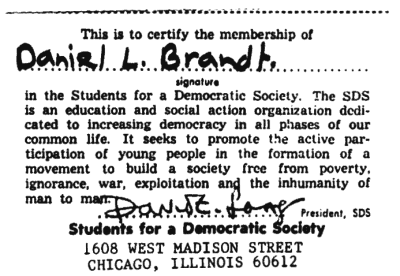
So forget it, Chip. I’ll turn in my SDS membership card if you promise to go away, but the only one qualified to accept it these days is former national SDS president Carl Oglesby. Carl is too busy writing JFK assassination books to bother with your concerns, and feels fine on our Board sitting next to Prouty. And if you ask him, he’ll probably tell you that at some point between the late sixties and now, you are the one who changed, not us.
Public Information Research
PO Box 5199, Arlington VA 22205. USA
Tel: +1 703 241 5437.