
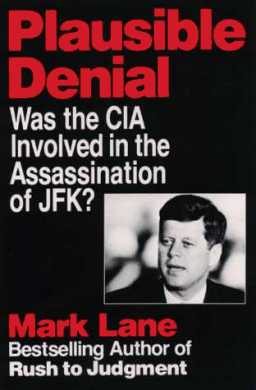
Mark Lane
Plexus, London, £9.99
In 1978 a right-wing American magazine, Spotlight, published an article by former CIA officer Victor Marchetti which claimed that in response to the beginning of public hearings of the House Committee on Assassinations, the CIA was about to admit that one of its former employees, Howard Hunt, one of the Watergate ‘plumbers’, had taken part in the assassination of John Kennedy. The admission would be a ‘limited hang-out’. Hunt sued Spotlight; Marchetti had — or was willing to present — no evidence, and in 1981 Hunt duly won damages large enough to close Spotlight. However, on appeal the verdict was overturned on a technicality, a second trial ensued and JFK assassination buff Lane was enrolled to defend Spotlight. In so doing he got David Attlee Phillips, Hunt, Richard Helms and Marita Lorenz into court. Half the book is about that second trial in January 1985. (The rest is a — not very interesting — summary of Mark Lane’s activites in the Kennedy assassination field since 1964.)
To a lapsed assassination buff like me, parts of the trial are rather interesting. Try this, the single most important claim in the entire book. David Attlee Phillips admits, for the first time, that Lee Harvey Oswald did not visit the Soviet embassy in Mexico City in 1963. If that means nothing to you, then the book will probably mean nothing.
At the heart of Lane’s case was Hunt’s alibi for November 22 1963 and the allegations of a woman called Marita Lorenz. In the event Hunt could not conclusively prove where he had been on the day — and doubts about his credibility were immeasurably increased by the failure of his children to back up his alibi. Marita Lorenz, former lover of Fidel Castro-turned-CIA-agent, testified that she had been part of the Kennedy assassination conspiracy along with Hunt, another Watergate ‘plumber’ Frank Sturgis, and some Cubans. But her first-hand knowledge of the assassination is nil. She left the group in Dallas on November 21st and claims she was told by Sturgis after the event.
Do we believe her? My initial reaction is that I don’t, but only because it is just too neat and tidy that the same people would bump off Kennedy and then turn up in the Watergate ‘plumbers’. Even if we believe her account of what Sturgis told her, Sturgis’s claim might be a lie — disinformation, perhaps for the Agency; water muddying. Many other false trails have turned up over the years. Either way, along with most of the serious Kennedy researchers, I do not buy her story, and didn’t buy it when it first surfaced in 1977. (See, for example, Sunday Times 6 November 1977.) Lorenz’s story must be disinformation. But if it is, what is going on?
My guess would be that what we have here is a disinformation project by the CIA. It is 1977: at the top of the CIA’s domestic agenda is making sure that House Select Committee on Assassinations uncovers nothing of interest. A number of disinformation projects are running. Over at the Reader’s Digest Edward J. Epstein’s preposterous book Legend is about to be published, reaffirming the Warren Commission’s central findings — with a KGB twist added. The CIA have another disinformation hare running, a faked document purporting to be a CIA internal memo from 1966 which refers to Hunt being in Dallas on 22 November 1963. This is planted in the media, along with the notion that the CIA is prepared to toss Hunt to the investigators of the House Committee. In traditional psy-ops fashion, the story starts in minor media — via Marchetti in Spotlight and via the Wilmington News Journal. Hunt, a former (or ‘former’) CIA officer, begins to amplify the message with his law suit against Spotlight. The final result of the two trials was Hunt’s failure to prove where he was on 22/11/63 — could you prove where you were on a day 20 years earlier? — and the inference that he was involved in Dallas, supporting the testimony of Lorenz. In other words, the outcome was exactly as originally predicted by Marchetti’s article: in a ‘limited hang-out’ the story that Hunt was in Dallas was broadcast. (Surely, had it chosen to do so, the Agency could have provided Hunt with an alibi?)
RR