
This began as a review of Deacon’s Truth Twisters by David Teacher, and grew as we both saw bits and pieces we could add to it.
Richard Deacon’s The Truth Twisters (McDonald, London 1987: Futura, London 1988) is a classic of Western disinformation purporting to describe Soviet disinformation. Deacon lines up all our favourite state and right-wing outlets to attack CND, ecologists, socially committed clergy etc. etc., and the master brain behind them all, the KGB. As sources Deacon cites:
- The Centre for Conflict Studies in Canada, erstwhile base for Maurice Tugwell, the first head of Information Policy in Northern Ireland. (See Lobster 16). Tugwell’s activities as a Director of the Canada-South Africa Society are described in Top Secret No 1/89.
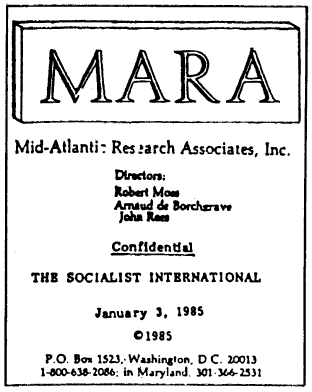
- Robert Moss. Where is Robert Moss these days? The last sighting we have of him is Mid-Atlantic Research Associates Inc. (MARA) in 1985. (Any sightings since then to us, please.) MARA’s Directors are/were Moss, Arnaud de Borchgrave, Moss’s co-author on several of their disinformation projects and editor of the Moonie paper Washington Post; and John Rees. The only redeeming feature of the otherwise appalling Manos Haris book, The Socialist International at Gunpoint, (Picton Publishing, Chippenham, 1988) is the reproduction of a MARA report on the Socialist International, portraying it as a global socialist conspiracy. At one level this MARA report is absurd: the idea of the Socialist International meaning anything is just funny. But the level of ignorance on the American right is so high, almost anything is likely to be believed. Where too is Brian Crozier? Since the Langemann papers identified Crozier as a Pinay Circle member who was engaged in setting up a ‘transnational security organisation’, little has been heard of the man or of the progress of the group. Crozier’s last known action — yet another attempt to discredit the Institute for Policy Studies, the Washington-based liberal think tank with an Amsterdam offshoot, the Transnational Institute — was a costly failure. IPS director Orlando Letelier was assassinated in 1976 by the Chilean DINA and CIA-linked Cuban exiles. Then in 1980 Moss and de Borchgrave referred to left-wing Washington and Amsterdam institutes funded by the KGB in their execrable ‘novel’ The Spike – until IPS lawyers forced changes in the text. In 1984 Crozier wrote to the Spectator attacking IPS director Richard Barnet (a former Kennedy aide) and accusing the IPS of being ‘a front for Cuban intelligence, itself controlled by the KGB’. Barnet sued, the litigation reaching a climax in 1986 when Crozier lost a key court battle to prevent the Spectator retracting. Shortly afterwards, the litigation ended with Crozier paying his own costs. The case reached the headlines when Crozier tried to substantiate his case by submitting a sheaf of articles and interviews with Fidel Castro as ‘proof’ of the Institute’s contacts. At this point MI5 began an investigation of Professor Fred Halliday who had links with IPS. After investigations lasting a year — which included putting Halliday on the Customs ‘black book’ under Code J (inform MI5 of subject’s movements) — MI5 dropped the case around the time Crozier’s defence against Barnet collapsed. (See Observer 2 October 1988.) Since then, with the exception of the occasional letter to the British press (one is quoted elsewhere in this issue), Mr Crozier has maintained a low profile.
- Baroness Cox, an example of what passes for an intellectual on the enervated British Right, last heard of roaming round the former Soviet satellites telling them how to convert their societies into versions of Thatcherised Britain. (The idea of Britain being offered as a successful role model is a lie at least as big as anything mustered by the Stalinist Soviet Union. Let’s hope the eventual stream of corporate managers from the Eastern bloc arrive by train at Kings Cross station and have to run the gauntlet of beggars, like we do on our occasional visits to The Big Nowhere.)
- Kitty Little, who, for years, has been telling anyone who would listen that she was a student member of a subversive pro-Soviet group in Oxford University, lead by the young don Harold Wilson. The fact that during the period she describes Wilson wasn’t at Oxford, matters not a jot. (Little’s fantasies are referred to by Chapman Pincher, see Inside Story p. 29, and have appeared a number of times in Kenneth de Courcy’s Special Office Brief).
- The now defunct Foreign Affairs Publishing Company of Geoffrey Stewart-Smith.
- Keston College, the British centre of the study of religion in the Soviet Union, certainly, but not yet provably, an MI6 operation. Soviet suspicion of Keston led to the collapse of a planned visit to Moscow by a British human rights mission in October 1989 when one British delegate — the Reverend Michael Bourdeaux, Director of Keston — was refused a visa by the Soviet authorities. (Guardian 11 October ’89)
- The Jamestown Foundation, the ‘private’ CIA operation to handle Soviet-bloc defectors; see, for example, ‘Communist turmoil brings exodus of Cold War spies’, in Guardian 9 December ’89.
- The late Joseph Josten.
And so on.
Deacon usefully reminds his reader of British State sponsorship of disinformation in spy fiction, a notable example of which is the 1981 ‘novel’, The KGB Directive, by Richard Cox. Born in 1931, Cox is a former First Secretary in the Diplomatic Service and Defence Correspondent for the Daily Telegraph. He has published several novels – Sam 7, Ground Zero and The Columbus Option. Quoted by Deacon, from the Winter 1982 edition of the Centre for Conflict Studies’s Conflict Quarterly, Cox wrote:
‘the novelist who values democracy can strike a blow for it… conversations with various well-informed people convinced me that I should write a novel on the subject of current KGB operations in Britain….the main reason I wrote a novel is that the British laws on libel make it difficult, if not impossible, to describe the penetration of the Labour Party as the conspiracy which many people are certain it is.’ (pp. 59-60)
Another outstanding example of this genre also used by Deacon is Frederick Forsyth’s 1984 The Fourth Protocol, in which, via an internal party coup, Ken Livingstone becomes Prime Minister, supplanting Prime Minister Neil Kinnock. This is achieved via a rerun of the political coup which made Livingstone leader of the Greater London Council. Such a coup is practically inconceivable, if only because, unlike the leader of the erstwhile Greater London Council, the Prime Minister is appointed by the Queen. No matter: to hint to his readers just how important this section of the book is, Forsyth dresses it up as a letter from Kim Philby (!) to the Chairman of the CPSU, and has it printed in italics, all ten pages of it; and he later confirmed, to the Times Diary, that he had got the idea from MI5.
Presumably it is this section that Mrs Thatcher finds so interesting. During the House of Commons debate on the Official Secrets Bill on 15 February 1989, Norman Buchan MP mocked the Prime Minister for admitting that she had read The Fourth Protocol twice. But she believes stuff like this, that was her appeal to the right-wing Tory/spook network in the mid 70’s who ran her for leader of the Conservative Party. This ‘Labour left coup’ theme was recycled in the Sunday Express (October 8 ’89), reporting a speech on these lines by another survivor of the original counter subversion-oriented Hard Right Tory grouping from the 70’s, Cabinet Minister Nicholas Ridley.
With a straight face, Deacon assures us that the aim of Forsyth’s book was to forestall the KGB from contemplating such an operation. Similar inversions were run by MI5 during 1987, notably through the Daily and Sunday Telegraph, the claim being that the operations against the Wilson government were designed to ‘stabilise’ not destabilise it; and by BBC TV producer Peter Taylor, who argued (Sunday Telegraph (21 January 1990) that ‘there was a conspiracy to remove [John Stalker] from Northern Ireland but the purpose I believe was to protect the inquiry, not destroy it.’ (Emphasis in the original.) Forsyth’s book was, in part, a piece of psychological warfare, published just after Kinnock became leader of the Labour Party. By coincidence no doubt, the film version, starring Michael Caine, was released in Britain just before the 1987 General Election.
If you can force yourself through Forsyth’s herniated prose, there are other little disinformation gems buried in it. For example, the means for the KGB to manipulate a Kinnock General Election victory turns out to be a mini-atomic explosion. ‘Plan Aurora’ was to infiltrate such a bomb into the U.K. and cause an apparent nuclear accident close to a U.S. air force base in East Anglia. This would ‘panic the 10% floating vote into unilateralism, and support at the polls the only party pledged to unilateralism, the Labour Party.’ (p.179)
An analogous theme, of radioactive waste and the KGB, surfaced in James Adams’ Secret Armies (London 1987):
‘Oleg Lyalin….brought with him documents which supplied clear proof of Soviet KGB . …… plans to drop radioactive isotopes into the water at Holy Loch to poison submariners and workers responsible for Britain’s nuclear deterrent’. (p.160)
This ‘KGB/radioactive waste/ Holy Loch’ theme is also mentioned in Colin Wallace’s 1974 MI5-sourced disinformation notes: ‘KGB plot to leak radioactive waste near Polaris submarine base’, attributed to ‘1 Directorate 3 Department’.
The explanation of this theme appeared to emerge in January 1989, when a former captain of a U.S. Polaris submarine admitted on Scottish Television that the Polaris submarines used to dump their radioactive coolant water into Holy Loch in the 1960s. A Captain Bush said: ‘I think we should have done it in our own country and not taken advantage of the Scots who were so wonderful and tremendously welcomed us. (sic) And we were discharging radioactivity in the harbour. I’m quite frankly ashamed.’ (Guardian 14 January ’89)
Did Lyalin bring over information about such a KGB plan? Or was his defection (in 1971) used as a convenient peg on which to hang things, and this KGB story merely exculpatory disinformation? The Guardian later reported that radioactive pollution in the waters around Faslane and Holy Loch U.S. bases is four to nine times higher than those recorded in official figures.(8th February ’89)
Deacon’s does his best to rubbish ‘the Wilson plot’ while maintaining some connection with the theme of his book: ‘Was Wilson disinformed (by the KGB) and so caused to suspect an MI5 plot against him? Or was the right-wing faction in MI5 disinformed and thus came unnecessarily to suspect Wilson?’ (p. 202) This at least shows a little grudging movement from Deacon’s absurd posture in his withdrawn 1979 The British Connection: Russia’s Manipulation of British Individuals and Institutions, in which (p. 259), using the standard ploy of denying an allegation in order to repeat it, he dismissed the ‘Wilson plot’ while recycling one of the disinformation themes:
‘Various suggestions have been made in books and articles that some members of MI5 (past and present) turned against Harold Wilson when he was Prime Minister with the aim of forcing him out of office. The closer these writers have got to Wilsonian sources the more melodramatic and fanciful their journalistic spook goonery (sic) seemed to become. One is asked to believe that MI5 tried to force Wilson out of office, but whether this was to be done by a ‘colonels’ coup or staging an imaginary scandal with mysterious photographs alleged to have been taken by the KGB in Moscow……there was never a word of truth in this hotchpotch of innuendo. It was, however, quite disgraceful that MI5 should have been smeared in this way’.
The British Connection, which is in some libraries despite being injuncted and then withdrawn, is in fact a pretty good guide through what some of MI5 (and others) believed, or said they believed, about Labour Party links to the KGB. Once again, by coincidence no doubt, it was issued just before the 1979 General election, and a number of newspapers ran large pieces based on it before it was injuncted. Deacon’s reference to ‘writers….. melodramatic and fanciful their journalist spook goonery’, is aimed at Penrose and Courtiour’s The Pencourt File of the previous year, which, for all its faults, was awfully close to the truth, especially in chapter 23. Penrose and Courtiour were ridiculed continuously while they were writing their book, chiefly by Private Eye, whose coverage of this now looks very much like more MI5 disinformation.
Deacon also defends old friends – the Goldsmith/ Spiegel case, the nuclear power lobby, SDI etc – and reveals recent thinking on the spook-connected British right:
‘Russian propaganda has found its way into British schools….Christianity has in recent years been distorted into a “front organisation” for international communism . ……Friends of the Earth draws support from known communist sources……the anti-nuclear lobby is not so much genuinely won over to the ecological cause as it is politically motivated and Soviet oriented…..Greenpeace would give the Russians excellent opportunities for studying French nuclear technology once they had penetrated the movement and gained access to some of their ships….’.
This last theme, the ‘watermelon’ line – green outside, red inside – crops up again in Deacon’s latest publication, The French Secret Service (Grafton, 1989)
Other members of the British spook writing fraternity have produced fiction recently. ‘Nigel West’ gave us The Blue List (Secker and Warburg, 1989). ‘West’s’ plot concerns the discovery of the ‘blue list’ of Nazi-sympathisers in Britain compiled at the beginning of the war, people the Fourth Reich would have used in the invasion of Britain. The list is found, and the finder is pursued, revelations are revealed, the leading man gets laid etc etc. Along the way ‘West’ drops a number of tidbits: an intricate explanation, going back to pre-war days, of how Philby was really a triple agent; and a version of the ‘peace plotting’ circa 1940 by the British right which purports to demonstrate that the ‘plot’ was really a Soviet operation – ‘Pro-Nazi sympathisers organised by Soviet moles’ (p. 60) – rather interesting in the light of the current interest in the ‘peace plots’ of the period; and, in passing (p. 105), an account of MRF, the shadowy British Army counter-insurgency unit in Northern Ireland in the early 1970s. MRF, says ‘West’s’ character, ‘only identified terrorist groups. We operated from the Palace Barracks, a couple of miles outside Belfast, and were separate from SIS and the Security Service. Once we’d nailed a suspect the others would move in.’
‘West’s’ gratuitous introduction of MRF is just one of a number of such references to the outfit in the past year or so. The first was in the memoir of Field Marshall (Lord) Michael Carver in which, though not naming MRF, Carver acknowledged the existence of ‘surveillance operations by soldiers in plain clothes ……initiated by Frank Kitson when he commanded the brigade in Belfast, some of them exploiting ex-members or supporters of the IRA, of which I was aware, and for which I had obtained Ministerial approval.’ (Out of Step, Memoirs of a Field Marshall, Michael Carver, Hutchinson London 1989 p. 429) ‘Ministerial approval’? Why is Carver keen to tell us this? The second was ‘West’s’, and the third is in Michael Asher’s Shoot to Kill: A Soldier’s Journey Through Violence (Viking, London 1990). Asher served in Northern Ireland in the Parachute Regiment and on p. 143 describes MRF:
‘…. ordinary soldiers recruited from the 29 battalions then working in Northern Ireland…..the army had arrested ten former IRA men and persuaded them by a combination of threats and promises to turn informers. The ‘Freds’ lived with a section of ten MRF soldiers at Holywood Barracks. Their objective was to penetrate hard-line Republican areas.’
It may just be coincidence that in the space of a year we have had three references to an outfit which had hitherto rarely been mentioned. On the other hand, these MRF references may be part of the on-going joint Ministry of Defence/MI5 effort to contain and discredit Fred Holroyd’s account of the SAS undercover units in Northern Ireland. In 1988 the MOD fed a barrow-load of disinformation to a trio of Sunday Times journalists, led by James Adams, about a unit called 14th Intelligence. Formed in the early 1980s, as far as we know, Adams and co. ‘back-dated’ 14th Intelligence to the early 1970s to account for the SAS troops then (secretly) in Ireland. (See Alexander Platow in Lobster 18.) Now we have MRF, and Asher, for example, is quite explicit: ‘There’s no SAS on the ground, only us’, he quotes one MRF member saying. (p. 143)
Chapman Pincher also produced a novel in 1989, Contamination (Sidgwick and Jackson, London 1989). This ‘snappy roman a clef about life in the cloak and dagger world’ would, said the Daily Telegraph (7 October ’89), ‘enrage’ Britain’s security chiefs. In case prospective reviewers didn’t get the point, with review copies came a press release from the publisher, which, after announcing that ‘because of the advent of the tough new Official Secrets Act….. spy-expert Chapman Pincher has been driven to disguise his disclosures about the world of secrets in the form of fiction’, helpfully listed the pages on which such ‘disclosures’ were to be found. (None of these seem terribly interesting, but, for anyone who wants to try, pp. 44, 45, 126, 170, 281, 287, 288 are suggested.)
Spetsnaz
Someone could usefully re-analyse the post 1945 period of British anti-Soviet propaganda in terms of the information delivered by Soviet defectors. This isn’t done by Gordon Brook-Shepherd whose excellent The Storm Birds (Weidenfeld and Nicolson, London 1988) describes their information rather than the uses subsequently made of it. One such (we are told) was Vladimir Rezun, who brought the information about Spetsnaz (Soviet special forces; their SAS, or Green Berets) on his defection in 1978. Rezun is better known in Britain as ‘Victor Suvorov’, under whose name a stream of books have emerged since 1981 which illustrate perfectly the manipulation of defector testimony by the host intelligence service. ‘Suvorov’s’ first book was The Liberators (Hamish Hamilton, London 1981), a sardonic account of the Soviet Army as a ghastly, brutal, shambles, about as threatening to NATO as the CPGB is to the British state. This, clearly, wasn’t quite what his intelligence mentors had in mind at that stage of the re-launched cold war, and ‘Suvorov’ (or, perhaps, some wise-guys somewhere in the British state) quickly put out another book, Inside the Soviet Army (Hamish Hamilton, London 1982) which returned to the traditional Red Army-as-gigantic-super-efficient-threat-poised-to-destroy-NATO theme. (This has been followed by Soviet Military Intelligence, Aquarium and Spetsnaz.) ‘Suvorov’s’ major contribution to British state disinformation has been the information (or disinformation) about Soviet Spetsnaz, on the back of which an ocean of print – and a good deal of military spending – has been launched in the past decade or so.
The best example of disinformation using the ‘Spetsnaz threat’ began in January 1986 when Jane’s Defence Weekly ran, as its cover story, ‘Spetnaz at Greenham’. ‘Several sources have indicated that the Soviet activities around Greenham Common are a ‘near perfect’ example of Soviet preparations to deal with the GLCM (Ground Launched Cruise Missile) threat.’ Etc., etc. The story was absolute junk: no information, no sources; classic disinformation. Nonetheless, perhaps because of Jane’s general reputation, (and perhaps because Jane’s article was merely the first part in a pre-planned campaign, the major media in Britain picked up the story and repeated it. The Daily Telegraph (22 January) began its piece, ‘Russian agents were involved at Greenham…..Defence Ministry officials have indicated to Mr Younger, Defence Secretary, that there is some truth in the reports…’ (Emphasis added.) On 26 January the Telegraph ran the story again, this time headlined ‘As Soviet special forces dig in at the perimeter fence’. (By this time Duncan Campbell and Claudia Wright had destroyed the story in the New Statesman [24 January 1986].) Undaunted, in that Telegraph piece the author, ‘expert’ on the British left, Blake Baker, used the ‘Spetsnaz threat’ to urge support for a campaign called ‘Defence Begins at Home’.
Defence Begins At Home
‘Defence Begins at Home’ began in 1983 with a cluster of retired British military big-wigs on board, Lord Hill-Norton, General Anthony Farrar-Hockley, etc., and was an attempt to launch the idea a ‘home army’, ‘capable of defending Britain against the threat of Soviet raiding parties’. (Sunday Telegraph 6 November ’83). But ‘Defence Begins At Home’ never got off the ground, at least not in public, and by the time Blake Baker came to recycle the ‘spetsnatz’ story in ’86 — an improved version of the ‘Soviet raiding parties’ of ’83 — he had to report that ‘Defence Begins At Home’ was being ‘wound down’.
The person running ‘Defence Begins At Home’ was Colonel Michael Hickey, who had retired from the General Staff at the MOD in 1981. On 29 December 1986, 10 months after the ‘Spetsnaz at Greenham’ nonsense, the Institute for European Defence and Strategic Studies (on whom see Lobster 13) published its Occasional Paper No. 23, ‘The Spetsnaz threat: can Britain be defended?‘ — by Michael Hickey. And there ‘Defence Begins At Home’ seem to have petered out. There has been just one more noteworthy reference to it. Searchlight (March 1988) reported the trial and conviction of one Reginald Cox on charges of the illegal possession of firearms. Cox had already been convicted in 1981 for firearms offenses while a member of the British Movement. Cox and some buddies were playing military games on Cannock Chase (a section of moorland in Staffordshire), apparently under the auspices of ‘Defence Begins At Home’. Searchlight wrote of ‘persistant reports [which] have suggested that many right-wingers joined Defence Begins at Home as a useful cover for their paramilitary activities’, but provided no details.
The Spetsnaz scare also gave us Operation Spetsnaz: the aims, tactics and the techniques of Soviet Special Forces by Michael G. Welham and Bruce Quarrie (Patrick Stephens Ltd, London 1989), which enthusiastically recycles some of the recent themes of the British secret state. And they get straight to it. On p.10 of the introduction, the authors warn us of the subversive menace represented by British trade union leaders Ron Todd, Ken Gill: ‘A combination of the policies of Messers Todd, Gill and other extremists such as the miners’ leader, Arthur Scargill, could deliver the United Kingdom into Moscow’s hands without a shot being fired.’ After a dull guided tour of the wastelands of officially-inspired (but barely sourced) speculation about what the Spetnatz might be and might do (in the event of war), the authors get to the disinformation meat at chapter 8. They rehash the curious case of the dying Marconi scientists and then ‘ask readers to draw their own conclusions, knowing of the GRU’S incessant quest for Western scientific and technical knowledge and of the existence of Spetsnaz anti-VIP squads.’ Sentences like this start to appear; ‘ Militant is only one of over a hundred organizations in the UK which could be of assistance to Spetsnaz in time of need’ (p. 143) (emphasis added); and we meet old friends like ‘the extremist Hurricane group’ — and the ‘Spetsnaz at Greenham Common’ story.