
More, please
In an account of his career as a writer of spy fiction (Guardian 16 November ’89) John Le Carré referred to the hostile reaction received by his (unnamed) second book, presumably The Looking Glass War:
‘Critics and public alike rejected the novel, but this time the spies were cross. And since the British secret service controlled large sections of the press, just as they may do today, for all I know, they made their fury felt.’
Angleton’s ghost
A wonderful piece of disinformation appeared in a New York Times editorial (7 January ’90) speculating on what we might learn from the Soviet Union now that the Cold War is over. Under the heading ‘Who was Lee Harvey Oswald?’, this appeared:
‘According to the Warren Commission, the man who killed John F. Kennedy in 1963 was a psychotic, acting alone. Not so, according to tireless conspiracy theorists, who speculate that Oswald, who had visited Moscow, was a K.G.B. “asset” in Dallas.’
Apart from Edward J. Epstein, lighting another candle at the shrine of James Angleton, who else takes this notion seriously? Good old, reliable, NYT, still in there, still muddying the waters 26 years later.
Angleton’s paranoia about the Soviet Union was amplified grotesquely by his encounter with the KGB defector Golitsyn, and his fantastic conspiracy theories about the global schemes of the KGB. (These are elegantly rubbished by Gordon Brook-Shepherd in his The Storm Birds: Soviet Post-war Defectors [Weidenfeld and Nicolson, London 1988].) One of the interesting (if minor) questions in the post-Gorbachev era is, ‘How have Golitsyn’s enthusiasts adjusted to the new reality?’. The answer appears to be, ‘not a lot’, if Brian Crozier is anything to go by. In the Independent (7 February 1990) Crozier presents a Golitsyn-esque view of the Gorbachev counter-revolution which concludes:
‘The evidence is very strong that Gorbachev’s “new thinking” was an ambitious deception operation which went wrong because of the advanced decay of an unreformable system.’
The fabric of British democracy
In Lobster 18 Gordon Winter referred to British state personnel accessing ballot papers. Winter reported the papers kept in locked metal boxes. Not so, writes David Northmore, referring us to the piece in the Independent (20 August ’88). From being a local election agent, I know that Winter’s account of the votes being put into bundles by party is true. But at the vote counting the ballot papers were put into locked metal boxes. At some point they must be transferred to the paper sacks for disposal. This is presumably done so that the metal boxes can be used in the next election; and there are now municipal elections every year in many places in England.
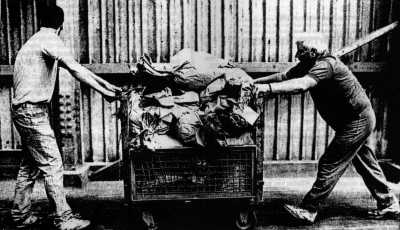 Two workmen push a trolley with sacks containing last year’s general election ballot papers at an incineration plant in North London, David Northmore writes.
Under the Representation of People Act 1983, a senior government law officer is required to keep custody of all ballot papers and official documentation relating to parliamentary and local government elections for a minimum period of a year and a day.
This enables any member of the public to petition for the convention of an Election Court if corrupt or illegal election practices are suspected. After this period, the Lord Chancellor’s Department must arrange for the documents to be destroyed.
The late Mae Brussel has been immortalised in The Mae Brussel Research Centre, PO Box 8431, Santa Cruz, Ca 95061. This produces a newsletter, World Watchers International, the first issue of which appeared in Fall ’89. Like Brussel’s own output, this first issue is a mixture of interesting information, new leads, publications of interest and the kind of nonsense which gives ‘conspiracy’ its bad name. The Research Centre has got Brussel’s files and promises to make them available to other researchers – for an appropriate donation. If you write, send a couple of dollars to cover postage back.
February 1990 saw the first issue of new parapolitical newsletter, Conflict:the Dorff Report. The first issue was 8 pages, mostly about the Kennedy assassination. Annual subs are $29.00 for 12 issues, to Robert Dorff Auctioneers Inc., 223 S. Beverley Drive, Suite 202- A, Beverley Hills, CA 90212. The first issue is an interesting beginning, but no more. The second promises to reproduce the text of CIA Document 1035-960, the Agency’s 1967 plan for discrediting critics of the Warren Commission.
Old Nazis, New Nazis
One of the most impressive pamphlets to come my way in recent years is Old Nazis, the New Right and the Reagan Administration: the role of domestic fascist networks in the Republican Party and their effect on U.S. cold war policies, by Russ Bellant. This is 96 A4 (typeset) pages, ring-bound, thoroughly documented, indexed, and with many photographs. Anyone who read John Loftus’ The Belarus Secret, or who is interested in the area encompassed by ABN, WACL, Singlaub, will want this. Send $6.50 to Political Research Associates, 678 Massachusetts Avenue, Suite 205, Cambridge, Ma 02139, USA. A much edited version of this appears in Covert Action Information Bulletin No.33