
Ken Livingstone MP, has been putting dozens and dozens of questions to our state about the cases and allegations of Fred Holroyd and Colin Wallace, those bits of the secret state you are allowed to ask questions about, Northern Ireland, psy ops and so on.
Putting down such questions is a fairly dispiriting business. Some of them ‘the table’ in House of Commons won’t accept; some don’t get answered; and such answers as are given are governed by the central rule of our political system – tell the elected representatives as little as possible. Yet some of Ken’s questions have been answered; and, even more remarkably, some of the answers have been revealing. Ken is demonstrating that the near universal belief in this country that almost nothing can be found out is not really true. We don’t have room to cover all of his questions, but here are some of the more generally interesting.
- On February 29th 1988 he asked “What has been the total number of police officers and civilians serving in, or responsible to, the special branches of English police forces in each year from 1969 to the latest available date” – and the same question for Scotland.The answer, for the Metropolitan Police only, was:
1968 – 410
1987 – 567But in Scotland, with information only from 1978 to 87, and for officers only, not civilians and officers, the figures were:
1978 -72
1987 -164This doubling over the period of the Thatcher years is very interesting. For while the South and Midlands has voted Tory, Scotland has been moving leftwards throughout the Thatcher period – the Tories now have only slightly more than 10% of the Parliamentary seats in Scotland. And – surprise, surprise – as Scotland has moved against the Tory government, the secret state in Scotland has doubled in size. That such a relationship should exist is obvious enough, but now it has been illustrated.
- On March 7th Livingstone asked the Foreign Office “How many civil servants were engaged in the Information Research Department in each year since 1971.”And got an answer. IRD is the one bit of the secret state, not officially a part of MI6, which the state can’t refuse to answer questions on. The figures are:
1971 1972 1973 1974 1975 1976 1977 117 99 91 91 88 85 85 (NB This is the ‘staff establishment’ which, I think, is Civil Service-speak for officers and does not include routine clerical personnel.)
IRD is an important part of our post-war history and it says something about our society (and about our politicians) that no-one before 1988 appears to have ever thought it worth asking such a question.
The received wisdom on IRD is that it was chopped down, in stages, throughout the 1970s. David Owen MP, who was the Minister at the Foreign Office when IRD was supposedly closed in 1977, said:
“It was closed down very gently over a period. It was in my time that the name was changed and certain sections were kept, but this was part of a fairly continuous change that had been going on from 1970 as far as I can remember.” (quoted in Covert British Propaganda: the Information Research Department 1947-77, Lyn Smith, in Millennium, Journal of International Studies Vol 9 No 1)
But Owen may be telling us more than he realises. ‘The name was changed..certain sections were kept’ – so, not disbanded as most reports insist; and a fall in personnel of only 14% in the last 5 years is closing it down very ‘gently’ indeed.
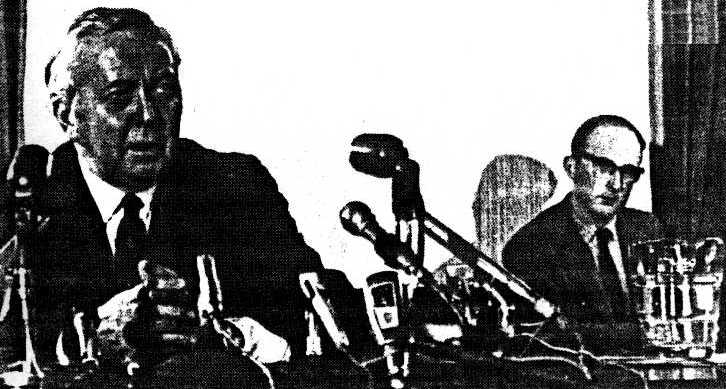
- On March 7 Livingstone also asked “How many members of the armed forces and civil servants were engaged in the Information Research Department in Northern Ireland in each year since 1971. “This a more pointed question, relating to Colin Wallace’s claim that an IRD officer was sent to Northern Ireland to help set up the psy ops unit, Information Policy. And indeed, the answer from the FCO did confirm
“One IRD officer served in Northern Ireland on secondment from November 1972 to December 1973”
This was Hugh Mooney. But this answer suggests that somewhere there is a committee reviewing these answers in light of what they expect Livingstone to expect. For that answer was false: there were two IRD people in Northern Ireland, not one. But as Wallace had only ever publicly talked of one, one was the answer we got. (One of Wallace’s former colleagues in Information Policy told me last year that he had seen Hugh Mooney on BBC’s Question Time in the audience asking an obviously ‘planted’ question, doing a bit of ‘fine tuning’ just before the election .)
- On March 7 Livingstone also asked “in what capacity Mr Colin Wallace served in the Ulster Defence Regiment whilst a Senior Information Officer in Northern Ireland?”Roger Freeman, junior MOD Minister replied:
“Mr Wallace served as a Part Time 2nd Lieutenant in 1(Co. Antrim) UDR.”
Which was the wrong answer. An error? An attempt to disinform? Livingstone wrote and corrected the error which Freeman had to acknowledge, that Wallace “was granted the acting rank of captain with effect from 18th January 1972. His resignation of this commission took place from 14th November 1975. “
- The Privy Council is what? None of the basic textbooks on the mythical (unwritten (sic)) ‘British constitution’ actually have anything to say about this. But it has a bureaucracy which does something. We know this because that bureaucracy buys newspapers and magazines. A question on 8th Feb. “to list all the periodicals subscribed to by the Privy Council since 1970” produced half an answer. Since 1980, Livingstone was told, the list has included Campaign, Economist, Farmers Weekly, Financial Weekly, Listener, New Scientist, New Society, New Statesman, Now, Private Eye, Spectator, Times Literary Supplement, Tribune and the UK Press Gazette.It is a pity that no information was available on the early 1970s subscription list because Geoffrey Stewart-Smith told me once that the Privy Council was subscribing to his publications then. And rumour, repeated rumour has it that the Palace was involved in some of the ‘What is to be done about a British crisis – a coup?’ discussions which were taking place then.
- On February 25th Ken asked the Prime Minister “if she will make a statement on the present definition of national security adopted by her Majesty’s Government.”The reply was really rather odd:
“This term is generally understood to refer to the safeguarding of the state and the community against threats to their survival and well-being. I am not aware that any previous Administration has thought it appropriate to adopt a specific definition of the term.”
What, no definition of something as central to her conception of the universe? And how about that notion of ‘well being’…..Something, I know not what, is going on here.
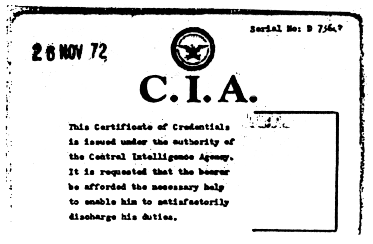
- Finally, on 28th March Ken asked the junior MOD minister, Roger Freeman, “If he will provide details of the use of forged CIA documents by the armed forces in Northern Ireland from 1971 to the present date.”Consider the alternatives facing the civil servant who answered this. If the answer is ‘No’, it sounds like a confirmation that such documents were used. If the answer is “It is not policy to comment on operational matters” – a comment/get-out used – this, too, sounds like confirmation. The only possible answer was the one given:
“I am unaware of any evidence that such documents have been used at any time by the Armed Forces in Northern Ireland.”
Here is such evidence. From the Wallace Collection, an nth generation photocopy of a 1972 fake CIA card issued to Army personnel in Northern Ireland, for purposes unknown.
Further Answers to questions from Ken Livingstone MP
As this issue was being prepared we received the then latest batch of answers to questions Ken Livingstone MP had put down in the House of Commons. One concerned Zeus Security.
Written Answers 23 MAY 1988
Private Security Companies
Mr. Livingstone: To ask the Secretary of State for Foreign and Commonwealth Affairs what payments have been made by his Department in each year from 1980 to date to Zeus and Lynx private security companies; and what was the nature of the work undertaken by these companies.
Mr. Mellor: The Foreign and Commonwealth Office has employed Zeus but not the Lynx security company. Detailed information on this subject is not kept in a centralised form and can only be researched at disproportionate cost. Available records show that Zeus Security Guards Ltd. were employed on access control duties in Whitehall six years ago and on two further occasions in 1983.
26 NOV 72 Serial No: D 7364
C. I. A.
This Certificate of Credentials is issued under the authority of the Central Intelligence Agency. It is requested that the bearer be afforded the necessary help to enable him to satisfactorily discharge his duties.
15 November 1971: Harold Wilson visits Northern Ireland. Briefing officer J. C. Wallace listens with interest.