
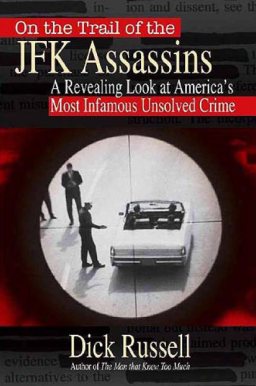
Dick Russell
New York: Skyhorse, 2008, h/b, $24.95
Russell wrote The Man Who Knew Too Much, about the late Richard Nagell. A couple of weeks before the assassination of JFK, Nagell walked into a bank, fired two shots into the ceiling and waited for the police to come and arrest him. Years later he claimed he got himself jailed to be off the streets when JFK was killed. He claimed he had been an intelligence officer who had been working with Lee Harvey Oswald and been asked by the KGB to kill Oswald to try to derail the assassination plot. (This is the point at which I ceased to believe this tale. No way, José. The KGB didn’t need to kill anyone: the Soviets had a back channel to the Kennedys through their Washington ambassador.) Russell wrote 800 pages about this, at the end which I was sure only that little of this extraordinary story was reliable. Since when, Nagell has been convincingly portrayed as an habitual liar and fantasist. This material’s status among the assassination research buffs is low. No-one else seems to have taken it seriously and pursued any of the apparent leads Nagell produced.
This collection of Russell’s essays on the assassination, spanning 30 years, suggests why he spent so much time on the Nagell story. The essays show Russell pursuing all manner of leads after Watergate, when the assassination returned to the stage, some of them generated by the Garrison inquiry, none of which ultimately amount to much. Russell reports on the inquiry by Senator Schweiker and the House Investigation; interviews Gerry Hemmings; and the first HSCA director, Richard Sprague, on the politics of the HSCA; discusses the death of CIA big-wig Paisley; accumulates a fair bit of Garrisonia; gives us more about Nagell; discusses Oswald qua Manchurian candidate; and interviews MK Ultra’s Sydney Gottlieb.
Russell is a journalist, and a good one to judge by the evidence presented here. It is easy to understand how Nagell’s style of offering tantalising fragments, plus the drama of the central act of him getting himself arrested, hooked Russell: here was a story, maybe even the story. (Subsequent research has suggested that Nagell fired the revolver in the bank because he wanted to get himself some mental treatment.)
To a dilettante Kennedy assassination buff like me, much of this is interesting because the entire history of the attempts to investigate the event by journalists and buffs is interesting. Best of all and, I suspect, most significant here, is an interview with Douglas Horne who worked as a researcher with the Assassination Archives Review Board in the 1990s. Horne has some detailed things to say about the forensics evidence, even suggesting how the Zapruder film might have been edited. Horne tells us he is writing a very large book about all this. That might be important. This book isn’t important but it is interesting; and interesting will do.