
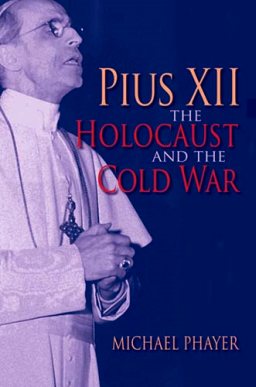
Michael Phayer
Bloomington: Indiana University Press, 2008, p/b, £15.99
In 1997, urged on by the US government, fourteen European countries together with Canada and Argentina, established commissions to investigate the involvement of their banks in the holding of assets looted by the Nazis and their allies during the Holocaust. One particular sovereign state refused to have anything to do with this long-overdue initiative: the Vatican. The legal action that resulted from this refusal is still working its way through the US legal system. Why the refusal? As Michael Phayer makes clear, in his fascinating new book, the Vatican bank still holds the Ustasa gold looted by the Croatian fascists during the Second World War.(1)
Ante Pavelic’s Ustasa regime was responsible for the deaths of some 50,000 Jews and between 300 and 400,000 Orthodox Christian Serbs, men, women and children, killed with a brutality that sometimes even shocked the Nazis. Despite this. the regime had retained Vatican support while in power, and once it had fallen, its leaders, including Pavelic himself, were provided with sanctuary in the Vatican and then smuggled to safety in South America along the Vatican’s ratlines.
Michael Phayer provides a convincing explanation of how this remarkable state of affairs came about. The book builds on his earlier outstanding volume, The Catholic Church and the Holocaust 1930-1965. It revises some conclusions in the light of new evidence, but more importantly, it establishes the part that Pius XII’s fear and hatred of Communism played in determining his attitude towards the Nazis and their crimes. It was, in Phayer’s words, the Pope’s ‘undiluted fear of communism that drove him. The extraordinary extent to which fear of communism shaped Vatican actions before, during and after the war is astounding’.
The priority the Vatican gave to anti-Communism did not just lead the Pope to fail to take a decisive stand against the Holocaust. As Phayer shows, when the Nazis invaded Poland and began their attempt to extinguish the Polish nation, the Vatican remained silent. The Nazis mounted a murderous assault on the Polish intelligentsia, overwhelmingly Catholic, as part of their attack on Polish national identity. The Church, one of the mainstays of Polish nationalism, fell victim to this repression. Between 1940 and 1945, some 2,800 Polish clergy were sent to Dachau, of whom only 816 survived. Churches were closed and priests were arrested or killed. In the diocese of Pelplin, the cathedral was turned into a garage. In much of what had once been Poland the practice of the Catholic faith became impossible or was driven underground. Pius refused to intervene. The Vatican sacrificed its Polish congregation in order to maintain good relations with the Nazis for the general good of the Church. Polish Catholics were cast in the role of Job as far as the Vatican was concerned. In these circumstances, it is hardly surprising that Pius was not prepared to put the Church at risk for Europe’s Jews. It has to be said that the Polish Church showed precious little sympathy for Poland’s Jews.
Pius believed, at least until the end of 1942, that Germany would win the War and that the defeat of the Russians would be a victory for Christian civilisation. He was confident that once Hitler was dead, Nazism would mature into the sort of fascism that the Church could comfortably accommodate itself to. Hitler would, he hoped, be replaced with someone more amenable, a German Mussolini or Franco or Salazar. As Phayer shows, when Pius condemned genocide in his 1942 Christmas message, the first and last time he pronounced on the worst crime in history, he personally took the German ambassador to the Vatican aside and assured him that it was directed against the Russians, not the Nazis. He assured him that ‘Stalin, not Hitler was the new Attila the Hun’. The Allies were, of course, being told a different story.
From 1943 onwards one of the Pope’s great fears was that there would be a Communist takeover in Italy. He relied first on the Germans to prevent this (in October 1943, the Vatican actually asked for more German police to be stationed in Rome), and then later on the Allies. In 1946 and 1947 he was warning the Americans of an imminent Russian invasion of Italy. And, of course, in the 1948 elections in Italy, the Vatican threw all of its resources, both spiritual and material, into the battle with the Left. As is well known, the Vatican acted as a conduit for the transfer of CIA funds to the Christian Democrats.
As for ‘the pope’s audacious ratline venture’, Phayer argues that it was once again his anti-Communism that lay behind the operation. As far as Pius was concerned, Nazi war criminals were first and foremost anti-Communists and this was more important than any mass murder they might have committed. He actually interceded with the incredulous Allies to urge clemency for the likes of Arthur Greiser and Hans Frank. Even more astonishing, Adolf Eichmann, Josef Mengele, Franz Stangl and hundreds more of the worst criminals of the twentieth century were smuggled to safety along the Vatican ratlines. Although Phayer describes his account of the ratlines as work-in-progress, he has no doubt that Pius was aware of what was going on and had sanctioned it, even if the actual dirty work was done by the likes of Bishop Alois Hudal, a well-known Nazi sympathiser, and Father Krunislav Draganovic, a well-known Ustasa sympathiser and himself a war criminal. Pius revealed his personal involvement with the ratlines, according to Phayer, in his determination to save the Ustasa leaders from justice. The case is overwhelming.
Notes
- While there is much talk today (mostly empty it must be said) about closing down overseas tax havens, the one that is never mentioned is the Vatican even though it is one of the major players.