
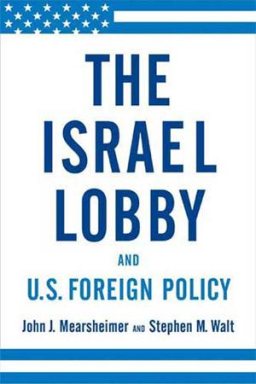
The Israel Lobby
John J. Mearsheimer and Stephen M. Walt
London: Allen Lane, 2007, £25
This account of the relationship between the ‘Israel lobby’ in the US, the US state and Israel should be required reading for anyone with an interest – personal, professional or political – in the troubled affairs of the Middle East. The authors, both of whom are academics, and both of whom support the right of Israel to exist, have produced an extremely interesting, detailed and carefully researched work. The publication of this book, and, one trusts, the effect of its content seeping into the consciousness of policy makers, strategists and politicians of all types, may increase our ability to have a rational discussion about Israel – its existence, policies and relationship with the rest of the world – without being immediately met with a counter barrage of accusations of anti-semitism and Holocaust denial from pro-Zionists.
Much of the value of the book consists of a catalogue of facts presented by the authors. Among these are the following:
- Between 1949 and 1965 the USA gave Israel an average of $63m per annum in food aid and economic aid.
- Between 1955 and 2005 the USA provided Israel with direct military and economic aid – in grants not loans – worth £154 billion in 2005 prices.(1) This is equal to almost the entire Israeli spending on defence during this period.
- In addition the US military gives Israel considerable amounts of modern military equipment.
- Because of this financial and military assistance Israel is today ranked as the 29th richest country in the world rather than considerably further down the list, as would be the case if it relied on its own natural resources.
- In December 1962 President Kennedy referred to Israel as having a ‘special relationship’ with the US of the same type that the US had with Britain.
- In the early stages of the 1973 Yom Kippur war – marked by some initial Israeli reverses – the US promptly flew in huge amounts of military aid to Israel and also supplied $2.2 billion of additional credits. As it transpired this did not have an immediate impact, but had circumstances deteriorated the US aid would have been critical.
- Six Israeli Leaders have addressed Congress – more than any other country.
- The Israelis (correctly) regard their relationship with the US as being without precedent in history.
None of the above are matters of opinion: all are facts, documented and sourced. The neutral reader may well wonder why more of this information is not in the public domain and why, for instance, the media do not use details like this as a preamble when routinely interviewing Israeli and US figures. Although there are explanations advanced to explain the extraordinary conduct shown toward Israel by successive US governments since 1948, the authors examine these arguments and find them wanting.
But what do we make of this? If there is a criticism to be made of the book it would be that it concentrates almost exclusively on the Israel-US relationship in the last 15 years. Had a longer perspective been taken, the material provided by the authors would be seen as being less of a recent aberration and more consistent instead with policies and objectives that have been systematically pursued over a much longer period of time. The authors argue that Israel benefits so closely from US foreign policy, and that US foreign policy is often so closely aligned to meeting Israeli requirements, that it is far from clear in many cases if the US government is actually pursuing its own legitimate interests.
What the authors mean by ‘the Israel Lobby’ (and its modus operandi) can be traced back to the initial deliberations of the World Zionist Congress at Basle in 1897 and its adoption, following the many appalling pogroms inflicted on the Jews in Tsarist Russia, of the explicit policy of founding a state of Israel in the Middle East.(2) Pre-1918 this entailed working with the Ottoman Empire to facilitate Jewish settlement in Palestine. The Jewish Colonial Trust was duly created in 1899 to fund this. As a result of these endeavours the Jewish population of Palestine rose significantly, from a small number of long resident indigenous Jews (perhaps 10,000 at most) to as many as 100,000 by 1910.(3)
Simultaneously with these efforts the World Zionist Congress sought to influence other nations and to create a climate of opinion in favour of Jewish settlers. These were often portrayed as ‘dynamic and European’ in comparison to the rather indolent Arabs. As early as 1908, Winston Churchill MP came out in support of this and promoted the idea of a Jewish administered area in Palestine under the protection of the British Empire. During the First World War, the Zionist movement, unable to determine, particularly in 1916-1918, which of the adversaries might win, and being traditionally hostile to Russia and somewhat more friendly to Germany, actively discussed the possibility of a ‘Jewish Homeland’ with both sides. After 1918, and the demise of the Ottoman Empire, Palestine was awarded to Britain as a League of Nations Mandated Territory. The Jewish Agency – established by the World Zionist Congress – volunteered to administer a great deal of the Palestine Mandate on behalf of the British, thus, helpfully, keeping the costs of running the area to an acceptably low level for the UK tax-payer. By the 1930s the British had come to realise that the best solution for the future in Palestine was not a 100% Jewish Homeland but two smaller self-governing areas, one Jewish and one Arab; with, perhaps, Jerusalem being a neutral zone guaranteed by the international community. When this view was put forward by the Peel Commission (1937) it was rejected by the World Zionist Congress which became markedly anti-British from this point onward.
Post war
After 1945 various Zionist and pro-Israel settler groups in the US and Eastern Europe fought against the British, causing the collapse of the Mandate. (4) They also fought successfully against the efforts of the United Nations to implement another version of the Peel Commission findings – Arab state + Jewish state + neutral Jerusalem – murdering the UN Envoy in Palestine, Count Bernadotte in September 1948 while he attempted to broker this.(5) Once Israel was formally established in 1949 (the first Ben Gurion government being composed of the membership of the Jewish Agency Board) it kept on good terms with both the UK and France, both nations being seen at that point as having more power and influence in the Middle East than any other. After Suez, Israeli foreign policy recognised instead the predominance of the US, with whom it had in any event continued to maintain close and cordial relations. Hence the exceptionally close relationship remarked upon today by Mearsheimer and Walt.(6)
All of which proves what? Firstly, Israel and its Zionist supporters have always worked with and sought the backing of whichever nations were most powerful at any given point in time to ensure that their overriding goal, a Jewish state of Israel, is achieved. In other words, Israel pursues its own interests at all times. Secondly, and not fully spelt out by the authors, the ‘lobby’ system is an endemic feature of US domestic politics. As well as the ‘Israel lobby’ today there is, and has been since the 1850s, an ‘Irish lobby’, after World War Two a ‘China lobby’, and, of course, there is also the ‘Cuba lobby’.(7)
An early example of US foreign policy being largely determined by expatriate and politically active migrants came in 1917-1918 when substantial communities of Slovaks and Ukrainians in the US lobbied for an independent ‘Czecho-Slovakia’, an objective subsequently adopted by the Lansing Declaration on May 1918. The US recognised the Masaryk government on 3 September 1918, when it controlled no territory, had not been elected, and Austria-Hungary still very much existed as a legitimate, internationally recognised and legally constituted body.(8) In the 1950s George Kennan, who disapproved of the close US relationship with Israel, commenting on the role played by the ‘Captive Nations’ (Eastern European émigrés, often of a right wing or neo-fascist type), described
‘….compact voting groups in large cities….able to bring to bear on individual legislators….an influence far greater than an equivalent group of reactive citizens are able to exert….’
To understand, then, the framework within which the US-Israel ‘special relationship’ operates it is necessary to grasp that much of US foreign policy has always been determined, or at least very heavily influenced, by domestic interest groups (‘lobbies’) putting pressure on politicians. In this context the Rolls Royce of ‘lobbies’ are clearly the 80 pro-Israel groups in the US, of which the American Israel Public Affairs Committee (AIPAC) is the biggest and best organised. This is not a conspiracy (it doesn’t have to be under the US constitution) and is openly influential. AIPAC and its allies allocate campaign funding for candidates at all levels of public office, provided that they support Israeli policies. They mobilise the Jewish vote to swing close elections and in a country where most US citizens know little to nothing about either Israel or the Middle East, they (successfully) put into the public domain a version of reality that is highly partisan and often incorrect.
Another curious and completely legal feature of US arrangements that is remarked upon by Mearsheimer and Walt, is the extent to which many US Jews, including many in positions of either public office or influence, have a ‘dual loyalty’ – i.e. as joint US-Israel citizens they place as much reliance on their views as expatriate Israelis as they do on their position as US residents. It is far from clear when considering as issue such as the Middle East whether the US dog is wagging the Israeli tail or vice versa.
Equally alarmingly, at least to those on this side of the Atlantic, are the alliances that the various Jewish lobby groups have built with a dismal array of neo-conservative organisations who regard Israel as a key and significant partner. This feature, also known as American Jewish Conservatism, extends to the Christian Zionists, the End Timers and the Christian Right. A typical outfit encapsulating this world view are Christians United for Israel (motto: ‘For Zion’s Sake I Will Not Keep Silent’), while the most prominent Christian Zionist, the Reverend Jerry Falwell has proclaimed
‘We are on the verge of a war….which will serve as a prelude or forerunner to the future Battle of Armageddon and the glorious return of Jesus Christ….’
The logic here appears to be: (1) All truly patriotic US citizens are also Christians; (2) Christians should believe in the literal truth of the Bible; (3) Israel was given by God to the Jews; and (4) The Bible says Armageddon will take place in Israel, presumably in our lifetime. Some of the Christian Right take this further to (5): in order to bring about (4) and the glorious salvation of all Christians, Israel should undertake pre-emptive nuclear strikes against non-Christian nations.(9)
As a US voting bloc the Christian Right plus the Israel lobby are formidable. The authors point out that the strength of this grouping is such that it enables Israel to defy US policy on the not particularly frequent occasions that a US president tries to advocate a contrary view. Thus, for instance, attempts to resolve the occupation of the Golan Heights are invariably ignored, delayed or wrecked.
Iraq
Perhaps the most interesting chapter in the book deals with the 2003 invasion of Iraq which, the authors argue, was triggered by intense Israeli lobbying of the US and the provision by Israel of misleading intelligence to back up the view that an invasion and war was urgently required. It is conclusively demonstrated by Mearsheimer and Walt that neither oil companies nor US military aggrandisement generally caused the 2003 war. Rather, without having to fight itself, it was Israel achieving its long term goal of the removal of Saddam Hussein and the cessation thereby of Iraqi funding for various troublesome Palestinian groups. The remaining target now for Israel is Iran and it is known that an Israeli strike on Iranian nuclear facilities as well as the selective assassination of key Iranian personalities are being considered.(10)
What is the alternative scenario? Mearsheimer and Walt conclude that the current cost of US policy and the danger that it poses to the US itself is counter-productive in the extreme and must change. Their view is that in an ideal world the US would treat Israel like any other country. US politicians and strategists would also define and publicly enunciate actual US interests in the Middle East rather than allow the agenda on these to be largely set by the Israel lobby and the Christian Right. It is worth considering how skewed US policy over Israel has been in the recent past. The official US view on Israel after 1949, for instance, was that it was a ‘major asset’ in the Cold War. With Egypt and Syria dallying with the Soviet bloc during this period this might have had some validity. However Israel did not join or participate in any way in CENTO, the Middle East version of NATO, between 1955 and 1979, the period of that organisation’s existence. In any event it could also be considered that part of the reason for Egypt and Syria having good relations with the USSR for much of this time was in itself due to US support for Israel. Today it is claimed that Israel is ‘a major partner in the fight against terrorism’. But if this were the case the absence of the well equipped (and US taxpayer funded) Israeli army in both Afghanistan and Iraq is notable.(11) In short, Israel is not a particularly useful asset. Ironically this conclusion can only be reinforced when one remembers that the contemporary debate about the Middle East and the ‘road map’ toward a solution to the conflict in the area still looks suspiciously like the Bernadotte/UN proposals kicked into the long grass by the Israelis in 1948: a ‘two state’ solution, one Jewish, one Arab, with international guarantees for Jerusalem. If anything like this ever comes to fruition, opinion in the US may well reflect that their country’s true role has been to pay Israel an awful lot of money for a very long time to delay something first recommended by the Peel Commission in 1937.
And as for Britain? Very little mention is made of the UK having any role of influence on either US or Israeli-US policy. The authors positively discount Tony Blair playing any significant part one way or the other in either Middle East events or the Iraqi war. They do state, though, that Israel gets access on a much larger and better basis to US military equipment and intelligence than the UK. The reader may also consider that the comments of President Kennedy in December 1962 – that Israel had a ‘special relationship’ with the US similar to that which the US had with the UK – are not accurate. There is no expatriate British voting bloc similar to the Jewish lobby in the US and as a result Britain has no discernible influence on US foreign policy. Also the US does not ‘give’ the UK military equipment – it sells or leases it. Most significantly of all, the UK borrows its nuclear deterrent from the US, where Israel has been careful to maintain its own independent capability.(12) Despite this, and unlike Israel, British armed forces regularly follow those of the US into conflicts and are frequently placed under US command. It is hard to see why the US-UK relationship is described as being particularly ‘special’ – though it is certainly unusual – and the true role of the UK seems to be that of a doormat.
It seems unlikely that very much will change very quickly in the Middle East. It may be that the election of President Obama will bring a different approach. All reasonable people would hope so. The results of the last Israeli general election, though, do not indicate that it is a country considering a new approach to the many problems it faces. In the last resort Israel has been so heavily armed over the last 50 years by the US and has such a significant arsenal of military materiel that any unwilling or intransigent Israeli government could sit tight knowing it was relatively secure until the term of office of any well meaning or liberal US President expires. It would retain the option during such a difficult period of agitating – via the Israel lobby – within US domestic politics, to convert elements of public opinion to its point of view whilst also seeking to demonstrate at all times that it was part of ‘the West’ and a valiant first line of defence in the new war against international Islamic terrorism.
This is a marvellous book but it could be business as usual for many years to come in the Middle East.
Notes
- The Israeli armed forces are astonishing. The Israeli army, for instance, has 3,400 armoured fighting vehicles (tanks, armoured cars etc). On a pro-rata basis this would be equivalent to the British army having 34,000 – enough for 68 armoured divisions. If this were the case the British army would be the greatest military force ever assembled. Israel is probably per head of population the most heavily armed country in the world.
- The World Zionist Congress effectively functioned as a government-in-exile for the Jewish people prior to the establishment of Israel. Its functions are now discharged by the World Jewish Congress. <www.worldjewishcongress.com>
- During this period, and for many years afterwards, the largest Jewish community in the Middle East was actually in Baghdad. The small indigenous Jewish population of Palestine is often overlooked. They were not Zionist and do not feature significantly in the Israeli story. Some caution is needed when interpreting Ottoman empire census data.
- The brief period when Israel enjoyed support from both the US and the Soviet power blocs was due in part to a number of the early Zionist leaders also having good connections with the leadership of eastern European left and Communist parties. Much early military assistance for Israel, in the 1940s, came from Czechoslovakia.
- The murder of Bernadotte was organised by a small group that included Yitzhak Shamir, later Prime Minister of Israel 1983-1984 and 1986-1992. It took place during a critical period in the US Presidential election cycle and when it was known that the incumbent President Truman was in favour of Bernadotte’s proposals.
- And the Jewish population in the US exceeds the Jewish population in Israel.
- There are also vocal US lobbies for Taiwan and South Korea.
- This event, an early example possibly of US inspired ‘regime change’, rapidly led to the disintegration of Austria-Hungary, the most significant problem of European diplomacy in the 1918-1939 period. Robert Lansing was the uncle of John Foster Dulles and Allen Dulles. It is not at all clear how much either Lansing or Woodrow Wilson knew about central and eastern Europe. The Lansing Declaration was made during the US mid-term Congressional Elections.
- In the last act of the cataclysm favoured by the End Timers the Jews are incinerated whilst the Christian elect ascend to Heaven.
- Supposed Israeli intentions toward Iran currently feature regularly in the press. See Daily Telegraph 17 February 2009 for instance, ‘Israel in covert war on Iran’s nuclear plans’, which states ‘recent deaths of prominent figures in the procurement and enrichment process in Iran and Europe have been the result of Israeli “hits”….’ In 1990 Dr Gerard Bull, who had designed a ‘super gun’ for Iraq, and who had also sold long range artillery shells to Israel in the 1970s, was killed in Brussels. It is considered that either Israel or, possibly, Iran were responsible.
- Perhaps this is just as well: if the Israeli army moved into Afghanistan what chance would any moderate Muslim leadership in Pakistan, Uzbekistan or Iran have?
- Israel acquired its own nuclear weapons in the late 1960s – initial work on this project took place under French auspices. There is some evidence that Israel assisted South Africa in developing a small number of nuclear bombs in the 1980s and even that a joint Israeli-South African nuclear test took place in the South Atlantic in 1979. Nuclear disarmament in the Middle East does not seem likely unless Israel agrees to divest itself of its own weapons in exchange for other countries abandoning theirs.