
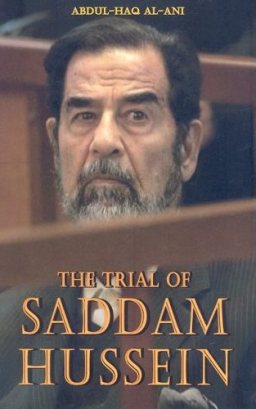
The Trial of Saddam Hussein
Abdul Haq Al-Ani,
Clarity Press, Atlanta, GA., 2008
Abdul-Haq Al-Ani’s troubling manifesto on behalf of the murdered Iraqi leader exposes bloody doings of empire from a lucid political-juridical perspective. ‘Imperialism is a universal historical phenomenon, but it remains, nevertheless, evil’, he writes (p. 23). ‘I use the term European [imperialism] loosely to describe the last five centuries of conquest, destruction, ethnic cleansing and exploitation of the Americas, Australia, Asia and Africa by different European navies and armies.’
Most authors play the role of objective observer. This could never be an option for Abdul-Haq Al-Ani. He briefly served as legal advisor to the daughter of Saddam Hussein; and coordinated on her behalf an international defense team. Given the controversial nature of this relationship, it is useful to review how the author evolved to take part in the Iraqi leader’s defense against charges of genocide.
Author as participant
Al-Ani attended American-run Jesuit College in Baghdad, graduating in 1961. While most became ‘Americaphiles’, a few graduates of the Jesuit College, including Al-Ani, dedicated themselves to revolutionary nationalism. A military tribunal acquitted 14-year-old Al-Ani of possessing seditious Ba’athist material. He later joined the Ba’athist party, but left after it broke into warring factions, each open to compromise with imperialism or Arab reaction.
With a degree in microwave communication, Al-Ani found employment at Baghdad University in 1973. He fell victim a year later to a Ba’athist dictat that barred professors married to foreigners. After refusing to spy on foreign companies operating in Iraq, Al-Ani voyaged in 1980 with his young family to Finland. Though strongly opposed to the Ba’athists, Al-Ani wondered how any Iraqi in the 1980s and 1990s could favour toppling Saddam Hussein’s government under conditions of imperialist threat. Rooting out the thirty-year Ba’athist authority, he believed, could only end in chaos and destruction.
Iraq’s slow strangulation under United Nations sanctions following the Gulf War prompted Al-Ani to study law; he was called to the English bar in 1996. Meanwhile his short-lived publication The Arab Review, which dealt with culture and politics in the Arab world, found favour in Baghdad and sympathetic authorities returned his passport. The author visited Iraq in 1999, returning to live there a year later. After becoming embroiled over a financial matter with the corrupt Iraqi justice system he left Iraq for good in 2002.
During the sanctions decade, Iraq’s rulers apparently believed world opinion would come to the country’s rescue. This dream evaporated following arrival of George W. Bush and the terrorist attacks on New York and Washington on September 11, 2001.
While living in Iraq, Al-Ani noted widespread apathy and depression among key Ba’athist leaders. Saddam Hussein himself had long since retreated into writing novels. Well aware of weakness and despair in the Iraqi leadership, Western military and intelligence agencies prepared for invasion.
When Saddam Hussein’s daughter Raghad Hussein requested his assistance in 2004, Al-Ani consulted an international team of lawyers that found the Iraqi Special Tribunal set up by Paul Bremer to try Saddam Hussein had no jurisdiction. The UK legal team coordinated by Al-Ani argued for boycott of a nonsensical American show-trial single-mindedly aimed at convicting and executing the President of Iraq. Meanwhile, US lawyers Ramsay Clark and Curtis Doebbler decided to contest the case along with a few Arab and Iraqi lawyers, thereby lending the process a halo of legitimacy. While assembling the UK team Al-Ani discovered that most Western lawyers were reluctant to be seen defending a person whom the US had effectively demonized over two decades. Moreover, those who provisionally agreed to defend the President of Iraq for a hefty fee withdrew when they discovered that the supposedly wealthy Saddam Hussein had no financial resources.
World-historical figure
As leader of the Ba’athist party Saddam Hussein occupied a momentous position in the modern history of the Middle East. Arab scholar Zaki Al-Alsouzi (1899-1968) first wrote about ‘Ba’ath Arabi’, the resurrection of the Arab nation, and the fight to overturn colonialism. By the mid-1950s Ba’athists formed a pan-Arabic nationalist alternative to Arab communists and poorly educated Islamist clerics. In a sense, Ba’athist politics embodied the universal spirit of Baghdad revered by Sunni and Shi’a alike, who located their greatest religious shrines in the city. ‘Assume for a moment that across the road from the Vatican is the shrine of Martin Luther, and then you can imagine what Baghdad means for both Shi’a and Sunni Muslims.’ US/UK invaders deviously encouraged fear among both sects that the other would seek hegemony, inspiring ‘polarization and bloody strife’ (p. 35).
Saddam Hussein joined a failed Ba’athist conspiracy in 1959 to assassinate President Quasim, who had gained power the year before in a nationalist coup that killed the Iraqi royal family and the prime minister. Quasim himself was ousted in 1963. In 1968 another coup brought Saddam Hussein’s faction of the Ba’athist party into power. The leaders took advantage of CIA help, but Al-Ani argues that they remained independent of US influence. The new administration created, on the basis of nationalised oil revenues, a semi-industrialised authoritarian state with strong social benefits unknown elsewhere in the Middle East.
In 1979 Saddam Hussein thrust himself into power. His most fatal error, claims Al-Ani, was the trial for treason that same year, of dozens of members of the Ba’athist party, with 22 ultimately executed. After the party massacre, ‘no one dared to question anything. This meant that the regime of Saddam Hussein acquired infallibility through fear and silence.’ (p. 50)
War with Iran was Saddam Hussein’s second mistake. Egged on by the West, both sides prodigiously expended blood and treasure. Peace in 1988 was closely followed by widespread circulation of one of those strange books that mysteriously transform the global political atmosphere. Written under a pseudonym by an Iraqi architect who had spent much of his life outside the country, The Republic of Fear parlayed information known only to top Ba’-athist ‘Party members and foreign intelligence services’, kicking off a demonization of Saddam that would only end with his execution almost twenty years later. ‘Ayad Allawi [Interim Prime Minister of Iraq between 2004-2005] told me when we discussed the book that it was done by the CIA.’ (p. 56).
Saddam Hussein’s 1990 incursion into Kuwait, carved out early in the century by European colonialism to deny Iraq a seacoast, was his most fatal tactical error. In contrast to the lame international response when Israel invaded Lebanon in 1982, a blizzard of Security Council Resolutions under article seven of the United Nations condemned an errant Iraq. For some reason, Saddam Hussein kept his troops in Kuwait while the US gathered its resources for a massive blow. ‘When Ahtisaari, the UN Assistant Secretary General visited Iraq in 1991, he said that the semi-industrialized Iraq had been bombed into the Stone Age.’ (p. 58).
The US/UK invasion of Iraq followed a cruel international blockade that brought consequences rivaling atrocities from the Middle Ages. ‘Iraq was not destroyed in March 2003, but during the 12 years of blockade which any student of law would easily identify as falling within the ambit of genocide, war crimes and crimes against humanity as defined in the statute of the I[nternational] C[riminal] C[ourt] and incorporated in the UK in the International Criminal Court Act of 2001.’ (p. 59)
Whether Saddam Hussein was ‘worse than Hitler’, to quote George Bush Sr’s memorable 1990 tub-thumper, he was certainly a flawed, authoritarian leader who made incalculable errors. But he also stood as a central figure in the recent history of the strategic Fertile Crescent. ‘[A]s far as Iraq was concerned, he alone had all the secrets. When he was gone, history would be freely rewritten by the victors and not necessarily by the facts, which would be buried with him.’ (p. 25)
Genocide Court as Ninth Circle of Hell
Noble words have rarely been employed to serve such a perverse result as in the dusty courtroom where Saddam Hussein confronted his Lilliputian accusers. For an idea of the flavor of this post-modern show-trial, it may be enough to record the first movement of Al-Ani’s bitter account of legalist travesty in the service of imperialism. President Clinton’s administration had already sealed the fate of Saddam Hussein’s Iraq in October 1998 with an obscure statute called The Iraqi Liberation Act. Against the letter and spirit of the United Nations Charter, this legislation called for abrupt, arbitrary removal of the leader of a sovereign nation – i.e. in the now standard argot, ‘regime change’. The Iraqi Liberation Act relied for its raison d’etre on a background analysis suitable for a comic strip. It mentions a horrific gas attack on a Kurdish village (allegedly perpetrated by Saddam Hussein’s Iraq) but does not situate the tragedy in the context of a horrendous Iran-Iraq war in which the US supported Saddam Hussein and embattled Kurdish border settlements were victims of murderous action from both sides. (1) Even clownish US-directed prosecutors ‘ensured that this was not the issue over which [Saddam] would be tried’ (p. 68). Instead, the American star chamber focused on a 1984 Iraqi legal action against 148 individuals – who, during the Iran-Iraq conflict, allegedly tried to kill the president of Iraq near the town of Dujail – as a ‘crime against humanity’. No one knows how many conspirators were eventually condemned to die as a result of the trial apparently ordered by Saddam Hussein, but it was far less than 148 persons; and far less than the civilian death toll of any number of US aerial bombings in Iraq or Afghanistan since 2001.
Three years after passage of The Iraqi Liberation Act, the US convened The Future of Iraq Project. With $5 million in funding, this was an exceptionally glowing occasion of bureaucratic largesse. Indeed, five initial Working Groups each received almost 250,000 pounds sterling for three months work. In total, seventeen Working Groups pondered Saddam Hussein’s over-throw in scholarly detail during thirty-three meetings between October 2002 and April 2003. The Brookings Institute and other American NGOs were notable contributors. Among distinguished agencies offering weighty opinions on the tangled subject of Iraqi transition was CARE USA. ‘The corruption of CARE USA may have been the cause of the attack on CARE in Iraq, which led to the unfortunate death of its Iraq branch director, Margaret Hasan.’ (p. 74) In line with their obsequious imperialist record, observes Al-Ani, Human Rights Watch and Amnesty International were prominent contributors to the Future of Iraq Project. Saddam Hussein, of course, would have no future according to the vision of the seventeen Working Groups, whose primary aim was the overturning of the Ba’athist order, the last dream of Arab unity.
Perhaps the most convincing cinematic portrayal of the political show-trial is Costa Gavras’s ‘The Confession’, based on the 1951 Slánsky Trial, in which high-ranking Czechoslovakian communists appear before puppet judges manipulated by the USSR. One notable scene features a putative traitor embarrassedly losing his trousers on the way from the dock, sparking hilarity among jurists and trial spectators. In a similar vein, US military television crews recorded capture of the bewildered Saddam Hussein, supposedly found in a hole in the ground in mid-December 2003. The Iraqi president complained during the trial that he was humiliated by a requirement to change into different clothing several times a day. His macabre December 2006 execution by Iraq’s Shi’ite puppet government on the very day of the worldwide Sunni religious holiday Eid-ul-Hadha (Feast of Sacrifice) was deliberately plotted by US occupiers to enrage Sunnis against Shi’ites in Iraq and throughout the Middle East.
Dressed up by the imperialist press as yet another instance of Middle Eastern injustice,(2) a few of the more heinous aspects of Saddam Hussein’s farcical trial, including murders of defense attorneys, intimidation of jurists, and the unseemly rush to execution, have come to light. But for the real story of the ‘criminal behavior of the United States, its foreign lobbyists and its partisans in this historic trial’, (p. 357) knowledgeable readers will always turn to Al-Ani’s immensely sobering exposé.
David MacGregor is Professor of Sociology at King’s University College at the University of Western Ontario.
Notes
- The most authoritative investigation (2001) into responsibility for the massacre, by Dr Jean Pascal Zanders at the Stockholm International Peace Research Institute (SIPRI), concluded that Iraq was the culprit.
- See for example The New York Times headline of 25 September 2008: ‘Western Lawyers Say Iraq Discarded Due Process in Hussein Trial’.