
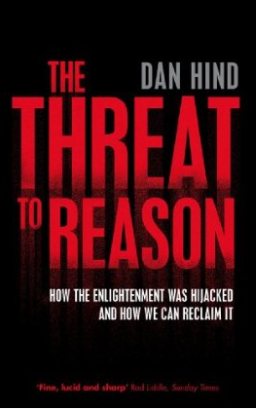
Dan Hind
London: Verso, 2007, h/b, £24.99
Hind’s ‘concern is to examine how ideas from the historical Enlightenment function in contemporary society.’(p. 6) His starting point is the aftermath of 9/11 and the outbreak of loose talk of there being a conflict between radical Islam and ‘the enlightenment’. (12) Some of this came from former members of the Left (Christopher Hitchens and John Lloyd spring to mind) who have become cheerleaders for American imperialism.
‘Politicians most often define the Enlightenment in terms of its opposition to forces of unreason, whether they be jihadis, fascists or homeopaths; this I shall refer to as the Folk Enlightenment, so called because the tune will be familiar to most readers, even if the lyrics change somewhat as the context demands.’ (p. 6)
The perceived threat to this Folk Enlightenment:
‘differs according to taste and local political calculations – the mainstream Left likes to fret about religious fundamentalism, the right tends to go after Post-modernism – but the basic structure is the same, Enlightenment is reason and a commitment to science: its enemies are irrational.’ (p. 27)
This Folk Enlightenment is impossible to take seriously because it is corrupted by, or becomes merely a front for, the forces of what Hind calls the Occult Enlightenment,(13) in which the state and capital seek to acquire knowledge and understanding of the world the better to manipulate and deceive us.
‘The enlightened defence of science as elaborated by the likes of [Frank] Furedi and [Dick] Taverne, and as accepted by much of the scientific establishment, has an inescapably paradoxical nature. The corporate threat to free inquiry is downplayed and obscured entirely and the always ambiguous and often downright fraudulent claims of corporations to be pro-science are endorsed by the self-styled champions of Enlightenment.’ (p. 97)
The military-industrial enlightenment, the Occult Enlightenment, ‘is a machine for absorbing information and radiating deception.’ (p. 104)
Against the Folk and Occult Enlightenment, Hind, after re-examining Kant’s original thought on the subject of enlightenment, offers his sort of updating of Kant, the Open Enlightenment. His vision of this includes:
‘an orderly investigation of the constitution of human reality, rather than confrontation between faith and reason………public research motivated by a disinterested commitment to truth provides an idealised model of the enlightened method……collective authorship and open review provide the means by which the work of individuals take on a wider significance, the mechanism by which individual Enlightenment fuels general progress………a programme of inquiry conducted outside the market will be superior to any possible commercial alternative, since it will not be forced to downplay or exaggerate certain features of that reality in order to protect established institutional interests.’ (pp. 138, 142-45)
This might once have described the idealised intellectual life of the mind, in universities for example, but Hind is thinking of the Net, the enormous amount of free data it offers, its ease of dissemination, free software, and Wikiesque endeavours.
His version of the Open Enlightenment obviously has something of Popper’s open society about it, but Popper was living in the world in which profs and ‘thinkers’ would sit and discuss Great Issues of the Day on Radio 3 and 4, armed with nothing more than broadsheet newspapers, a classical education and academic articles. They were not trying to deal with the massive amounts of knowledge and detail we now have; nor with the deafening, disinformative effects on society of the Occult Enlightenment. (14)
Hind is suggesting that a Net-based community of part-time ‘disinterested researchers’ will eventually form consensual pictures of the nature of reality, side-stepping the attempts by the Occult Enlightenment to co-opt it and – eventually – overcoming it:
‘Together we can challenge established, allegedly enlightened descriptions of the world and propose in their place openly generated, and openly reviewed descriptions of our own.’ (p. 144)
Hind isn’t sure that this is possible but thinks we have to try (and he points out that the endeavour offers solace for people – like himself – locked into careers within the Occult Establishment). There is one obvious stumbling-block. Most, maybe almost all of us, feel acute psychological discomfort faced by contradiction and conflict, and Hind’s suggested methods of enlightenment are going to generate lots of that. And how many ‘disinterested researchers’ are there? This is not going to replace the popular culture provided by the Occult Establishment for many people.
Hind’s pursuit of Open Enlightenment is a daunting task and he is suitably daunted. He notes on the last page:
‘Enlightenment is dangerous. As we begin the work of knowing the world without restraint we will be forced to address subjects that threaten vertigo.’
The last footnote on his last page refers to ‘Nerve-wracking subjects that cannot be ignored under conditions of Enlightenment include state and corporate mind-control programmes’; and he comments – the book’s final words – that ‘Serious inquiry into the world is likely to make most of us sound like foaming lunatics for considerable periods of time.’
Notes
- Hind has/had a blog on the book and its reception at <http://thethreattoreason.blogspot.com/2007_07_01_archive.html>
- Named after Francis Bacon who, while a great scientist and thinker, was also an enthusiastic servant of the secret arms of the state.
- This book appeared just before the stories of forces of the Occult Enlightenment trying to rewrite Wikipedia entries – the perfect illustration of the conflict between the Occult and Open Enlightenment.