
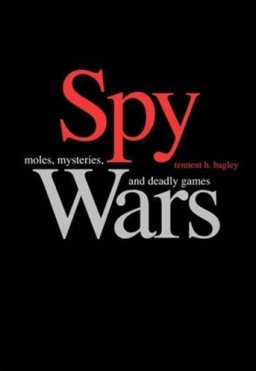
Spy Wars: Moles, mysteries and deadly games
Tennent H. Begley
London and New Haven: Yale University Press, 2007, h/b, £18.99
Begley was one of James Angleton’s allies in CIA counterintelligence and this book is the Angletonian view of the Nosenko case, one of the touchstones or causes célèbres of the CIA in the post-war era.
Briefly, Nosenko was a KGB officer who defected to the Americans just after JFK’s assassination, having been in contact with the CIA before it. All defectors were treated with suspicion because both sides of the Spy versus Spy game of the Cold War sent false defectors to the other side.
Having defected, Nosenko told his CIA hosts that, inter alia, he had been in charge of the Oswald file in the Soviet Union and that they, the KGB, hadn’t trusted him and had ignored him. Thus the Soviets had nothing to do with JFK’s death. This did not satisfy Angleton and his CI people who suspected that Nosenko had been sent to disinform them. Nosenko was given three years of sensory deprivation, bad diet, isolation and hostile interrogation to get him to confess to being a plant. He never did. Eventually the agency accepted his bona fides and he was rehabilitated. After Angleton was fired by DCIA William Colby in 1974, pro- and anti-Angleton sources within the Agency began briefing journalists. The pro-Angleton leaks led to the various books produced by the Angleton-influenced faction in the UK, notably those written by Chapman Pincher and Peter Wright, and oddities such as Edward Epstein’s Oswald-as-KGB Legend. The anti-Angleton leaks led to a number of books about Angleton – in this country Tom Mangold’s Cold Warrior – and accounts of the damaging effects of Angleton’s paranoia on the Agency’s attempts to understand the Soviet Union.(5) In this briefing war the anti-Angleton forces won and the consensus formed that Angleton was a nutter who did terrible damage to the CIA and, by extension, to allied intelligence agencies such as MI5 and MI6.(6)
This anti-Angleton consensus is challenged by his former ally Begley, who reanalyses the Nosenko affair and tries to show the reader that their – counterintelligence’s – view that Nosenko had been sent to disinform them and so conceal the identity of the KGB’s real mole inside the CIA, was correct. Potentially this is fascinating – who doesn’t like a good intelligence mystery? – but Begley’s account is so dense that I gave up trying to understand it before halfway. It would take weeks of full-time study to make sense of this; because in writing this account Begley has presented huge chunks of the CIA’s counter-intelligence files on the Nosenko case in all their unintelligible intricacy.
The main reasons that the CIA’s CI people didn’t believe Nosenko was the fact that two earlier Soviet defectors they had adopted, Goleniewski and Golitsyn, didn’t believe him. But Begley does not tell the reader (a) that Golitsyn was the major author of the KGB ‘monster plot’ believed by Angleton, which claimed that everything, up to and including the Sino-Soviet conflict and Gorbachev’s perestroika and glasnost, were KGB disinformation projects and (b) that Goleniewski claimed to be a Romanov and heir to the throne of Russia. Fantasists – or disinformers – such as these were not reliable sources, no matter how many Soviet operations they may have blown.
If you want to get a sense of what counterintelligence analysis looks like at its most convoluted, Bagley’s book is for you. For me, life is too short and the agenda too full to be bothered wrestling with it.
Notes
- For example David C. Martin’s 1980 Wilderness of Mirrors.
- This may not have been the real reason for his ouster. Angleton was also the liaison between the CIA and Israel and during the 1973 Arab-Israeli war, Nixon and Kissinger tried to ‘tilt’ American foreign policy away from its unconditional support for Israel. To do so in the longer term they may have felt it necessary to get another liaison with Israeli intelligence.