
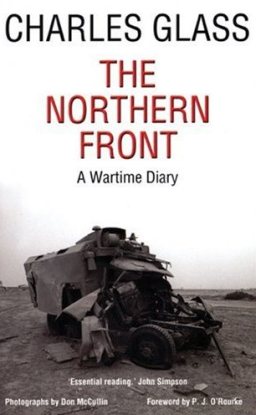
Charles Glass,
London: Saqi Books, 2006, £12.99, p/b
Early in his diary of ‘a war that never was’, the independent journalist and traveller, Charles Glass (b. 1951), writes of the late Edward Said: ‘he has tried, more than most, to penetrate the ram-parts that protect a well-fed public from seditious thought.’(1) It echoes a remark once made by his friend and influence, Noam Chomsky, that he attempted to provide people (at least those who ‘don’t matter’) with some kind of intellectual self-defence.
Charles Glass presumes no grand purpose or importance for his writing; you will occasionally find him quoted in the media on the ongoing Middle East crisis, but I doubt any foreign affairs committee has ever sought his knowledge and firsthand experience. Yet his articles, notably those in the London Review of Books, and those collected in the out-of-print Money for Old Rope, haven’t dated, however immediate and heretical they might have seemed when first published. They do not deal in profound social and political insights;they stand apart in their absence of polemic and personal abuse.
By his own account of 1990, he is not a columnist; he deals with facts, and with events that happen, with a simplicity that usually informs and interests. ‘I work alone,’ he has written. ‘My opinions revolve around an aversion to war, a love of liberty, and a belief that life should be better for the vast majority of mankind for whom it is unbearable.’ And on the subject of liberty, and the Iraq of his diary, he quotes approvingly T. E. Lawrence: ‘Freedom is taken, not given.’ Glass does not pontificate on the remark – he rarely does on anything.
What he does best in The Northern Front is to pay attention to, and record faithfully, the sentiments of those aspiring to power, and the victims of power, particularly the much betrayed Kurds, with whom he shows a great affinity. It is an evenhanded record. The nauseous horrors of Saddam’s rule are threaded through his account; and despite Glass’s scepticism of US motives and foreboding of the consequences of war, he finds space for the remark of a PUK leader – ‘war is cheaper than continuing with this regime.’
Travelling between London, Tehran, Erbil and Suleimaniya, October 2002 to April 2003, he awaits the inevitable US intervention in Iraq, with an invasion through Turkey, a country whose alliance Washington has always coveted, an invasion its population largely opposed.
And while columnists were framing lucrative moral positions in London, Glass was out there, along with the photographer, Don McCullin, as both had been during the Kurdish uprising of 1991.
Though this is not a diary to be dipped into, rather absorbed in long stretches, certain entries are worth high-lighting, evoking the response ‘exactly so’. From December 2002, Glass interviews Noam Chomsky, who later gives a talk at St. Paul’s Cathedral: ‘I’ve never heard him speak down to anyone’, he notes, not, presumably, expecting any reader to demur.
At the opposite end of the spectrum, Glass records his return to London with an observation that needs to be repeated:
‘The Labour apparatchiks swallowed whole the late Tory view that the public does not exist……. everyone is a customer; all services and professions are businesses.’
The public did seem to exist as protests against any intervention in Iraq increased, but it was ignored. Its spokespersons, accused by supporters of the invasion of belonging to a left that no longer welcomed the downfall of fascism, were predictably dismissed as anti-American.
Subsequently, in July 2007, Charles Glass wrote in The Nation about what he knew well in those heady days during which he composed his diary:
‘Washington’s ideologically charged neo-conservative coterie possessed little or no understanding of the Middle East, allowing it to dismiss the easily predictable consequences of invading and occupying Iraq.’
A defensible charge, to go with the authentic voice of the reporter who has given up much to provide an antidote to the weekly diet served up by many columnists ‘to a well-fed public’.
Notes
- Glass’s interviews with Said are available on an ICA dvd. His website is <www.charlesglass.net>