
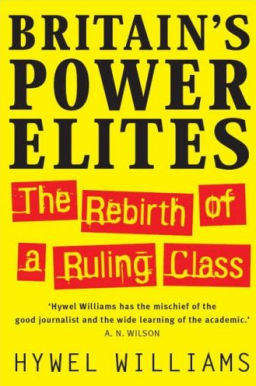
Hywel Williams
London: Constable, 2006, 274pp, £12.99, p/b
In the USA, every decade or so an acclaimed book is published, posing the big questions: ‘What Went Wrong with America?’ and ‘Where Are We Going?’ Fifty years ago at the height of the Cold War, C. Wright Mills contributed his masterpiece, The Power Elite, that documented the emergence of what would come to be called the ‘Military-Industrial Complex’, and inspired a whole generation of power structure investigators in the sixties and seventies. ([6]) This genre of publishing hardly exists in Britain, although Anthony Sampson has been updating his classic Anatomy of Britain series regularly ever since 1962.([7]) Maybe the British think it is narcissistic to keep examining our collective myths; but we certainly have them in spades, and they mystify things just as much as American Dreams. Hywel Williams has attempted to penetrate these illusions and produce a vivid and detailed picture of the grotesque concentration of power and wealth in this country today, as well as a blistering critique of the myths – and the culture of corruption, secrecy and complacency – that keep the show on the road.
Williams is a writer of some academic distinction. If you haven’t heard of him before (nor had I, apart from some interesting essays on historically erudite topics in The Times Literary Supplement or The Guardian), this is because the elites he is writing about have frozen him out from the public sphere, in their inimitable manner – not ‘sound’ (not ‘one of us’). One reviewer even called the book ‘Marxoid’!
In his introduction, he pays generous tribute to Mills and his own book invites comparison with the work of the great Texan maverick. It doesn’t do too badly in my view. It is a first rate polemic aimed at the rulers (and beneficiaries) of what passes for the UK national state – a wholesale denunciation of an entire political culture. But, for many people, it is bound to be irritating to read. To be honest, I got pretty irritated myself: the author’s florid rhetoric can seem over-eloquent and pompous. But this is a great pity, because what he has to say is incontestably important. The value of the book is in its sheer detail: he names the names of the respectable fraudsters and charlatans who have plundered the economy and debauched society. (His style is infectious.)
The book is organised, conventionally, into separate chapters dealing respectively with the ‘political’ elites, the ‘professional’ elites and, finally, the ‘financial and business’ elites. But the idea that reality can be so neatly arranged into such ‘institutional’ sectors is undermined by the very story he is telling. He points out, for example, that the professional elites (such as academics and lawyers) are thoroughly permeated by the commercial ethos. The City of London ‘now absorbs and directs the aims of all the other power elites and thereby makes those elites subordinate to its own interests’ (p.215). He documents this, drawing on, among others, the late Paul Foot’s research on the Private Finance Iniative (PFI), and there is a mine of information in his footnotes.
The central thesis of the book is the assertion that a ‘coup’ took place in this country whereby the business and financial elites have captured all the levers of power. It is a picture that he presents in some detail, and with consequences (what he calls social ‘degradation’) that to me seem all too convincing. The problem is he doesn’t give precise dates for this supposed event. One is left to suppose that it all revolves around the ‘rise of Thatcher’ – a formula he rightly refuses. The historical perspective he brings to bear down-plays the decisive significance of the 1980s. It all looks, in retrospect, as if it were foreshadowed by the very form that capitalism took in Britain from the seventeenth century, with money in the driving seat from the beginning.
Neither does he really substantiate the claim implied by his subtitle ‘Rebirth of a Ruling Class’ because he doesn’t seem to acknowledge that the concepts of ‘ruling class’ and ‘power elite’ belong (as academic theorists would say today) to different ‘discourses’. Classes and elites, in other words, are different ways of thinking about society. This, after all, was the very reason for Mills’ invention of the phrase ‘power elite’: social classes don’t themselves do the ‘ruling’. This is why it’s important to focus empirically on the mechanics of power.
He is absolutely correct in my view to highlight the ‘offshore’ nature of the capitalist class in these islands, how it gets its wealth from the rest of the world, without contributing anything to the rest of society, and how it uses government for its own ends. But to explain this very disconnection of the UK state from the interests of its own country surely requires a more global analysis of capitalism, and in particular a more specific examination of its subjection to the USA. Williams knows this well enough, and everything he says points in this direction.
The true meaning of ‘national security’, he demonstrates, has always been the protection of ‘institutions’ (above all, in effect, the defence of capitalist property relations) rather than protection of the population. While Williams contributes no specific parapolitical information, I think this book does give us part of the ‘bigger picture’ as well as abundant detail about the individuals at the centre of economic power. I recommend this book unreservedly. Just stomach the style.
Notes
6 The Power Elite (NY: Oxford University Press, 1956). This book is still in print.
7 Sampson, The Anatomy of Britain (NY: Harper & Row, 1962), The New Anatomy of Britain (London: Hodder & Stoughton, 1971), The Changing Anatomy of Britain (London: Hodder & Stoughton, 1982). The latest is Who Runs this Place? (London: John Murray, 2004). Williams is the better read.