
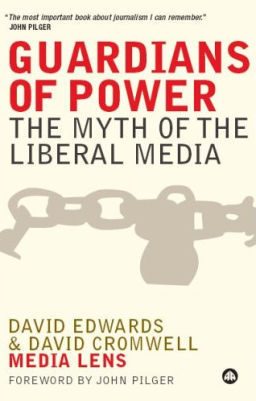
David Edwards and David Cromwell
London: Pluto Press, 2006, £14.99
Since 2001 the two authors have run the website MediaLens, with its watching brief on the British mass media, putting out media alerts which encourage readers to contact the media to take issue with what they perceive to be inaccuracies, distortions and omissions, in particular related to political and environmental matters. They take their inspiration from media analysts such as Noam Chomsky and Edward Herman and campaigning journalists such as John Pilger.
Their main, but not exclusive, focus is on the liberal newspapers, such as The Guardian and The Independent and the BBC. This is because the papers are allegedly writing from a viewpoint that is in some way critical of the powers that be, and the latter because it aspires to be accurate and a public service broadcaster, not beholden to commercial pressures.
The book is structured around several key episodes in modern history: the second Gulf War and the build-up to it; NATO intervention in Kosovo and Serbia; US involvement in Haiti; the western invasion of Afghanistan; the Indonesian invasion and repression in East Timor and the West’s lack of critical response to it; coupled with global warming – or ‘climate change’ as it’s called to downplay the seriousness of the situation. These case studies say pretty much what anyone who has followed the stories would expect: the interests of the domestic state and capital are taken to be paramount, mainstream criticism is muted and, generally, the role of the mass media in relaying what government and big business want their readers and viewers to see and hear is clearly outlined.
Now the two Davids aren’t just interested in documenting the failures of the media. They take an active role in complaining to the media and encourage others to do the same. In itself, this seems a laudable and productive line to take, based on the assumption that the media really do care about what people say about them and are sufficiently concerned to respond to reasoned criticism. However, the responses from the journalists and media executives they contact over the media’s coverage of the stories reveal that being on the receiving end of an avalanche of e-mails isn’t what journalists care about. They soon get tired of receiving them and shut down communication, not least because they earn their money researching and presenting news stories, not answering the feedback from consumers. Hardly surprising then that The Guardian and The Observer take every opportunity to snipe and sneer at MediaLens and people like Noam Chomsky. In the mass media, people who frequently contact them to complain inevitably become labelled as ‘nutters’ and what they say gets ignored.
So what starts as (and which in most cases is) a reasoned attempt to rectify the errors of the mass media, ends up reinforcing the stereotypes that media people have of ‘outsiders’ which leads to them ignoring valid criticisms.
Without seeming too fundamentalist, it appears that only the total transformation of society, of which the restructuring and redefinition of the mass media (not to mention the change of ownership into a more collective form) would be part, will end the problems about which the authors rightly complain. (One winces somewhat at their Buddhist-inspired caring strategy at the end of the book as being hopelessly naïve.)
The book is adequately written for the task it sets itself and there’s nothing necessarily wrong about the information they present or the way they do it; but it does rather reek of a sort of self-righteousness that will be offputting to some readers. As for letting the general public know about the failings of the mass media, the irony here is that the very people who would most benefit from reading the book are unlikely ever to hear about it or be inclined to read it if they did, whereas those most aware of the subject are unlikely to find much here that they weren’t already aware of.
Recommended for those blissfully unaware of the nature of the mass media in Britain and elsewhere.