
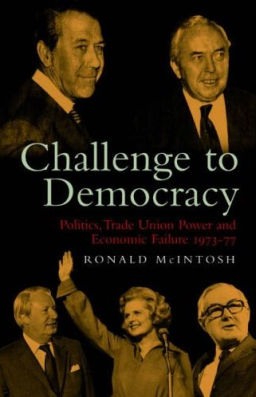
Ronald McIntosh
London: Politico’s, 2006
Some of us on the wrong side of 40 will have experienced a certain sinking feeling on our first encounter with this book, not least because of the misleading subtitle: ‘Politics, trade union power and economic failure in the 1970s’. All the signs suggest a reworking of the sort of publication popular during the decade in question, the sort that placed ‘democracy’ in one corner, the trade unions (sorry, ‘union power’) in the other and suggested the latter was an enormous threat to the survival of the former. The spirits lift, however, once one reads beyond the front cover.
McIntosh is a former Whitehall official who served as director general of the National Economic Development Council (Neddy) from 1973 to 1977. This is a diary of those years. As befitted a boss of this quintessentially consensus-minded institution, McIntosh was a firm believer in getting the unions (and everyone else) round a piece of furniture that, during the crisis years of the 1970s, acquired semi-mystical status: ‘the table’. Neddy was a key custodian of ‘the table’, acting as a place where all sides could meet on neutral ground. When he refers to a ‘challenge to democracy’, it is economic failure to which he refers, not organised labour.
An eminently fair-minded man he may be, but has he produced an interesting book? Yes he has, both in the story that he is aware that he is telling and, perhaps more importantly, for the extraordinary sidelights that, consciously or not, he sheds on official and semi-official goings-on during the Fright Decade. For anyone who thought the story of those years had lost its power to shock, some of McIntosh’s entries would make sobering reading:
On November 29 1973 (p.5), McIntosh has lunch at the Pearson group, one of whose directors, Rupert Brooke ‘foresaw a right-wing regime, with tanks in the streets’.
On December 19 1974, (p.184) Sir Alan Neale, permanent secretary at the Ministry of Agriculture, ‘said he thought we might be in a siege economy by midsummer – if the currency collapsed we couldn’t take it for granted that the Canadians would still be willing to sell wheat to us.’
On July 4 1977, he attends a conference at the Festival Hall on the future of the capital (p.356). ‘London is evidently losing population quite heavily, services are steadily deteriorating and nobody seems to have the least idea of how to deal with it.’
On October 6 1976 (p.301) he declares: ‘we are really in a wartime situation now.’
On March 15 1975 (p.197): ‘The two main headlines in The Times this morning are: “Militant consultants threaten to close NHS hospitals” and “Troops to move into Glasgow tomorrow”. This really does look like a collapsing society.’
Not that there is nothing to lighten the gloom. Roy (later Lord) Jenkins pops up from time to time ‘a friend of the author’. It is possible that his presence is meant to suggest a civilised alternative to the chaos of the time, but the effect can be unintentionally comic: ‘Roy wants a coalition government and expects to see one in the first half of this year….Roy said he wouldn’t mind whether Wilson or Callaghan led the new government but made it clear he would expect to succeed whichever of them took it on.’ (January 1 1975, p.184) When McIntosh warns Jenkins that a split in the Labour Party would drive even social democratic union leaders into the arms of the left ‘[Roy] said it was a risk he was very conscious of; but I don’t think that, in his heart of hearts, he cares – or knows – much about the trade union movement.’ (June 30 1974, p.120) (no kidding?). ‘[Roy] said he had decided that if he couldn’t be Prime Minister he would like to be Foreign Secretary and was therefore a bit put out when Callaghan didn’t offer it to him. He was, however, happy to become president of the European Commission’ (April 14 1976, p.272).
Neddy itself may have been handicapped in its efforts to bring together all the actors in the economy by the fact that all bar two of the chairmen of the ‘little Neddys’ the specialist industry-specific committees, were from the management side. Hilariously, McIntosh noted: ‘The exceptions are a duke and a professor’ (March 21 1974, p.98). So much for the trade union ‘dictators’.
In the entry for November 21 1974 (p.175) we learn from Toby Aldington, a close friend of Edward Heath, that the former Tory Prime Minister ‘would be quite willing to serve under Callaghan – or for that matter Wilson – in a truly national government.’ The mind boggles!
But aside from the picture of crisis enlivened by occasional light relief are the stories that McIntosh seems to be telling almost by accident. And they are fascinating.
On January 25 1974 (p.63), Kenneth Adams, director of studies at the Royal family’s own think-tank (St George’s House at Windsor Castle) ‘said he could see no way out of the current situation except a change of leadership in the Conservative Party.’ Were the Royals, or some of them, showing Heath the door?
On March 22 1974 (p.98), we learn that the Department of Trade and Industry was dismembered after Labour’s return to power that month because Harold Wilson ‘did not want anyone – and especially Tony Benn – to have such a strong power base as the old DTI could provide.’ Thus was our industrial strategy, or lack of it, decided.
On September 12 1974 (p.143), Treasury permanent secretary Sir Douglas Wass tells McIntosh that ‘he doesn’t think the social contract will achieve anything at all.’ This was the social-partnership policy on which Labour had just been elected, thus it is not hard to see why some in the party suspected the Treasury’s ideological leanings.
And, indeed, those of the Bank of England; on April 21 1975, McIntosh is chatting to Bank Governor Gordon Richardson: ‘He said Harold Wilson had no will to put things right and that he had told outright lies to industry about the content of the Industry Bill [an interventionist measure].’
But perhaps the most significant event in the book was an economic summit meeting held at Chequers, the Prime Minister’s official country residence in the autumn of 1975. Here is McIntosh’s verdict on November 5 1975 (p.239): ‘On balance the mood was very constructive. There was an encouraging sense of urgency and everyone was agreed on the need to give manufacturing industry higher priority even at the expense of social objectives.‘ (my italics)
Given that the ‘everyone’ present included not only the Treasury and the Confederation of British Industry but also trade union leaders such as transport union leader Jack Jones, the remarkable nature of this pow-wow becomes apparent. In the atmosphere of crisis, an about-turn in the direction of policy was agreed with little in the way of public debate or internal dissent. Business and profits were the priority; ‘social objectives’ were not.
Interesting as a read in its own right, this book is positively intriguing when seen as a compendium of clues, hints and leads for further inquiry.