
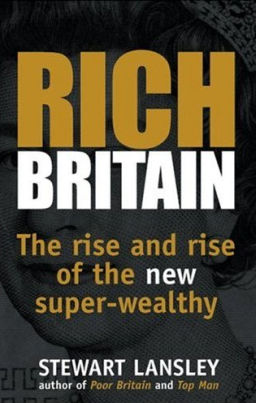
Stewart Lansley
London: Politico’s, 2006, £18.99
The sight of the Rolling Stones arriving in China to perform a government-approved selection of songs coincided with my reading a chapter of Stewart Lansley’s fine new book entitled ‘Only little people pay taxes’. He recounts Bianca Jagger’s 1979 divorce revelation that her former husband was obsessed with avoiding paying taxes. ‘Throughout our married life, he and I literally lived out of a suitcase in a nomadic journey from one place to another in his quest to avoid income taxes,’ she said of the man who went on to become a member of the MCC and, since 2003, a knight of the realm.
Sir Mick is far from alone in receiving Establishment recognition while doing his best not to pay the taxes little people – that’s most of us – can’t avoid. Lansley lists many of them and details the lengths they will go to not to cough up their democratic dues. He shows the old money of the landed aristocracy is still very much part of this picture as is the more recently accumulated wealth of those whose company Tony Blair seems to enjoy. Indeed part of Lansley’s indignation at the growing inequality in Britain is directed at New Labour’s support and encouragement for it – and this book was written before the revelations about the Tessa Jowell/David Mills household finances. Off-shore fund arrangements and other accountancy devices seem common in the upper reaches of the Blair court, one in which commercial lawyers figure prominently.
Lansley distinguishes between the ‘deserving’ and ‘undeserving’ rich, and shows how many in the latter category figure in the growing redistribution towards the super rich. Many in the City, the executives of privatised industries and utilities, foreign billionaires and ‘stars’ in the world of celebrity infotainment he says are not creators of wealth in any normal sense of that term, and have largely exploited their powerful positions at the expense of employees and shareholders as well as the Revenue.
As a BBC journalist Lansley knows from experience how much of the corporation’s licence fee for programme making is diverted into the pockets of a handful of big-name presenters, and he sees little organised political opposition to this encouragement/ admiration of super-enrichment.
‘The limit of the moderate left’s ambition today is to improve the lot of the poorest,’ he says. ‘In 2004, Britain still had a level of relative poverty that was higher than in the late 1970s and higher than in most developed countries – only Ireland, Greece, Italy and the United States had higher rates. What progress has been made has been achieved is the redistribution from middle rather than rich Britain. While those on lower incomes have got richer, so have the rich themselves and at a faster rate than the poor. Hence the rising wealth and income gap between the very top and the bottom.’
He goes on:
‘Britain is in danger of falling into the trap that has ensnared the United States, a country that has little social mobility but pretends that it has.’
Is there a chance of this changing?
‘The rising concentration of wealth at the top has been driven by government policy, from tax cuts to deregulation. There is no reason why that predominant ethos should not be challenged and reversed. Whether it happens is ultimately a matter of choice.’