
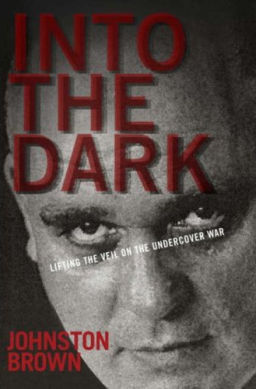
Into the Dark
Johnston Brown
Dublin: Gill and Macmillan, 2006, £22.99, h/b
When Fred Holroyd first made his disclosures regarding the activities of SAS Captain Robert Nairac to Duncan Campbell of The New Statesman in 1984, they were credible because Holroyd was a loyal Army Intelligence Captain with absolutely no sympathies for IRA terrorism. (1) Despite efforts on the part of Martin Dillon in The Dirty War (Hutchinson, 1989) to smear Holroyd as an embittered ex-soldier motivated purely by vengeance, Holroyd’s claims have also been vindicated. (2) Not only did Nairac execute the IRA terrorist John Francis Green, in Monahan, during the phoney IRA ceasefire of January 1975, (3)he orchestrated the Miami Showband massacre in the July of that year. Worse still, there is evidence linking Nairac’s team of UVF renegades back to the Dublin and Monaghan bombings of 1974. (4) This point was again made by Holroyd himself, in evidence given to the Barron Inquiry in Dublin in 2003. At its simplest, and to paraphrase what Irish Labour Leader Pat Rabbitte recently said about Jonty [Johnston] Brown’s disclosures, in the Irish Dail in October 2005: when credible allegations as serious as this are made, they have to be the subject of independent investigation, irrespective of how they might be used as propaganda.
What makes Jonty Brown’s book convincing is the fact that, like Fred Holroyd, he does not condemn the RUC (the Police Service of Northern Ireland [PSNI] in its previous incarnation) wholesale. Indeed, after 30 years as an RUC detective in Belfast he says that ‘90% of Special Branch [including most of the RUC he served with] were good, honest, law abiding men.’ If this is a man with an axe to grind, then its being ground from a perspective of balance and proportion, as well as integrity – and no small amount of guts, given that he still lives in Belfast. I was further impressed by the fact that Brown was one of the detectives, working undercover, who first won the confidence of Johnnie Adair, (head of UFF C Company, the Lower Shankill), got him to boast of his crimes while being secretly taped, then secured his conviction in 1993 on charges of directing terrorism. At its simplest, if I thought that Jonty Brown was a Shinner, (5) I wouldn’t be writing this review.
The core of Jonty Brown’s allegations are not entirely new, as he alludes to the establishment of an ‘inner force’ in the RUC around about 1973, under the auspices of one Jack Morton, an MI5 officer who had worked with the colonial authorities in Malaya. This ‘inner force’ was discussed in a Channel 4 Dispatches documentary in 1991. This in turn, led to the unprecedented use of the Prevention of Terrorism Act against the makers of the programme. (6) Like Dispatches, Jonty Brown links the ‘inner force’ to the execution of Pat Finucane, a lawyer and IRA sympathiser who exclusively defended Republicans, after Finucane secured the acquittal of an IRA murderer who killed two British soldiers at a funeral.
Unlike the Dispatches programme, which was taken in by Billy Wright’s fantasies that he was a key assassin of Republicans (rather than a squalid sectarian murderer on his own turf), Jonty Brown claims that, using the same methods he used to entrap Adair, as early as 1991 he had secured on tape, a confession by Ken Barrett that he killed Finucane. (7) That Barrett killed Finucane has been common knowledge only since a BBC Panorama programme in 2001. In contrast to Adair however, Jonty Brown claims that his efforts to secure a conviction against Barrett were blocked and that he was targeted by Loyalists working in collusion with the RUC Special Branch ‘inner force’, causing him to resign from the police in the mid 1990s. He does add, however, that he was tipped off about this by one of his own UVF informants, who also said that few UVF or UDA would have the stomach to kill an RUC man. (8)
Most of Jonty Brown’s allegations concern collusion between the RUC Special Branch and UVF, rather than the UDA; and this is significant. His turf was North Belfast, where the UVF were represented by the notorious figure of Johnnie Bingham until 1986, and where Brown was once beaten up by some of his RUC Special Branch colleagues for trying to arrest a UVF man in the 1970s. He also links the UVF specifically to the murder of 23 year-old Sharon McKenna, in 1993 and implicates Mark Haddock, a UVF Commander who was also a Special Branch agent, in this killing. Haddock is currently on remand for charges arising from paramilitary activity and his unit is believed to have killed around a dozen people in North Belfast during this period. The claims are being investigated by the Police Ombudsman and have led Pat Rabbitte, in the Dail in Dublin, to call for a public inquiry.
Things get complicated however, when one recalls that during this period, in the early 1990s, the UVF were the driving force in the establishment of the Combined Loyalist Military Command, whose objective was to professionalise the assassination of IRA members and close down indiscriminate sectarian murder. Significantly, people like Billy Wright, Alex Kerr and Johnnie ‘daft dog’ Adair denounced these as ‘the peace people’ and wanted to step up indiscriminate sectarian murder to expose IRA claims that they could ‘defend’ the Catholic community as the fiction that it was. (9) Given their links to British fascism at the time they may also have had an interest in ethnic cleansing. (10)The inference here is that the RUC ‘inner force’ at least opposed the campaign of indiscriminate sectarian murder. (11)This conflict may have been amplified with the rise of T-Branch, as against F-Branch, in the MI5 firmament post the Cold War, and with the Chinook crash on the Mull of Kintyre, which wiped out some of the best people both in the RUC Special Branch and F-Branch. (12) It also raises important questions about the Pat Finucane assassination, in relation to which Jonty Brown claims he personally incurred the wrath of the RUC ‘inner force’.
What was significant about Brian Nelson, the former Black Watch soldier who was persuaded by MI5 to become a UDA intelligence officer, is that he wasn’t actually a sectarian. This was borne out both in the Panorama program in 2002 and also in a conversation I once had with Brian Nelson’s sister. Nelson was most upset when defective intelligence he passed to the UFF led to the murder of a Catholic civilian and this may have convinced his MI5 handlers (operating through the Force Research Unit [FRU] at this point) that he was unreliable. He was also persuaded to finger Pat Finucane only when he saw the infamous photo in which Finucane, flanked by the IRA murderer of two British soldiers, smiled triumphantly at getting said murderer off on a technicality
It is widely believed in Belfast that Nelson was actually burned by MI5’s T-Branch because they opposed the strategy based on the RUC ‘inner force’ and CLMC that is exposed in Jonty Brown’s book.Thanks to the Stalker and Stephens Inquiries, most of the UDA leadership, including Tommy Lyttle, who was an RUC informant committed to preventing sectarian murders after all, had been imprisoned. (13) The vacuum created enabled the rise to prominence of such dangerous individuals as Johnnie Adair, committed to indiscriminate sectarian murder. Had the likes of Andy Tyrie still been in charge, Adair could not have seized control of C Company, nor unite the North and West Belfast Brigades against Gary McMichael, nor form links with Billy Wright’s UVF renegades, who became the LVF. (14)
Secret state agendas
Jonty Brown’s book raises general questions about collusion and also about the agendas of the secret state. In 1981 an American criminologist called Klockars wrote an important book called The Dirty Harry Problem, in which he argued that police vigilantism in general arises when the police are not provided with adequate powers to do their job. (15) This, I think, is true, and was particularly true in Northern Ireland, where the security forces faced ridiculous constraint under the ‘yellow card’ principle of commitment to minimum force. (16) At its simplest, as McDonald and Cusack tell us, (17) had the security forces been given adequate powers to defeat the IRA as the unlawful combatants that they are, then there would be no Loyalist paramilitary groups at all. Indeed, from an RUC standpoint, given that 300 RUC officers were murdered by the IRA, what is surprising is that there wasn’t more collusion.
The popular belief in many a left circle is that the RUC, even in the 1990s, was some kind of Loyalist militia. In fact this fantasy belongs in the same rubbish skip as the myth that Northern Ireland is a British colony or that Catholics have experienced any kind of discrimination since the Fair Employment Act of 1976. I’ve made the point before (18) that what is wrong with Northern Ireland is not that it is British but that it isn’t British enough: i.e. that it isn’t fully integrated into the UK on the basis of secular and socially inclusive politics that particularly require the establishment of a Labour Party.
The RUC may have been a Loyalist militia once, when it defended Northern Ireland Unionists from ethnic cleansing in May 1921 and when the Unionist bourgeoisie were stupidly given their own Parliament in the wake of the Russian Revolution. (19) This was the Protestant militia described by Michael Farrell.(20) But with the 1971 Hunt Commission that led to the disbanding of the B-Specials (and the rise of the UDA) this derogation of repressive power was removed and the nature of the RUC began to change. (21) Inevitably the RUC resisted and resented efforts to change the policing culture after a fashion that Reiner describes in relation to the mainland British police post the 1981 riots and the Scarman Inquiry that culminated in the Police and Criminal Procedures Act of 1984. (22) In 1974 for example, the RUC may well have sided with the UWC strikers; and in 1977, according to Mary Holland in The New Statesman at the time, RUC officers would accompany UDA thugs in ordering shop keepers to close down during Paisley’s 1977 strike. (23) By 1986 however, the RUC were re-routing marches under the rubric of the Anglo-Irish Agreement and incurring the fury of Loyalists, as Gavin Hewitt showed in a Panorama documentary at the time. Writing in The Irish Times in 1999, Jim Cusack made the astute point that had the RUC indeed been a Loyalist militia it would have mutinied in 1986. (24) There were also further reforms prior to the implementation of Chris Patten’s proposals, that led to the establishment of the PSNI as ‘Huw’s Ordinaries’. (25)
In looking at this process, parallels with the situation in mainland UK and the criminological theories of Brogden and Reiner, (26) are incredibly salient. Anyone who has read a G. F. Newman novel knows that the police in the 1970s were shamefully corrupt and racist and openly sided with capital against the working class in major industrial disputes. As Reiner tells us, the Police Federation overtly campaigned for Thatcher before the 1979 election. Then came the riots in 1981 followed by Scarman, and a forced policy of reform and change that was initially resisted by the police – much as the Hunt Commission generated a culture of paramilitary collusion in Northern Ireland (27) – culminating in the Police and Criminal Procedures Act of 1984. This didn’t prevent the police from revealing themselves as instruments of the bourgeois state in the Miners’ Strike; and indeed, to quote Brogden, the primary imperative to law enforcement remained a ‘class imperative’. (28)
Today, the police force is still institutionally racist and corrupt – but markedly less so than in the 1970s. The Police Federation in particular was deeply resentful of the Tories, in the late 1980s, for subjecting them to audit, part privatising some of their functions and introducing rival law enforcement agencies, some of which – like the National Criminal Intelligence Service – were linked to MI5.
The coercive state
While the Macpherson Inquiry into the Stephen Lawrence murder revealed that institutional racism and corruption still existed, there was significantly less internal resistance to Macpherson than Scarman.(29) Moreover, while in the late 1970s the Police Federation were to the fore in demanding the criminalisation of trade unionists and other forms of dissent, this kind of practice, identified with what Hillyard and Percy-Smith call the coercive state (30) is nowadays more likely to be identified with the Home Office itself.
A useful model for understanding changes both in the RUC and mainland UK Police is that of Brogden and Reiner, in which the primary imperative for law enforcement remains a class imperative, but where in a formal democracy this is regulated by other, consensual factors. In other words, police reform, whether in the case of the Police and Criminal Procedures Act of 1984 in mainland Britain or Patten in Northern Ireland, is never just an ideological device or exercise in ‘mystification’ as Hillyard and Percy Smith suggest. (31) Rather, it is permanent, meaningful and limited, and arises from real processes of social upheaval and legislative change that are initially always resisted by the police. Ergo, the fact that the culture of collusion that Jonty Brown described was established during the 1970s, during the period of initial resistance to the Hunt Commission, is as significant as Steve Bruce’s observation that it also diminished over time.
At the same time, the trend towards the establishment of a coercive state, as observed by Hillyard, that marks a significant departure from the post-war social democratic state form, is also real as Stuart Hall understood before he became a cheerleader for New Labour.(32) This is typified by a shift from reactive towards preemptive policing, and a criminalisation of dissent, consistent with what Hillyard calls the substitution of ‘the rule by law’ with ‘the rule through law’. It is also typified by the politicising of the Judiciary by the state executive and diminished significance of the legislature. Anyone who’s studied British politics over the last 20 years will immediately recognise in this a process that began under Thatcher and which has been further consolidated under New Labour.
What is significant about this process however, is that while the police are part of the coercive state, they have not provided the driving force in the establishment of it. These structural changes since the 1990s have been much more visibly identified with the Home Office itself and of course, with MI5, which was placed on a legal footing in 1993. In Northern Ireland, if anyone was running the likes of Adair and Wright as agents, in the perpetration of indiscriminate sectarian murders, then these case officers were not to be found in the Special Branch. As Jonty Brown reveals, it was the RUC Special Branch that was resolved to arrest these people – just as the politicians and Northern Ireland Office let them out again on the merest of pretexts.
Coming back to collusion, one can see that this would have meant something very different to MI5 than to the police. Being mostly people from mainland British backgrounds, the MI5 case officers in Castlereaugh and Gough barracks would not have lost colleagues, family and friends to IRA terrorism. Their motives were different in that they serviced long-term agendas. In the 1980s and 1990s they would have revolved around a belief that they, as part of the state executive, rather than elected politicians, had the right to determine how the war against the IRA was being fought. Their methods, in the pursuit of these agendas, were both ruthless and cynical. (33)
In Northern Ireland today, support for the PSNI is crucial. So too, is support for the involvement of Catholics on Police Boards, the recruitment of Catholics and other ethnic minorities. (34) Indeed, in the context of contemporary Northern Ireland, anybody who doesn’t support the PSNI is likely to be a Shinner. Does this mean that we don’t have independent inquiries into collusion? Of course not. The IRA would never provide evidence to a public inquiry into its role in the murder of Jean Somerville and other Catholic civilians in the ghettos that it controlled by terror. The PSNI has to be seen to be better than the IRA by being accountable. It also needs to be given adequate powers to do its job – for precisely the reasons that Klockars grasped.
What bothers me about Jonty Brown’s allegations, is that they could be used to further the argument that MI5 should actually take over from the PSNI Special Branch in dealing with Northern Ireland security; perhaps even that the Special Branch should be disbanded. As I believe I have shown above, the role of MI5 in Northern Ireland was actually a hell of a lot more sinister than that of the RUC Special Branch proper. MI5 is also closer to the agendas and practices of the coercive state.
Notes
1 Fred Holroyd and Nick Burnbridge: War Without Honour, (Hull: Medium, 1989).
2 The state itself tried to smear Holroyd as mentally ill by committing him to an Army mental hospital.
3 On the phoney ceasefire see Liam Clarke, Broadening the Battlefields: The H-Blocks and the Rise of Sinn Fein (Dublin: Gill and Macmillan, 1987).
4 According to a UVF statement that coincided with the Fernhill House Declaration of 1994, they alone were responsible for the Dublin and Monaghan bombings, for which they apologised and it had nothing to do with British Intelligence. In their book, The UVF (Dublin: Poolbeg, 2000) Jim Cusack and Henry McDonald accept this view but the empirical evidence says otherwise. A former UVF commander who conceived a plan in the early 1970s to bomb the US embassy in Dublin, which was never executed and abandoned by the Army Council, has privately told this writer that they had completely lost control of the UVF in Portadown by this time, which was being manipulated by elements of British Intelligence, almost certainly linked to MI5.
5 Derisive term for Sinn Fein/IRA by all their detractors, both Loyalist and socialist (and those of us who are both).
6 The programme, and the controversies it produced, became Sean McPhilemy’s The Committee (Roberts Reinhart, [USA] 1998). It is worth noting how Dispatches have fought shy of taking on Britain’s secret state ever since.
7 Jim Cusack and Henry McDonald, The UVF (Dublin: Poolbeg, 2000) reveal that Billy Wright, the sectarian murderer, was also a fantasist and self-publicist who claimed credit for several assassinations of IRA that were entirely beyond his competence. In fact, the Mid Ulster UVF kept him out of the loop of any serious anti-Republican assassinations sanctioned by the Combined Loyalist Military Command, to which Wright was opposed, and eventually moved against Wright for his sectarian murders and other criminal activities, including drug dealing. It was on this basis that Wright’s successor, ‘Swinger’ Fullerton, in cahoots with Johnnie Adair, had the UVF Commander for Mid Ulster, Robert Jameson, murdered in 1999, precipitating the first UVF-LVF feud. By this time, Wright had been killed in prison under what Cusack and McDonald admit are suspicious circumstances. The INLA gunman had been a police informant, Wright was called to the visitors compound, the CCTV wasn’t working and a prison warder in an observation tower was called from his post.
8 Loyalist murders of policemen are rare but not unheard of. Both the first RUC man (Constable Arbuckle) and first British soldier to be killed in the Troubles were shot dead by the UVF; and Johnny Bingham’s Turn of the Road Gang/Protestant Action Force land mined RUC land rovers in Ballysillan, even before Keith White was killed by an RUC plastic bullet in Portadown in March 1986.
9 Colin Crawford, Inside The UDA (Pluto, 2003)
10 Both Steve Bruce in The Red Hand (OUP, 1992) and Cusack and McDonald (see note 6) point out that historically, British fascists were always much more enthusiastic about attaching themselves to Loyalism’s cause than Loyalists (both UVF and UDA) were to accept that support. Indeed, the UDA drove the National Front out of Belfast in 1989 and the UVF did likewise with Combat 18 in 1993. That said, Johnnie Adair was a member of the National Front and Nazi rock band, Offensive Weapons, before ever he joined the UDA in 1989; and McDonald and Cusack add that Rathcoole UDA commander John Gregg was an admirer of Adolf Hitler. See Jim Cusack and Henry McDonald, UDA: Inside the Heart of Loyalist Terror (Penguin, 2004). UVF members have also been involved in race attacks on Sandy Row despite the opposition of the Progressive Unionist Party to such attacks.
11 Peter Taylor, ‘States of Terror’, BBC, 1990. According to one rumour presently circulating in Belfast, the Security Services themselves were deeply divided over tactics once MI6 started talking to the IRA from 1989.
12 According to a former Special Branch officer I have spoken to.
13 Cusack and McDonald, see note 6.
14 This places in an interesting light the willingness of Wright (the self publicist and fantasist) to falsely boast that he killed Finucane on a Channel 4 documentary that explicitly named the RUC ‘inner force’. If, as Billy Wright’s father now claims, his son was an MI5 asset who was executed with state collusion in the Maze prison in 1998, then he may certainly have been prepared to appear on a TV program that burned and discredited the RUC Special Branch ‘inner force’, if such a force was no longer expedient to MI5 strategy in Northern Ireland as then developing. I stress this is only conjecture, but it is informed conjecture.
15 See also R. Abrahams, Vigilant Citizens, (Cambridge: Polity Press, 1999) and L. Johnston, ‘What is Vigilantism?’ in The British Journal of Criminology, v. 36, no. 2, 1996.
16 Peter Taylor, Stalker: The Search For The Truth? (London: Faber and Faber, 1987)
17 See note 10.
18 In Lobster 50.
19 The vast majority of working class Protestants who joined Carson’s 100,000 strong UVF did not want a devolved Parliament but full integration into the UK. If this had happened then we would have none of the problems in Northern Ireland that we face today.
20 In Arming The Protestants (Pluto Press, 1987).
21 Paddy Hillyard, in Darby [ed], Northern Ireland: The Background to the Conflict (New York: Syracuse, 1983); Paddy Hillyard, in Fine and Millar, Policing The Miners Strike (London: Lawrence and Wishart. 1985).
22 Robert Reiner, The Politics of the Police (Oxford, 2000); Lord Scarman, The Scarman Report: The Brixton Disorders, (London, HMSO, 1982).
23 Barry White, John Hume: Statesman of the Troubles (Belfast:: Blackstaff Press, 1984)
24 Following the shooting of a Brazilian civilian in London, thought to be an al-Qaeda terrorist, by SO19 officers of London’s Metropolitan Police, the irony is not lost on most loyalists that John Stephens now endorses a shoot to kill policy because the terrorists involved are non-white and the bulk of the terrorism focused on the UK mainland.
25 ‘Huw’s Ordinaries’ is what Loyalists who wish to see the return of the old RUC call the PSNI.
26 Mike Brogden, ‘All Police Is Connin’ Bastards’, in Fine, Hunt, McBarnet and Moorhouse [eds]: Law, State and Society (London: Croom Helm, 1981). R Reiner, The Politics of the Police (Oxford: OUP, 2000).
27 See Hillyard (note 21).
28 Brogen (see note 26). See also Fine and Millar (see note 21).
29 B, Cathcart, The Case of Stephen Lawrence (London: Viking, 1999); W. Macpherson, The Stephen Lawrence Inquiry (London: HMSO,1999).
30 Hillyard and Percy-Smith, The Coercive State (London: Fontana, 1988).
31 See note 30.
32 See his Drifting Into A Law And Order Society, (London: Cobden Trust, 1979).
33 On 13 March 2006 Mark Durkan MP, leader of the SDLP, described MI5 in the House of Commons as ‘para-terrorists in their handling of and engagement, involvement, collusion and complicity in all sorts of crimes committed by terrorists.’ <www.publications.parliament.uk /pacm 200506/cmhansrd/cm060313/debtext/60313-17.htm>
34 Having ditched the stupid and racist Irish language qualification, the Garda Siochona in the Irish Republic is now doing a better job than the PSNI in recruiting from ethnic minorities with this particularly applying to Ireland’s large Chinese community.