
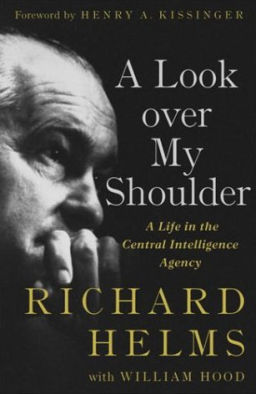
A Look Over My Shoulder: A Life in the Central Intelligence Agency
Richard Helms and William Hood
(New York: Random House, 2003)
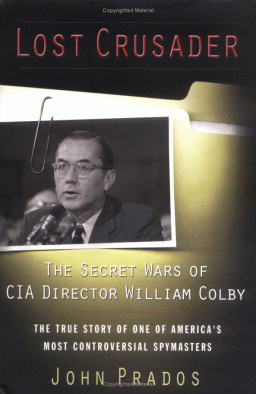
The Lost Crusader: The Secret Wars of CIA Director William Colby
John Prados
Oxford University Press: Cary [North Carolina], 2003
The Man Who Kept the Secrets
Thomas Powers
(New York: Knopf: 1979)
Honorable Men
William Colby
London: Hutchinson, 1981
Many people find stories about spies interesting. Some of us identify with the spies, some with those spied upon. If the stories claim to be true they offer the promise of finding out what really happened. Of course some of the words in the preceding sentence (‘true,’ ‘really happened’) should be safely encased in quotation marks. That said (and so-warned) the history of the CIA and the biographies of its leaders have a particular interest for those seeking to understand the Cold War and its impact on the way in which our government functions today both on the international stage and at home. The coincidence of the publication of the autobiography of one CIA director, Richard Helms following by two decades The Man Who Kept the Secrets, Helms’s biography by Thomas Powers and the biography of his successor, William Colby following by an equal interval Honorable Men, Colby’s auto-biography gives us occasion to recall some Cold War stories which reverberate in today’s headlines.
A Look Over My Shoulder and The Lost Crusader touch on issues that return with each morning’s newspaper: is a foreign secret intelligence service bound by international conventions governing such matters as murder, illegal imprisonment and the overthrow of governments? Is the word of the Director of Central Intelligence to be believed? Is it proper for a foreign intelligence service for the CIA to be used for extralegal activities within the United States? Is the very existence of the CIA and its related agencies compatible with our democracy?
Secret intelligence services have long been assumed to be hidden players wherever the Great Game of international politics is played. And so they are. The traditional definition of a secret intelligence service is that, like the military, it is an instrument of government in its role as defender of the citizenry from foreign threats. It is different from the secret police, which is an instrument of government in regard to its domestic enemies. This distinction is enshrined in the charter of the Central Intelligence Agency, which restricts its operations to foreign shores on the assumption that the FBI will ensure domestic tranquility.
Secret intelligence agencies have three classic functions: intelligence collection and analysis (spies and scholars); oper-ations (overthrowing foreign governments and the like), and counterintelligence (protecting secrets from other secret intell-igence agencies). The British tend to divide these among a related set of organizations; we combine most, or elements of most, in the CIA.
Each of these functions has its characteristic disorders. Intelligence collection and analysis can fail to obtain or fail to understand crucial information: Pearl Harbor is said to have been one such instance, the September 11, 2001 attacks are another. Operations can fail as with the Bay of Pigs or succeed only too well Guatemala, Iran, Congo their unforeseen consequences bringing disaster for the locals or the masters of the operatives. Counterintelligence can fail to find spies Aldrich Ames or can cast suspicion on people who are not in fact spies, a particular speciality of Stalin’s organizations, with dire consequences for organizational efficiency and individual longevity.
There is also a set of disorders particularly troubling in democracies, which occur when practices that are considered allowable abroad are brought home: when a foreign intelligence service collects and analyzes information about its own citizens, conducts operations at home (assassinations, the destruction of oppositional organizations, the distribution of propaganda) invented for use abroad, or employs at home without due deference to the Constitution other methods to which it has become habituated in the foreign alleys it has frequented.
If a diplomat was famously defined as a gentleman employed to lie abroad for his country, all the more is it to be assumed that the profession of secret intelligence is defined by lies. The lies are sometimes perhaps noble Churchill’s bodyguard for the precious truth sometimes are to be discovered, sometimes they are simply operational. It should go without saying, therefore, that books by and about spy-chiefs must be read with due caution as they form a genre riddled with the paradoxes of the profession. Doubts about the truthfulness of such books are reinforced, when, for example, one of the better known British authors in the field, Rupert Allason, who, under the name of Nigel West has written standard accounts of the British secret intelligence services, is described by a British judge as ‘a profoundly dishonest man’. Mr. Justice Laddie added: ‘Mr. Allason appears to believe that all he needs to do is assert in firm terms that a state of affairs existed and his audience would have to accept his word for it.’ It does give one pause: the literature of secret intelligence is filled with firm assertions of states of affairs.
Having said that, we might divide these books by and about Helms and Colby into those by Powers and Prados, who are not employees of the CIA, and those by Colby, Helms and Hood, who were. We should stipulate the scholarly goals and bona fides of Powers and Prados, but assume at minimum a community of interest between the CIA as an organization and those authors who had spent their working lives in its service. This is, after all, how Helms and Hood counsel us to approach the memoir of the British/Soviet spy Kim Philby: as a product of a foreign intelligence service and a component of its psychological warfare campaigns. So should their and Colby’s memoirs be approached.
We now know that in its Cold War heyday the CIA’s psychological warfare efforts included an extensive publication program aiming to influence public opinion in the Soviet Bloc, the Third and Free worlds. Both Helms and Colby were involved in these efforts Colby feeding a collection of newspapers in Italy, Helms supervising the Congress for Cultural Freedom, its concerts, exhibitions, books, magazines and tame intellectuals. A Look Over My Shoulder and Honor-able Men are not untouched by this common experience of their authors, as authors, who had many axes to grind some institutional, perhaps rising to the level of psychological warfare directed at the American people themselves some personal.
Not by us
Helms, for example, was personally concerned in A Look Over My Shoulder to avoid blame for a rather extensive list of assassinations of foreign leaders, for a coup or two, and for the domestic operations of the Agency. His accounts of the foreign assassinations attributed to the CIA in his time follow a curious pattern: the Agency is tasked with ‘eliminating’ some foreign leader; the Agency sets an operation into motion, and the personage in question is killed, but not, Helms says, by staff or agents of the Central Intelligence Agency. For half a century this has been the position of the CIA about what the Soviets called ‘wet’ matters. Such a chain of events might be believable once or twice. By the time we get to Chile, belief has been strained to the breaking point. And yet the story is blandly trotted out once more. It seems that it was important to the image the Agency wished to project of itself that it was not publicly known to assassinate foreign leaders. Or did not admit it. (On the other hand, it suited one Secretary of State to exploit the CIA’s reputation for assassinations by threatening a foreign leader he thought responsible for the death of an American diplomat.) Of course these matters are viewed differently today. Helms was a good soldier at both ends of the psychological warfare spectrum: planning and supporting assassinations and denying to the end of his life their attribution to his Agency.
Similar, and often overlapping, accounts are given of coups as of the assassinations. The Agency considered, or planned, coups, Helms tells us, but was not actually responsible for them, except for those few celebrated in the popular histories of the Agency. The coup in Iran that put the young Shah back in power, that in Guatemala, and one or two others are featured and glorified by Helms and Hood, as has become traditional in CIA histories. Others, especially the overthrow of Diem, President of Vietnam, are denied. Linked to the murkiness around the Diem affair there were the attempts to assassinate Castro (also denied). Yet other interventions are passed over in silence by Helms just as they are routinely denied in publications of CIA origins or influence: Argentina, Bolivia, Congo, Egypt, France, Greece, Haiti, Italy, Jordan…. Denying and obscuring the CIA’s role in various assassinations, coups, and interventions helps create in the mind of Americans a certain view of the history of the past fifty years, of the role of the American government and, in particular, of the role of the CIA. Insofar as this view is perhaps not entirely consistent with the facts its propagation is a form of psychological warfare waged against the American people (‘disinformation’ is the term of art), corrupting the processes of a democracy.
Most thoroughly denied, minimized, shoved into a drawer while attention is directed elsewhere, are Helms’s and his Agency’s domestic violations of its charter. The CIA ran illegal operations in the United States from the earliest years of Dulles’s tenure as Director of Central Intelligence: opening the mail and copying telegrams sent or received from abroad, compiling lists of people who, in event of a national emer-gency, were to be placed in camps like that now in use in Guan-tanamo Bay, secretly funding the National Student Association and the activities of the Congress for Cultural Freedom (including its publications and others, such as the Partisan Review). The revelation of some of these matters by Ramparts magazine and President Johnson’s conviction that the Anti-War movement was directed from abroad plunged the CIA into efforts to collect information about Americans opposed to the Agency and those involved in the Anti-War movement. Helms, his counterintelligence director, the legendary James Jesus Angleton, and the latter’s assistant Richard Ober, head of a ‘Special Operations Group’, focused significant Agency resources on these matters in activities that slid from the collection of information to efforts to destroy Ramparts and disrupt the Anti-War movement. None of this was legal. Helms was particularly anxious to minimize Operation CHAOS and his responsibility for it. His defense is that the President told him to do it: the word of the Leader has the force of law, as they used to say in the Third Reich.
Helms’ two oaths
This brings us to ‘the two oaths of Richard Helms’. Helms testified in February and March 1973 before the Senate Foreign Relations Committee in connection with his confirmation as Ambassador to Iran. On both occasions he was questioned concerning CIA activities in Chile. On both occasions he answered untruthfully. Helms took one oath when testifying to tell the whole truth to the Committee. The other oath he had taken decades earlier to protect the secrets of the CIA from ‘any unauthorized person…..without the express written consent of the Director of the Central Intelligence Agency [DCI] or his representative’. In case of a conflict between those oaths, James Angleton notoriously held that ‘It is inconceivable that a secret intelligence arm of the government has to comply with all the overt orders of the government.’ Helms agreed, judging the Senators on the Foreign Relations Committee to be unauthorized persons whose orders he was not required to obey. He feared that secrets revealed to Senator Church, in particular, would be placed in the public domain in other words, made available to the Soviets.
In the Fall of 1977 Helms was convicted of failing to testify fully and accurately before the United States Congress. The Department of Justice had agreed in a plea bargain with Helms’s politically-well-connected lawyer not to seek a felony perjury indictment in return for the guilty plea to the lesser charge, a misdemeanour, which would leave Helms with his civil rights and pension. Judge Barrington Parker was uncomfortable with the plea bargain, issuing a judgement that he believed disgraced and shamed the ex-CIA director; or, rather, that held that Helms had disgraced and shamed himself. Helms was as contemptuous of Judge Parker as of the Senate. He had pleaded as agreed, but did not feel guilt, shame, or remorse. He thought the whole episode a symptom of problems with American society, not a consequence of his own behaviour and the nature of his Agency. More specifically, he blamed his legal problems on his successor as Director of Central Intelligence, William Colby. (Prados provides evidence that Colby had tried to protect Helms, but was overruled by his own legal advisors. Helms would not have believed it.)
Was Colby a Soviet agent?
The spectacular claim implied if not quite made in A Look Over My Shoulder is that William Colby, while Director of Central Intelligence, was a Soviet agent. Readers of espionage thrillers, whether or not they are now (or have ever been) employees of the Agency, will remember that the nightmare haunting John Le Carré’s George Smiley was that the head of his secret foreign intelligence service was in the employ of the enemy. It is well-known that this nightmare came near enough to reality for MI6, Britain’s CIA, at the beginning of the Cold War. H. A. R. ‘Kim’ Philby, that perfect spy, was quite possibly within a few months of becoming head of MI6, when the British diplomat and Soviet spy Donald Maclean a rising star in his own right was fingered by the U. S. government’s code breakers. Maclean and his too loyal friend Guy Burgess took the ferry to Calais, thence the train to Moscow, leaving Philby implicated, but not convicted, and intelligence services all over the Western world looking over their shoulders at their own images in the washroom mirror.
The question raised by Helms in A Look Over My Shoulder is: was Colby America’s more successful Philby? In other words, was what Helms and Hood view as Colby’s destruction of the CIA the deliberate act of a Soviet agent?
Helms and Hood agree implicitly, but quite clearly with those Agency insiders who told Powers that Colby’s acts ‘as Director of Central Intelligence were entirely consistent with those of a man who was a Russian agent’. This ‘entirely consistent with’ is an artful formulation from the discipline of counterintelligence, whose practitioners do not so much want to put spies (or terrorists, to use a contemporary concern) in jail as to identify them, move them away from secrets, and, if possible, use them to find others in their network. For a secret intelligence professional pursuing these goals there is little, if any, operational difference between a person whose actions are ‘entirely consistent with’ those of an agent and an actual spy: he or she will react to each in the same way.
On the first page of his preface Helms, as if to alert his readers to an aspect of this theme, charges Colby with contributing to ‘a wanton breach of……secrecy’ by his cooper-ation in the mid-1970’s with the U. S. Senate’s Church comm-ittee and the House of Representative’s Pike committee, which investigated the CIA during Colby’s directorship. He goes on to say that Colby ‘effectively smashed the existing system of checks and balances protecting the national intelligence service by his ‘single-handed thrusting of highly sensitive, classified data upon the Rockefeller Commission and sub-sequent congressional investigating committees’. To the lay reader this may sound like an expression of a difference of opinion about the way that Directors of Central Intelligence should deal with Congress and the administration of the day. But by repeatedly charging that Colby delivered secrets to those not authorized to receive them placing CIA secrets in the public domain being tantamount in their eyes to deliver-ing them to the Soviets Helms and Hood were making it clear to ‘witting’ readers, other intelligence professionals, that they thought Colby was, perhaps not consciously a spy, but in their view someone whose actions were those of a spy. Careers, at a minimum, have been terminated for less.
Helms and Hood reinforce this series of overt and emotional statements with an argument concerning Colby that is in com-parison quite subtle. They imply that the very fact that Colby rose to the top of the Agency was suspect, in the same way, in some accounts, that Philby’s shining career in MI6 was part of the case against him: Philby rose so effortlessly, it was said, because he had help from the other side. The argument Helms and Hood deploy is a matter of career patterns, dots, as it were, that the knowing reader can connect. The argument about Colby’s deviant career pattern, Helms and Hood imply, goes something like this.
The first civilian Director of Central Intelligence (DCI), Allen Dulles, popularly considered and to a great extent in fact the founder of the CIA, or, at least, of a certain idea of the CIA, become Deputy Director for Plans (‘the Clandestine Services’) of the Agency in January 1951, Deputy Director of Central Intelligence in August 1951, and served as DCI from February 1953 until November 1961. Dulles set the career pattern foll-owed by the next ‘insider’ to become DCI: Richard Helms himself, who became Chief of Operations in the Directorate for Plans in January 1953, Deputy Director for Plans (DDP) in February, 1962, Deputy Director of Central Intelligence from April, 1965 to June, 1966, then DCI until February, 1973. Given that pattern, it would have been and was expected that if an insider were to follow Helms as DCI it would be someone like Thomas Karamessines, Deputy Director for Plans from 1967 to February 1973. But instead Helms was succeeded by Colby, whom Helms had twice passed over for the position of head of the Clandestine Services.
Joining the CIA after a daring career behind enemy lines in WWII, Colby spent the 1950s at the CIA’s Rome station. In 1959 he was sent to Saigon as Deputy Chief of the CIA’s operation there, becoming Chief of Station in June, 1960. During his years in Saigon Colby became well-known in some quarters, notorious for his support of President Diem and his opposition to CIA spying on Diem’s government, police or military. It was also at this time that Colby developed a relationship with a French doctor, known as ‘Vincent Gregoire’, who was later found to be a Soviet intelligence asset. Colby violated regulations by not reporting his contacts with the French doctor. CIA counterintelligence staff were not pleased by Colby’s approach to security matters. Rumour has it that they went so far as to deny him access to their part of the CIA’s Saigon headquarters. Their displeasure at his trust in Diem’s security measures was redoubled when it turned out that Diem’s government in fact had been infiltrated by tens of thousands of Viet Cong agents.
In spite of the doubts of the counterintelligence staff Colby was brought back to Washington in 1962 as head of the Agency’s Far East Division. Early in 1965 Helms became head of the Clandestine Services and then moved up to Deputy Director of the Agency. This gave him for the first time direct control over Colby’s career. Prados writes that there were three candidates to replace Helms as DDP Desmond FitzGerald, Thomas Karamessines and Colby. Helms gave the job to FitzGerald. When FitzGerald died in the fall of 1967, Helms put Karamessines in his place, passing over Colby a second time and offering him the Soviet Bloc Division, the senior division in the Clandestine Services, as a consolation prize. 1967 one of the most intense periods of counterintelligence activity within CIA itself (the ‘Mole hunt’) was not a good time to be head of the Soviet Bloc Division. Helms himself observes that Colby’s ‘lack of understanding of counter-intelligence…..would not have been compatible with the Soviet responsibilities, and would surely have put him at logger-heads with Jim Angleton.’ Angleton was convinced that there was a ‘mole’, in the Soviet Bloc Division and was investigating dozens of officers. It would have been a tough assignment for Colby. Or, perhaps, a set-up. Placing Colby in the Soviet Bloc Division might have been a way to determine if Colby was in fact a mole.
The problem Helms had with Colby was security and to begin to understand that problem we must come to some understanding of the peculiar nature of counterintelligence, which in those years at the CIA was embodied in James Angleton, Helms’s familiar spirit. (Angleton, of the same generation of Helms and Colby, quite early on decided to specialize in counterintelligence work spy hunting rather than spy running and as early as 1954 had achieved a position of unique power as chief of counterintelligence for the Central Intelligence Agency, a position he held until fired by Colby in 1974.) Angleton’s basic assumption, which he shared with his peers in other secret intelligence service organizations, was that it should be assumed that the CIA might at any moment contain an official who was passing its secrets to a foreign intelligence agency. He defended against that possibility through a continuous investigation of everyone within the CIA who might be in a position to act as would a foreign agent. In practice the burden of proof was placed on the suspect, a situation that had been envisioned in the Agency’s charter, which gave the Director the power to dismiss any of its employees without cause. This is not an absurd approach to the job at hand. Better safe than sorry. It also appears to have worked. The CIA staff was not infiltrated as far as is known on Angleton’s watch. After Colby fired him and dismantled his system, it was infiltrated by Ames and his like. Q.E.D., possibly.
In any case, Colby dodged that bullet by securing an assign-ment as deputy head of CORDS (Civil Operations and Revolutionary Development Support Staff). CORDS was the ‘pacification program in Vietnam. Colby’s appointment required him to resign from the CIA in order to join the Agency for International Development, where he received the rank of ambassador. Colby, in his own account of the incident in Honorable Men, says that he was surprised and ‘stunned’ by the appointment. Helmsnotes that he himself was ‘irritated’ by it. Helms tells this story in such a way as to present Colby as an intriguer, pursing personal ambition without regard to the needs of the Agency. Helms’s account of the facts of the matter if not the atmospherics is the more likely: the President would not have picked Colby to work with Robert Komer, the head of CORDS, without Komer suggesting it, and Komer is unlikely to have done so without having spoken to Colby. In any case, Colby resigned from CIA, avoiding Angleton’s mole hunt, and went back to Vietnam. At this point political considerations at the highest level came into play. Colby, a self-described liberal, had a fortuitous personal connection with Richard Nixon. (Colby’s son was the roommate of Tricia Nixon’s fiancé, Edward Cox, who in 1970 was Jonathan Colby’s best man.) This became useful when Nixon was elected to the presidency. Colby succeeded Komer as head of CORDS.
Consolation prize
Colby suddenly returned to Washington and the CIA in June 1971. He wrote in Honorable Men that he did so because of his daughter Catherine’s deteriorating health (she suffered from epilepsy). Be that as it may, he was not expected, did not have an assignment and the Agency was somewhat embarrassed about what to do with someone as senior as Colby was by this time. Eventually Helms offered him the Executive Directorship of the Agency, the consolation prize that had been given to Lyman Kirkpatrick nearly twenty years earlier when he was eliminated by illness from his ambition to become DCI. The message was probably clear to both the sender and the recipient: it was to be a terminal, pre-retirement position. According to Prados, the French doctor affair revived in late 1970 and, a year after his return to Washington, Colby was the subject of a formal counterintelligence inquiry by Angleton’s top lieutenants. The very fact that it was considered necessary to interr-ogate Colby about this matter, when he was at least nominally number three in the Agency, would have in practice blotted his record, no matter what the outcome of the investigation.
The leadership situation at the CIA when Nixon was re-elected in November 1972 was Helms as DCI and Karamessines, his natural heir, leading the Clandestine Services, while Colby was relegated to the half-invented job of Executive Director/Comptroller. Then, on 20 November 1972, Helms was fired by Nixon and Karamessines resigned. James Schlesinger was moved into Langley from the Budget Office to reorganize the Agency, and Colby, finally, got the Plans division, renaming it Operations. Colby also became the zealous chair of the Agency’s new management committee: leading the reduction in force Schlesinger had ordered; firing hundreds of spies; trying to fire Angleton, as might have been expected, but unexpectedly failing when Angleton secured the support of Schlesinger himself. In early May 1973, after the Watergate resignations of Haldeman, Ehrlichman and Dean, Colby was told that Nixon wanted him to be the next DCI. And it was at just this time that he began the Schlesinger-ordered rifling of the Agency’s closets for the ‘Family Jewels’ list of Agency horrors. When Colby gave this record of its potentially embarrassing operations to the Church Committee he was in large part providing the Committee with the resumé of Richard Helms.
In sum, Helms had not viewed Colby’s career with favour: passing him over twice for DDP, arguably trying to put him into a dangerous position in the Soviet Bloc Division; object-ing to the CORDS assignment and then side-tracking him into the Executive Directorship. That should have been the end of it: a security problem, Colby had been moved away from the center of the CIA on the way to being moved out entirely. Colby met the Angletonian criteria for a presumption of possible guilt: his actions (e.g. the French doctor affair, his views on security) were ‘consistent with those of a man who was a Russian agent’. That did not mean that Angleton or Helms or Hood thought Colby actually was a Soviet agent. It did mean that, in the end, they thought he should have been treated like one within the Central Intelligence Agency: not put on trial, but fired, or forced into early retirement, which is what Helms may have been preparing to do with the Executive Director appointment. Instead, it was Helms and Angleton who were forced out, while Colby dismantled much of Angleton’s counterintelligence apparatus and tradition, its immune system, as it were. This probably clinched the case as far as Angleton was concerned, while Helms might simply have been annoyed that someone he had thought unworthy to head the Clandestine Services had become his successor as Director of the entire Central Intelligence Agency.
Interpretation and definition
The Colby Affair, if one might call it that, is a difficult issue to think through from the outside. Not that there is a dispute about the visible facts: Colby co-operated with the investigating committees beyond the traditional CIA norm, acted in ways that were bound to arouse suspicion in any reasonably professional counterintelligence officer, became DCI due to unfathomable political influences, and dismantled the counterintelligence staff of the Agency. That leaves questions of interpretation and definition. Colby in his autobiography and Prados in his recent biography say that Congress asked for the information Colby supplied and had a right to it and that Colby believed Angleton’s approach to counterintelligence unintelligible as well as counterproductive. The Helms/Hood/ Angleton position was that Congress is a collection of individuals, that some of those have a right to intelligence information and others do not. Helms, for one, was willing to go to jail over his belief that his oath of secrecy took precedence over Congressional authority.
Rational people can differ. The professional counter-intelligence judgement is of a piece with Helms’s position: that is, a person who appears to be (in this case) a Soviet asset must be assumed to be one unless evidence can be found that the appearance is misleading. Given Colby’s refusal to take counterintelligence measures in Vietnam and his unreported contacts with a person who was later identified as a Soviet agent, his ‘promiscuous’ placing of secret material in the public record would have firmly put Colby in the ‘must be assumed to be’ category if Angleton had been head of counter-intelligence during the Church committee hearings. But it was, of course, precisely the firing of Angleton by Colby that cleared the way for those hearings.
Helms and Colby are both dead now: Helms died quite recently of the natural consequence of great age, Colby in 1996, as the result of a mysterious boating accident. In lieu of a revelation from the Moscow archives, the dispute among Helms, Angleton and Colby must remain unresolved. All three were, no doubt, as Colby, without apparent irony, put it in the title of his memoir, honorable men.
When considering books like A Look Over My Shoulder we ask, with more than usual urgency and less than usual expectation of satisfactory answers: ‘What are these books? Who wrote them? Why were they written?’ For they are not merely about lives spent in the service of secret intelligence organizations; the autobiographies come from, and some of the biographies are much influenced by, that secret world. Both A Look Over My Shoulder and Colby’s autobiography contain notices that they were reviewed and approved for publication by the Central Intelligence Agency. It therefore can be assumed that, at least in part, these are attempts to present information in such a way as to further the goals of the Agency. Given that, A Look Over My Shoulder and Colby’s autobiography Honorable Men are to some extent psychological warfare instruments in which a target in question is the American public.
Helms and Colby aimed to convince their readers that the CIA is a valuable asset of American democracy, that their careers in it were those of dedicated and patriotic men, and that the history of the CIA includes what is generally known about it (in part from earlier publications of CIA origin) and does not include any hitherto unknown enormities. Given Helms’s position on the two oaths matter and the record of the CIA’s psychological warfare efforts, statements or publications by CIA officials, whether in testimony before Congress or in books for the general public, cannot be assumed to be truthful. Which does complicate the reading of books like A Look Over My Shoulder.
There is another, more important lesson to be found in books by and about spy chiefs. At this moment of the history of the Republic we hear on all sides calls for strengthening organizations like the Central Intelligence Agency. The books under review here by what they say and what they conceal remind us of the difficulties encountered by CIA officials in reconciling their activities with the demands, with the very existence, of the Constitution.
Richard Tomlinson, former MI6 officer, and author of The Big Breach, has (or maybe that should be had at time of writing) a blog at:
http://richardtomlinson.typepad.com/
Michael Smith, convicted of espionage in very dubious circumstances and the subject of an essay in Lobster 40, ‘The strange case of Michael Smith: spy or tourist?’, has a blog at:
www.parellic.blogspot.com/