
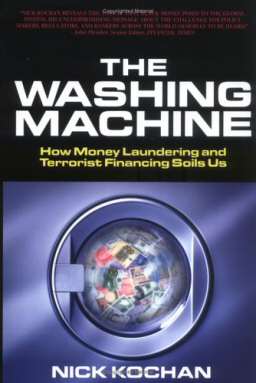
Nick Kochan
London: Thomson, 2005, £19.99, h/b/b
Nick Kochan is one of a small band of writers who try to bring together business and politics in an effort to understand a world often rendered incomprehensible by narrow specialists in these fields. He moves from the safe places think of the cosy world of the personal finance editors or that of the sheeplike Westminster Lobby corps into challenging ones where, for example, what is happening in the bulge-bracket investment banks is linked up to foreign and domestic policy making. In short, he’s into politics for grown-ups: collecting and then connecting details to form big pictures.
His 1991 book with Bob Whittington on the BCCI fraud remains one of the best guides to that financial and political scandal 14 years later, as the Bank of England’s regulatory role is finally being examined in the High Court. That book raised awkward and far-sighted questions about the role of the British and American intelligence services in relation to BCCI and to the corrupt bank’s clear links with prominent politicians and international terrorism: there aren’t many places outside Court 73 of the Royal Courts of Justice where the names of James Callaghan, Oliver North and Manuel Noriega crop up with such regularity as they did in Bankrupt: The BCCI Fraud.
Kochan’s new book is similarly revealing. He opens by throwing light on the way the Russian oligarchs most of them equipped with Israeli passports, he tells us have used their ill-gotten gains not least in the Middle East.
‘Israel’s desperation for foreign exchange means Russian Mafiosi have been allowed to integrate themselves into the country’s political and financial system. Many Russians with criminal records have used their wealth to promote themselves into the top echelons of Israel’s political parties.’
Think then what that might mean for international politics, given the close ties of Israel to the United States and the extent to which the latter’s election process depends on huge cash injections. Kochan also tells us that laundered money in this case from the former dictator of Nigeria, General Sani Abacha helped Tony Blair get New Labour off the ground.
“The British Financial Services Authority conducted its own investigation of British banks’ involvement in the Abacha scandal and unearthed one account of particular importance. The account, called Umbria, which had been established in 1996 at the Union Bank of Switzerland in Switzerland (UBS) was held in the name of Uri David, an Israeli citizen and businessman living in London’s plush Hampstead district who was also a major donor to the British Labour Party. Umbria was found to contain $60 million thought to belong to the Abacha family.’
Kochan writes that David had told UBS that the money belonged to two Nigerian businessmen and ‘assured the bank that the two men had no political background. The bank took his word for this reference, and did not require a passport from the “businessmen”.’ UBS was heavily fined by the Swiss banking authorities and, The Guardian reported several years ago, Uri David was heavily fined himself, before being made a British citizen soon after New Labour was elected in 1997.
Kochan ranges widely from the Bank of New York scandals to the IRA in courageously pursuing his theme that laundered money corrupts the wider economy. He concludes:
“Money laundering by criminal or terrorist groups has far-reaching implications for the world’s security.’
As in his earlier BCCI book, Kochan shows a subtle understanding of the role of British bank regulators in dealing with these corrupt practices. The evidence to date from the High Court BCCI case is that the Bank of England, which was the regulating authority until New Labour’s Financial Services Authority was created, was ill-equipped for the job. It was also fearful of appearing too strict in its regulation lest it drive away banks the American ones in particular who were more tightly controlled at home.
Kochan sums up the present situation this way:
‘London’s vulnerability to launderers is not in its laws but in their implementation. Government has failed to invest in sufficient skilled law enforcement officers or regulators to curb its sprawling financial system. But this is no accident. The UK’s economy cannot afford to curb its income from the ‘invisible’ financial sector while its industrial sector becomes anorexic. As the United Kingdom feeds its addiction to finance and hot money, its regulators bluster ever less convincingly about the security of its financial system and its antipathy to money launderers.’
This is an important book by a gutsy writer. All political editors keen to inform their audiences about the real world beyond Westminster should read it. I wonder how many will.