
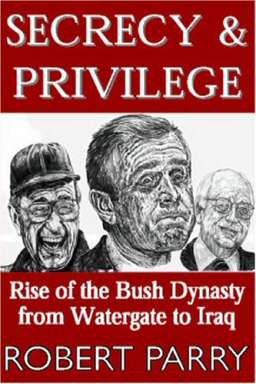
Robert Parry
Arlington (VA): The Media Consortium, 2004; $22.95 (US); p/b
Order from
<www.secrecyandprivilege.com>
This is the book I have enjoyed most since the last Lobster and it is one of the best books I have read on American politics and parapolitics. Robert Parry really is very good indeed: he has the serious investigative journalist’s care with sources and that simple, transparent style which lets the reporting speak for itself.
This is a survey of Republican politics since Watergate, a set of essays on the big (para)political events of the last 30 years which show that since Nixon ([8]) the Republican Party has been the political front for a series of massive criminal conspiracies. We might say that the Republican Party is an ongoing criminal conspiracy. Gore Vidal’s quip that there is one political party in the US, with two wings, is only half true. I don’t want to sound too naive here, but whereas the Democratic administrations (Carter, Clinton) mostly tried to do things for the common good as they perceived it (within the limitations imposed by their sources of finance), behind the Republican rhetoric of freedom and Jesus are crooks, gangsters, assassins and torturers as well as their corporate sponsors.
Parry discusses:
- Watergate (he has a new answer to the question: Why were they bugging Spencer Oliver’s phone? This is discussed elsewhere in this issue.)
- The senior Bush’s role as Republican National Committee chair during Watergate; and then as head of the CIA during the post Watergate period, notably the Team B episode which paved the way for the Second Cold War of the Reagan years.
- The October Surprise of 1980 and the media’s false ‘debunking’ of the story.
- The politicisation of the CIA under Reagan and Casey and the fabrication of the ‘Soviets support for terrorism’ thesis.
- The role of the Moonies and their money through the 1980s.
- Iran-Contra
- CIA-cocaine
- The post-Watergate creation by the Republican right-wing of an alternative media and ‘counter-establishment’ essentially a set of psy-war outfits to attack the Democrats and inhibit the media in exposure of future scandals.
- The assault on Clinton and Al Gore by that right-wing media.
- The stealing of the 2000 election.
Those are the major headings; and if they sound familiar, their treatment by Parry isn’t. Much of this is reworked with new sources and from new angles.
The careers of the Bushes run through this, as do two subsidiary themes. The first is the failure of the US media to report accurately, let alone investigate, these events. The second is the political cowardice and ineptness of the Democrats who have declined to pursue most of it. They passed on the October Surprise one of whose initial investigators was Parry Iran-Contra, CIA-cocaine, the wars in Central America, right down to the Republicans stealing the 2000 and 2004 elections. And before that they flunked the assassinations in the 1960s. Only once, with Watergate, and then only half-heartedly, have the Democrats been willing to take up the issue of the secret powers of the state and its links to their political enemies.
Parry explains this paralysis, in part, as a fear of the Republican-supporting media created since the mid 1970s; and in part as the result of a kind of naivety about their opponents. He describes Clinton seeking to create a consensus, a ‘bipartisan approach’, with the Republicans in Congress and thus abandoning the four ongoing inquiries into Republican crimes, of which Iran-Contra was the biggest. The Republicans thanked him by launching the largest private sector political warfare campaign in history against him.
But there are other factors. For an American politician, getting embroiled with the intelligence services or the military looks almost uniquely dangerous. There are also two more general reasons for the inertia. The Democrats are reluctant to criticise America, domestically or internationally, for fear of being seen to be insufficiently patriotic. This feeds into a wider reluctance to pursue big issues. Politicians, like the rest of us, find that pretending that things aren’t really that bad, is always the easier option. Denial of the reality of American society and its foreign policy is almost universal among American political and media circles. ([9])
In Parry’s view:
‘Democratic retreat from the investigative battles of 1993 cleared the way for a restoration of the Bush political dynasty 8 years later’ (p. 6)
How many defeats and humiliations are the Democrats willing to take before they conclude that attack may be the only form of defence?
Notes
[9] I haven’t read the party’s history before 1960 and don’t know.
[9] A great deal of this critique of the Democrats – fear of the spooks and the media, for example – applied to the pre-Blair Labour Party.