
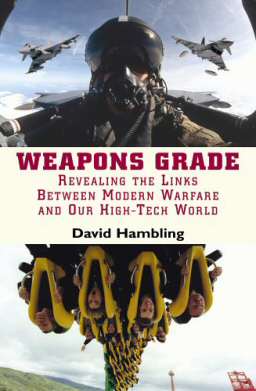
David Hambling
London: Constable, 2005, £12.99, p/b
This is clearly laid out, with a few key scientific ideas illustrated by simple but effective black and white figures. The style is pitched just right for a general audience so one doesn’t get swamped in technical details, while it does a good job of explaining the concepts being used. The book is in two main parts. The first provides an overview of the history of military research during the Second World War and immediately thereafter and how that has lead to all manner of developments in civil society. The second half of the book takes a look at various contemporary military research programs and sees how they may lead to developments in the civilian arena.
So let’s examine the two parts. The historical one gets off to a shaky start with a howler on page 22 which suggests that V-1 bombs had been used against London since 1943; and one has to question how a statement such as ‘The Second World War was the first in which technology played a key role from the start’ (p. 3) got past the sub-editors, when one can convincingly argue that ‘war’ is defined as human conflict PLUS technology and that technology has been integral to warfare from day one. Apart from these minor points the rest of the first half of the book deals with the military development of rocket science; the variety of jet and rocket propelled aircraft types that led to the modern airliner; military advances in computing that led to the PC and the Internet as we know and love them today; ray technologies such as microwaves and lasers; nuclear weapons and its spin-offs; and finally experimental aeronautical craft including tilt-wing devices. Given the space (each chapter only gets 2030 pages) Hambling does an excellent job in indicating the way that the technologies were developed and the importance of military funding of that process. He also makes the important point that no matter how much money is thrown at a project there’s no guarantee anything useful will come out of it.
Inevitably, readers with a degree of specialised knowledge in these areas will come away thinking that so much more could have been said on each of the topics; I was puzzled by the absence of the Fairey Rotodyne from among the hybrid and unusual aircraft. But if you multiply all such occurrences you soon realise you’d need a book twice as big to fit everything in. There is one very obvious shortcoming though: the lack of illustrations. Would sales not be improved if there were, say, 24 pages of photographs to liven up the text?
In the second section Hambling groups the technologies under nine main headings again: UFOs and secret technologies; next generation informatics (including A.I.); ray technologies (including ‘non-lethal weapons’); vortex rings (could be very useful weapons once the technology is sorted out); hypersonic aircraft and space vehicles; information warfare; radar; robots; EM weapons; and finally nanotechnology. Again the author can only give a brief run through of the technologies involved. I found much of the information was new to me and was especially intrigued by the possibilities of vortex ring technology. However, the same problem arises as with the first section: there simply isn’t enough space to give a comprehensive coverage of the material. For example, I was hoping we might see something of the wave rider hypersonic craft, or maybe a some detailed look at the microwave/laser plasma ball weapons technology which seems to have been tested in the mid 1990s, giving rise to numerous ‘UFO’ sightings. ([7])
The book is seriously lacking in references. Each chapter has only a few footnotes collected at the end of the text. Hambling gives a short bibliography and states blandly that hundreds of websites were consulted in the preparation of the book. But only three are cited. The reader has either to take the information on trust or engage in a lengthy web search. However this is an excellent start point for examining the subject matter. Even those who may have some expertise in particular areas are bound to find much new information in its pages. It is clearly written, well produced and at a reasonable price. Despite the lack of photographic illustrations and proper references I can thoroughly recommend this book to anyone with an interest in cutting edge science and technology.
Note
[7] Talking of UFO sightings, Hambling has a brief discussion of what most of us call the Black Triangle or Flying Triangle UFO craft, but which he calls the Black Boomerang and which he thinks may be some form of solar powered aircraft. We shall see.