
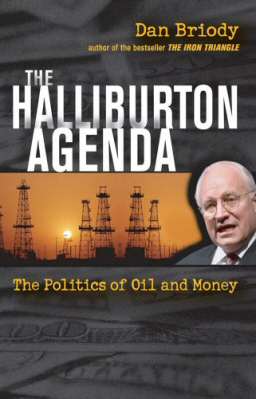
Dan Briody
John Wiley and Sons, Hoboken, 2004, £16.99 (hb)
The Halliburton Agenda provides a fascinating insight into the American military-industrial complex though there seems little point in discussing the actual content of the book: the activities of Halliburton, its subsidiary Kellogg, Brown and Root, or its infamous CEO, the vice-president of the United States, Dick Cheney. For those who read Collin Challen’s article in Lobster 47 it’s a depressingly familiar story.
That said it’s a story well told by Briody who should (again) be applauded for providing another window into the intersection of the deep structures of the American state. What really comes across in Briody’s account is anger at the tacit collusion between Halliburton, the Republican administration and the Pentagon in an absolutely gargantuan misuse of public money. And the sums involved are truly staggering.
As an extended piece of investigative journalism The Halliburton Agenda did not feel as exhaustive as his The Iron Triangle, however. Indeed, on closer inspection many of his fascinating insights into the nexus of the self-willed corruption of Lyndon Johnson betray a rather heavy reliance upon Robert A. Caro’s, The Years of Lyndon Johnson: The Path to Power.
Similarly in his treatment of Halliburton under Dick Cheney’s steward-ship, Briody focuses, understandably, on Cheney’s influence without investigating more broadly the wider synergy between Halliburton and the Bush White House.
These caveats aside, The Halliburton Agenda remains an indispensable guide to the ‘crony capitalism’ of global corporate culture and its corrosive effects upon the body politic of America. British corporate culture and its increasing ‘synergy’ with the structures of the state under Labour would benefit from similar scrutiny. Indeed such a study would be particularly timely given Tony Blair’s concerted attempt to dissolve the current democratic safeguards which prevent senior civil servants and former ministers from accepting lucrative jobs in the private sectors in areas in which they had overseen policy. Take, for instance, Blair’s personal intervention to overrule the decision of the committee on standards in public life to delay for a year Air Chief Marshall John Day’s appointment as a military advisor with BAe Systems, despite his knowledge of forthcoming defence contracts. The Halliburton Agenda serves as an urgent reminder of what lies in store.