
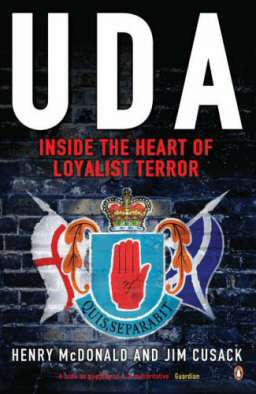
Henry McDonald and Jim Cusack
London: Penguin, 2004, £12.99, p/b
Henry McDonald’s highly readable recent book with Jim Cusack on the Ulster Defence Association (UDA) is everything that other recent offerings on the subject were not. On the one hand, it avoids the kind of borderline homo-erotic sensationalism, in which the atrocities of self-serving death squads are simply catalogued in every gory detail. On the other, it avoids the academic, social-anthropological approach which, in so many recent books on the Loyalist paramilitaries, has failed to address the central question: the relationship of the politics of sectarianism to those of social class.
The book has two core correct premises. In the 1960s, the key issues in Northern Ireland were as they remain class issues. This particularly applied to the issue of housing: the Lower Shankill, in particular, experienced some of the worst housing in Europe. Contemporaneous editions of The People’s Press, edited by Billy Hull, (later of the Loyalist Association of Workers) attest to that. But the class nature of these issues was always obscured by sectarianism. In particular, the Unionist regime itself responding to the Nationalist-Republican siege of Northern Ireland had exploited the legitimate fears of the Loyalist working class to try and block any kind of ‘normal’ democratic socialist politics, then developing elsewhere in the UK.
The authors’ second premise is linked to the above: namely, that a distinction must be drawn between the mass-based UDA that came together, in response to IRA terrorism in the 1970s, and the small but nonetheless deadly organisation of Hitler-besotted, drug-dealing fascists that is now parasitic on the community from which it was derived bizarrely fêted and given public money by the government.
Inevitably, given the book’s vast research area, there is little attention given to how the Civil Rights movement first emerged from Labour’s historic landslide in the Belfast elections of 1958 and how the biggest missed opportunity in Northern Ireland’s post-war history can still be laid at Stalinism’s door.([1])At least McDonald and Cusack acknowledge that there was sectarian violence on both sides and that the failure of the Civil Rights movement to root itself in labour politics and distance itself from Republican goals enabled a self-serving rabble-rouser like Ian Paisley to contribute to the biggest example of self-fulfilling prophecy in history.
There is new material on the emergence of McKeague’s Shankill Defence Association from Paisley’s Ulster Protestant Volunteers.([2]) Unfortunately, there is nothing on McKeague’s paedophile activities, e.g. at Kincora Boys Home, his murky links with Unionist politicians and layers of the Ulster Volunteer Force (UVF), via TARA, nor on his later role as a secret state asset. ([3]) At the same time the authors show how many contradictory forces were brought together in the early UDA many of which were indeed searching for a working class alternative to sectarianism. The early death of Ernie Eliot in Woodvale, in 1972, however, suggests that paramilitary groups serve as poor facilitators for such politics then or now!
The book thus differs from Steve Bruce’s The Red Hand (Oxford University Press, 1992) in showing how the contradictions in Loyalism, particularly between contractual and deferential manifestations of Loyalism, ([4]) came to a head during the Ulster Workers’ Council (UWC) strike and examines the consequences of the strike as in no publication that I know of since David Miller’s Queen’s Rebels (Dublin, 1978).([5]) While the authors are right not to accredit the 1974 strike to MI5 conspiracies, and to differentiate it from Paisley’s 1977 strike, they omit all reference to the activities of the secret state during this critical period.
McDonald and Cusack only address collusion in the context of Brian Nelson’s role from 1989, which is a pretty well worn route, given the public acknowledgement of the Force Research Unit (FRU)’s existence in 1998. There is no speculation for example, on whether MI5 were involved in Andy Tyrie’s removal from the UDA leadership, or in the reorganisation of the UDA that followed the John Stephens Inquiry from 1989 particularly the rise of C Company, which the book does look at in some detail.
The authors meticulously chart the rise of Johnnie Adair from being an obscure, NF skinhead and member of the Rock Band, Offensive Weapons, in the 1980s, to a key figure within C Company in the 1990s. This took place when much of the UDA’s original leadership was in prison or had been squeezed out, and when forces close to Adair, (Alex Kerr, John White) were working to undermine the Combined Loyalist Military Command and unite the West and North Belfast UDA against Gary McMichael’s leadership. At this time, the UVF and sections of the UDA did want to professionalise their operations against IRA members while Billy Wright of the Portadown UVF and C Company in Belfast wanted to kill Catholic civilians thereby destabilising the British government’s covert talks with the IRA.([6])
McDonald and Cusack have already explored these issues at length in their earlier book on the UVF, alluding to how a sinister figure called ‘The Pastor’brokered relations between C-Company and what became the Loyalist Volunteer Force. The origins of this process are complex and have their roots in the activities of Johnnie Bingham’s Turn-of-the-Road-Gang, a.k.a. the Protestant Action Force, in the 1980s. But by taking up the story again, from the other side of the UDAUVF divide, the authors provide a useful context. The men who rose to prominence in the UDA, and particularly C-Company, during this period, were not products of the mass-based UDA of the 1970s and had grown to maturity in an environment where working class politics had been purged from working class Belfast and the communities themselves were in decline. Their motives for joining paramilitary organisations were thus different from those of say, Ernie Eliot or Glen Barr in the 1970s and they reflected a different social milieu. In addition, they rose through the ranks after the old, more politically-minded leadership were gone, when the UDA was involved in more open manifestations of criminality (including drug dealing) and when the British government was already listening to John Hume and capitulating to Republicanism, right down the line.
In Steve Bruce’s book, The Red Hand, this scion of Big House Unionism tells us that the overtures of British fascism towards Loyalist paramilitaries worked one way and were largely unwanted. Historically, this was true; but not in the case of Adair and the Hitler-worshipping John Gregg, whose publicly funded memorial hall dominates part of Rathcoole; nor of the paramilitaries, both UDA and UVF, who are involved in squalid race attacks in Sandy Row.
When McDonald and Cusack wrote their previous book, on the UVF, they showed some sympathy with their subject material which would be understandably out of place in a book about the contemporary UDA. But even the Progressive Unionist Party (PUP) has failed to transform itself into a mass party for democratic socialism, to break from the paramilitary baggage of its own history and to avert what looks like its terminal decline. Dave Ervine no doubt remains genuine in his denouncing of racism and fascism but the UVF thugs involved in race attacks in South Belfast simply sneer at ‘Dictionary Dave’. In Rathcoole, the PUP are still visibly less venal than their UDA opponents but they are very obviously a UVF front with little in the way of social vision. The UVF, meantime, seems itself to be turning bad the more that the political heads in the PUP are marginalised a process that has long reached its zenith in the UDA.
The best part of this book is thus its derision towards the British admin-istration for continuing to talk to and kow-tow to the terrorists, both Green and Orange, giving them state money, bankrolling IRA propaganda films and trying to nurture them as community representatives, because they see nothing beyond the now moribund Good Friday Agreement.
Northern Ireland still needs a Labour Party and a radical policy of social inclusion, to undermine the cancerous roots of sectarianism, racism and gang-sterism in civil society. But it also needs to get tough on the paramilitaries and put them in their rightful place not in the conference rooms but behind bars! At its simplest, it wouldn’t be tolerated in Wolverhampton. Nor should it be tolerated anywhere in the UK.
Notes
[1] For an analysis of why the movement courted bourgeois nationalism, rather than rooting itself in the NILP and trade unions, readers are still recommended to catch up with Henry Patterson’s important book, The Politics of Illusion (Hutchinson-Radius, 1989) probably the best denunciation of Irish republicanism from a left standpoint ever written.
[2] The previous best account was David Boulton’s The UVF, 1966-1973 (Torc Books, 1974).
[3] For that, readers are referred to Paul Foot’s Who Framed Colin Wallace?, (MacMillan, 1989) and Cusack and McDonald’s previous collaboration, The UVF (Poolbeg, 2000).
[4] Contractual Loyalism is that which negotiates its British/Loyalist identity against a secular class based identity as workers – and on occasion socialists. Deferential means deferential to the institutional forms of traditional Unionism, including its sectarianism. The distinction is not hermetic. Because consciousness is negotiated through culture and lived experience, many Loyalist workers are capable of articulating aspects of both. (Examples would be two friends of mine in Rathcoole, who were briefly in the UDA in the 1970s then drifted out when they became disgusted at the thuggery, yet are horrified that I have a Catholic ex-girlfriend called Orla.) These days deferential loyalism would be less inclined to identify politically with the Ulster Unionist Party (UUP) which has discarded the old anachronistic trappings of traditional unionism, only to see them taken up by Paisley’s rabble – initially a petty bourgeois party with a working class base of support. The more violent end of deferential loyalism would be attracted to the UDA or Loyalist Volunteer Force (LVF) although most Loyalists, contractual or deferential, do not support the paramilitaries. The Progressive Unionist Party (PUP) leadership and a layer of their cadre would be contractual loyalists although their inability to break from paramilitarism places limits on this. Most rank and file UVF are not that sophisticated.
[5] Even then, Miller confused contractual loyalism with a nascent ‘Ulster Nationalism’ that he also saw as progressive.
[6] LVF stands for Loyalist Volunteer Force the group within the East Antrim and Mid-Ulster UVF loyal to Billy Wright and Swinger Fuller-ton, that was expelled from the UVF after the Mid-Ulster UVF commander was murdered in 1999. It was Johnny Adair’s support for this group that led to the UVF-UDA feud, triggered when Adair’s supporters unfurled an LVF banner on a march through the Shankill, then attacked the Rex Bar and homes of PUP supporters, then burned down the PUP headquarters in Agnes Street.