
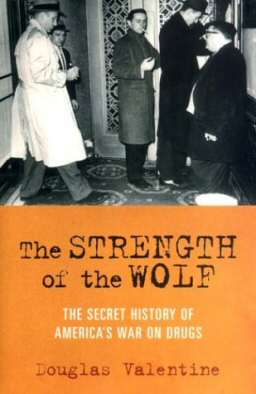
The Strength of the Wolf: The Secret History of America’s War on Drugs
Douglas Valentine
London/New York: Verso, 2004, h/back, £20
This comes garlanded with praise from Jim Hougan and Anthony Summers. The praise is justified: this is, as Hougan says, ‘a ground-breaking work of investigative reporting’; and it is, as Summers says, ‘a Herculean exploration of the dark world of drugs and law enforcement.’ Yes, but.
This is the first history of the Federal Bureau of Narcotics (FBN) which existed from 1930 until 1968. Some of the sources are published accounts (including one or two memoirs by FBN agents) and interviews with FBN personnel. But as the published material on the FBN is slight and much of its activities were conducted in secret, the book is dominated by the reminiscences of FBN agents, woven into an intricate parapolitical history of drugs, organised crime and American foreign policy during the Cold War. How dense some of this gets is suggested by the fact that the name index is 30 pages long! (Repeatedly Valentine begins a paragraph, reintroducing a character, with a version of: ‘As the reader will recall….’. This reader never did.)
The further back you go the fewer the sources are and the chapters on the early years of the FBN are understandably thin. But as the story rolls through the 1950s the sources increase and the story gets more complex, for two reasons. The politics of heroin – and this is almost entirely about heroin; the FBN was centrally dedicated to the hunt for opium and heroin – intersects with Cold War politics. As the FBN expanded overseas after WW2, trying to target the supply of opium, it discovered that the sources of heroin were largely America’s political allies in the Far East: centrally, nationalist China (the KMT). Thus the FBN’s policy of publicly blaming the Peoples’ Republic of China for the heroin entering America must be one of the biggest lies in a period of big lies.
The second cause of complexity was the FBN’s disruptive role in American domestic politics, and the management of organised crime. Which is to say the FBN was a political loose cannon in both overseas and domestic policy, engaged in continual bureaucratic warfare with the FBI, CIA, and local police forces, repeatedly discovering things that were supposed to stay hidden and trying to arrest ‘the wrong people’.
In the introduction Valentine offers this summary:
‘The moral to their [FBN] story is simple: in the process of penetrating the Mafia and the French connection, the case-making agents uncovered the Establishment’s ties to organised crime; and this was their great undoing.’ (p.3)
But who or what is ‘the Establishment?’ He doesn’t define it.
On p.386 he writes:
‘In the same way that big-city vice squads across America managed the Mafia’s drug distribution operations, the CIA oversaw the international narcotics trade on behalf of the Establishment.’
There’s that ‘Establishment’ again; and also an exaggeration. He does not show that vice-squads ‘managed’ drug distribution: he shows that organised crime paid-off some police vice squads.
He has a couple of striking quotations from FBN agents – Dennis Dayle, ‘The major targets of my investigations almost invariably turned out to be working for the CIA’ (p.325); and John Evans, ‘We were in constant conflict with the CIA because it was hiding its budget in ours, and because CIA people were smuggling drugs into the US’ (p.392) – and some other evidence of CIA involvement in the drugs business, but he does not show that the the CIA ‘oversaw’ the international drug traffic. He shows that, putting the Cold War first, the CIA turned a blind eye to, and sometimes assisted its local allies in, their narcotics business – just as it did again in the 1980s with the Contras. Valentine’s claims about the CIA and police vice squads may turn out to be true but he doesn’t have the evidence.
The temptation to make dramatic statements shows elsewhere. On p.262, of the Kennedy assassination, he writes:
‘Meanwhile, General Walker, the far-right American Security Council (including General Lansdale and Air America Chairman Admiral Felix Stump) and Texas ultras started plotting their coup d’etat in Dallas.’
He presents no evidence of this; nor is there any, to my knowledge.
On p.431 he writes: ‘….the CIA imported Phoenix to America and called it Chaos.’ But Operation Phoenix, about which Valentine has written a widely-praised book, involved identifying and assassinating supporters of the North Vietnamese, while Operation Chaos was a domestic surveillance and counter-intelligence operation.
But still: these quibbles aside, this big book (500 plus pages) is a fascinating collection of stories, and adds some major pieces to the vast jigsaw of American post-war history and parapolitics. There is so much here, it’s a pity that Valentine succumbs occasionally to the desire to make the picture tidier, more clear-cut – and more dramatic – than it actually is.