
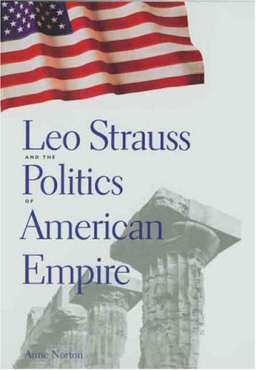
Leo Strauss and the Politics of American Empire
Anne Norton
New Haven and London: Yale University Press, 2004
$25/£16
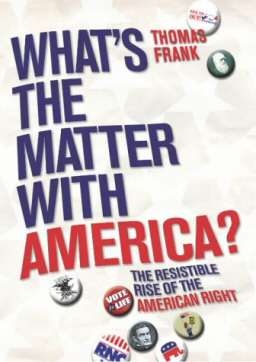
What’s the Matter with America?
Thomas Frank
The Resistable Rise of the American Right
London: Secker & Warburg, 2004, £12
Most of us in Europe find it difficult to understand what happened in America on November 2. This is certainly so among the polite and reasonable people of Sweden, where I live. I notice that right-wing pundits in Britain are now castigating us for our ‘arrogance’ in assuming that most Americans were as polite and reasonable as us. Actually, I’m not sure that it’s necessarily arrogant to give other countries the benefit of the doubt over this kind of thing. It is certainly not a sign of the ‘anti-Americanism’ which some right-wingers also accuse us of. Besides, many Americans had much the same view pre-November 2. They are just as surprised and devastated. We all have to admit that we had it wrong. America isn’t like us, with just a few crazies at the edges. It is ‘crazy’ (from a European point of view) all over; or in the great middle heartlands, at least. I imagine that this realisation may raise European anti-Americanism to new heights.
Europeans also need to try to understand it, however. These two books will help. They deal with different aspects, or levels, of the phenomenon that swept to victory in November. (Both of course were written before then.) Norton’s book is about a small, close-knit group of intellectuals who seem to have taken over the Republican party at the top. Frank’s is about the people at the bottom of the social heap who elect them (effectively) to power. They complement each other, therefore. Obviously they do not cover the whole picture: the role of big business, the slavish American TV media, the trauma of 9/11, and so on. But they are both immensely illuminating, partly because they address, specifically, these ‘crazy’ aspects of American culture. Haliburton and Fox probably don’t need explaining as much to us Europeans (to Leftists, at any rate).
Straussians
The Norton book is about the ‘Straussian’ strain in present-day neo-Conservative thought. The name comes from Leo Strauss, who is someone very few of us had heard of until recently. He was a Jewish refugee who fled from Hitler to the USA in the 1930s, taught political theory mainly at the University of Chicago, and died in 1973. His speciality was the ancient (Greek and Roman) philosophers. He has come to posthumous prominence because of the influence he is supposed to have had on a surprising number of the men who are now big in the Bush (II) administration, especially in the realm of foreign policy. Among the best known of these are Paul Wolfowitz, Deputy Secretary of Defence, of hair-combing fame (Fahrenheit 9/11), and Francis Fukuyama, who wrote that book – The End of History – showing that the American Way was the ultimate human achievement. Others are (or were) prominent in the American intelligence community, including Carnes Lord, Abram Shulsky and Gary Schmitt. All these were either taught by Strauss directly, or by students of his.
So was the author of this book, Anne Norton, Professor of political science at the University of Pennsylvania; who believes, however, that Strauss’s true message has been distorted by his self-styled ‘disciples’. That may well be so, though some of Strauss’s echt ideas still seem pretty wild to me. One is his theory of the ‘Last Men’, indebted to Nietzsche. These are the products of modern liberal civilisation, who have been softened, weakened and ‘feminised’ by comfort and democracy. The solution, thought Strauss, was a good bracing war or two. Apart from this, however, it is not always clear from Norton’s book which of the ‘Straussian’ ideas she is describing are his, which are natural developments of his ideas, and which are perversions. I can see why Norton wants to protect the reputation of her guru; but in the larger scheme of things it probably doesn’t matter much. It is ‘Straussism’ that is influential, not Strauss himself. Nowadays he is just a label, a figurehead who, conveniently, cannot answer his followers back (there is a particular kind of academic psychology that seems to need this kind of ‘authority’ figure), and a website: <http://straussian.net>. You can hear a snippet of him lecturing on that; it all seems very distant and arcane now. Rather like Marxism, or Christianity, the movement has eclipsed the man.
This book is not an account of how the Straussians insinuated themselves into positions of power in America, as I had been half expecting. Nor is it an analysis of how influential they really are. Norton takes that as read. Rather, it is an intellectual demolition in my view a very effective one – of their ideas. I say ‘intellectual’, but not all its arguments are on the same high level. Here ís a taster – describing Straussian seminars in Chicago.
‘Tiny little men with rounded shoulders would lean back in their chairs and declare that Nature had made men superior to women. Larger, softer men, with soft white hands that never held a gun or changed a tire, delivered disquisitions on manliness. They were stronger, they were smarter, and Aristotle had said so. This may not have been entirely successful in warding off the evil eye of sexual rejection, but it seemed to furnish some consolation.’
Most of Norton’s punches, however, are more above the belt than that one, and directed at the Straussians’ view of America’s place in the world, which is their main concern. They call it ‘expansive internationalism’; to the rest of us, of course, itís known as ‘imperialism’. Keeping women down is important to that, but the crucial thing is to ensure that the American Way prevails all over the globe. That is America’s new ‘manifest destiny’. There is almost a mystical element to it, rather like with Nazism, though the Straussians appeal to ‘Nature’ a lot. (But then so did the Nazis.) Straussism is also explicitly anti-democratic, and keen on ‘leadership’. (Some Straussians have problems with women leaders. Norton points out how unusual Carnes Lord is among American conservatives in not admiring Margaret Thatcher. ‘On the contrary, [she] is castigated for being too harsh, too demanding; for humiliating men.’) Again, some of this sounds almost fascist. (Almost?) For European liberals, aware of their own fascist histories, this will make alarming and perhaps surprising reading. It makes sense, of course, of much current American foreign –and for that matter intelligence – policy.
Norton’s arguments against these ideas – the main point of the book – are more targeted at her American readership than at a European one. For example, she is at pains to emphasise how unconservative this whole philosophy is: how out of step with traditional American values as they used to be preached. She also revels in showing how ‘anti-semitic’ the Straussians’ pro-Israel policies are – Palestinians are Semites too, of course, as well as Jews – which few Americans will like to hear. Her comparison between the followers of Strauss and of the Moslem teacher Sayyid Qutb, known as ‘the man who inspired bin Laden’, may come as more of a shock to Americans than to Europeans, who spotted the general parallels between American Christian and Moslem fundamentalisms years ago. Europeans, obviously, do not need to be taught the horrors of war – what she calls ‘post-modern war’ – so much.
There is also something missing here, from a European perspective. Much of this kind of thinking is familiar to us, historically. (This is quite apart from the fascism.) Norton has something to say about Theodore Roosevelt, as the originator of this kind of idealistic American imperialism; what she doesn’t mention is that Roosevelt was greatly inspired in this by the British empire, which at that time (the early 1900s) had its own ‘Straussian’ intellectual tendency, identical in many respects, though of course it didn’t go under that name. Norton chaffs the Straussians for forgetting their own Rooseveltian history, in order to present their new ‘Project for the American Century’ as something bright and new, instead of the ‘adolescent adventure’ she sees it as. For much the same reason, they also tend to ignore these modern (as opposed to ancient) European precedents; as does Norton. Straussism, too, might appear differently in this broader perspective; less ‘American exceptionalist’ than Norton implies. That said, however, this is a rich and stimulating short book; eminently readable and accessible – you don’t need to be a philosopher to understand it, though it will help to know something about American history – and persuasively argued.
Kansas
 Strauss and his disciples worked in the ‘higher’ reaches of politics. It is highly doubtful whether any of their ideas percolated through to the ordinary people of America. Unfortunately for some of them, however, America is a democracy, and so its people had to be cultivated, in order to bring the Straussians into the sorts of positions whence they could implement their grandiose schemes. We have seen how Karl Rove did that: appealing not so much to America’s ‘manifest destiny’, as to ‘moral values’ (including some that dovetailed neatly with the Straussians’ anti-feminism), and peoples’ – largely irrational – fears. Frank’s book – the second of these two – shows how this could work at the ‘lowest’ electoral level of all: among the poor of Kansas, one of America’s most impoverished states. (The book’s American title is What’s the Matter with Kansas?)
The book would be a hoot, if what it describes were not so deeply disturbing: more so, really, than anything happening among the intellectuals. ‘Superior’ people, both European and coastal American, have sneered at the craziness of the American mid-westerner for years. There’s much more evidence of it here. It really is risible. But it is also more than that. To a great extent it is these same crazies who elected the Straussians’ patrons to power in 2000 and 2004; against their own obvious material interests, as it seems to most of us, including Thomas Frank. (We used to call it ‘false consciousness’.) Chickens voting for Colonel Sanders is one thing; when Colonel Sanders then goes out and bombs the world to bits, however, it gets serious. It is time to stop being superior, and (again) try to understand it. That is Frank’s aim. He concentrates on the state and city of Kansas for two main reasons. The first is that itís where he comes from, so he knows it best. He also admits to having shared much of the Kansans’ craziness in his youth, which makes him an insider in another sense. (This book occasionally recalls that old genre of ‘confessions’ by 1940s and ’50s communists who later came to see the – Catholic or whatever – light.) The second reason is that Kansas is what he calls a ‘vanguard state’. ‘Things that begin in Kansas – the Civil War, Prohibition, Populism, Pizza Hut – have a historical tendency to go national.’ Look at Kansas, therefore, and – after you have had your superior little snigger – beware.
Better still: cut the snigger. It only encourages them. Like Millwall FC supporters (‘Everyone hates us and we don’t care’), the more they are criticised, the stronger they become. In part this derives from a traditional (and healthy) American disdain for those who put on airs. A word for them in current mid-westese is ‘latte-drinkers’. (‘Frasier’ comes to mind.) But it has gone beyond that now. Kansans despise all urban east- and west-coasters; liberals; intellectuals; vegetarians (Kansas grows a lot of meat); Volvo drivers; effete Europeans; and – it seems – anyone who can do joined-up thinking. These are the causes of their woes: not big agribusiness; Reagan’s de-unionisation; deregulation; or the whittling away of the welfare state (or what passed for it in the US) – surely the most obvious villains behind ordinary poor Kansans’ present-day plight (described pathetically here) – but the big-city liberals who won’t let them mention God in their schools, tear unborn babies from women’s wombs (I had little idea of the full political significance of the anti-abortion movement in America until I read this book), demean Holy Matrimony by letting queers do it, inflict all manner of ‘PC’ notions on them, and persecute America’s current heroes, like Bill Gates (that cruel anti-trust action) and (even) Ken Lay. Criticism from this kind of quarter is worse than water off a duck’s back. It toughens the feathers, confirms the poor Kansans in their prejudices.
A vast conspiracy
One of those prejudices is that there is a vast conspiracy at work against them, composed of those self-same liberals, backed by dark agencies unknown. This aspect of their mind-set may be crucial. Conspiracies are not just rival ideologies. They have more power than that. By their (secret) nature, they are much more difficult to counter. It may even be impossible. The more difficult it seems, the more proof it is of their conspiratorial nature. That most of the evils the Republican Right complains of have not been rolled back, even under Republican governments, as Frank points out – Roe v. Wade, for example – merely proves how insidious the liberal conspiracy is. Frank hints that this may be one reason why Republican administrations have not done more in this direction: it would neutralise a running grievance which at present delivers them votes. (It will be interesting to see what happens to Roe v. Wade if Bush does what is predicted, and uses some upcoming vacancies to radicalise the Supreme Court.) By the same token, reasoning with the Kansans over this will cut no ice. Sweet reason is all part of the liberal plot. (They are devilishly clever, those latte-drinkers.) This really is the daddy of all conspiracy theories. Most of the latter are resistant to reason; this one elevates ‘reason’ as part of the plot. This may be why George W. Bush’s popular image of blank stupidity actually plays in his favour with these ‘folk’. The best prophylactic against liberalism is to act ‘ornery’. Even rich elitists like the Bush family can get away with it. (The Connecticut-born, Yale-educated George W. Bush’s makeover as a Texas cowboy really is extraordinary.)
What hope?
So, in the face of all this, what hope is there for ‘polite and reasonable’ America; and – for that matter – for the rest of us? Both Norton and Frank show that the Republican Party was not always like this, but used to be decent and caring (relatively). Now those sorts of Republicans are sneered at as ‘RINOs’ – Republicans in Name Only. Frank shows that Kansans used to be very different, too. Anti-capitalism, for example, played a key part in Kansas Populism in the earlier 20th century. It was only ousted from the political agenda recently. Frank’s subtitle claims that this shift was ‘resistable’. He partly blames Clinton for wooing ‘middle America’ too much, and Democrats generally for not having the courage of their real convictions, and not organising like the neo-cons. Can the trend be reversed? Obviously not by liberal persuasion, for reasons just stated. Maybe writers like Frank can chip away at this Kansas phenomenon a little, if they keep their liberal streaks well enough hidden. Frank goes on a lot about liking burgers, which may help; but he also uses some long words. Before November 2 I thought Michael Moore’s approach might be the one that would get through eventually: ‘ornery’ folk might respond better to the image of the slobbish hick. Fahrenheit 9/11 has been criticised in Europe for not being subtle: but that may have been its strength at home. Clearly, however, it wasn’t enough.
Near the end of Norton’s book, she quotes Chalmers Johnson on Senator Robert Byrd from West Virginia, giving ‘brilliant speeches – week-in, week-out to an empty Senate chamber. They sound like Cicero. They really do sound like a passionate lover of our Constitution and what it stood for. Nobody is listening to him.’ Let’s hope that Americans start listening to Byrd, and to Norton and Frank, soon. But it may depend on the Kansans turning, first. And it is difficult now to see that happening, without an economic or some other kind of catastrophe to intervene that they cannot blame on the ‘liberals’. It is a shame that, in the wake of 2/11/2004, this is the best that America, and the rest of the world, have to hope for now.