
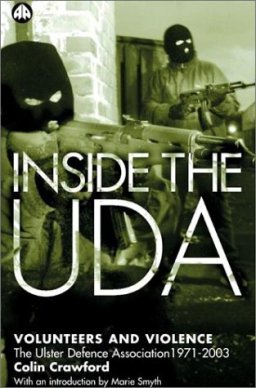
Colin Crawford.
London: Pluto Press, 2003, £14.99, p/back
When World-in-Action and Tribune journalist David Boulton published his excellent book, The UVF, 1966-73, (Torc Books, 1974) he bemoaned a near absence of valuable books and journal articles on Loyalism. In contrast to their Republican counterparts, Loyalists do not have a substantive support base overseas; nor have they received much in the way of academic attention. They are not fêted by Dublin, Washington or London. Their self perception is that of a community that has systematically lost out, while Republicans hijack the Good Friday Agreement to their own ends. Nor, in contrast to the IRA, have Loyalists duped a section of the left into seeing them as freedom fighters. Historically, even bourgeois and mainstream unionists have been quite inept at handling the media and public relations. This has been amplified by the subsequent fragmentation of loyalism that Crawford’s book, in part, addresses, and by the deepening sense of disempowerment and alienation among the loyalist working class from which the para-militaries are historically derived. Given the reality of the situation created by the Good Friday Agreement, the institutionalisation of divisions and the exclusion of working class politics as a factor, sectarianism has deepened in both of the main communities of Northern Ireland with depressing results in the recent election. Loyalists, in particular, just don’t care what the rest of the world thinks about them any more.
At this level, Colin Crawford’s book is certainly to be welcomed but that welcome has to be qualified. As a probation officer who works with former loyalist prisoners, Crawford was almost uniquely placed to produce an ‘ethnography’ on loyalism, in which sections of the UDA describe themselves and their actions, in their own words. In essence, this is what Crawford’s book is; and it has all the strengths and weaknesses of a certain kind of ‘reflexive sociology’ that, since the ‘cultural turn’ of 1977, has emphasised ‘ethnicity’ and other forms of ‘identity’, at the expense of class analysis.
At the general level, Crawford refuses to see how the relationship between working class politics and sectarianism is continually negotiated through the lived experience of the community itself. When class politics are forced into retreat, sectarianism prospers and vice versa. The historical background to the crisis provided by Crawford is not only selective but often inaccurate; and the idea that civil rights agitations led logically to IRA terrorism is actually quite offensive.
Crawford grasps that in contrast to the highly disciplined command structure of the UVF, the UDA was always an unwieldy coalition of territorially-based groups with their own agendas; yet seems surprised at the consequences of this, in terms of gangsterism and unbridled sectarianism. He refers to the Ulster UDI position developed in the mid-1970s but does not root this in the contradictions of the Ulster Workers Council strike of 1974. He notes that the Ulster Democratic Party (UDP) fared more poorly than its (Progressive Unionist Party) (PUP) counterpart in elections, but does not grasp that this is precisely a consequence of its lack of a radical social agenda. He does grasp that having so fared poorly, those like Johnny Adams and Gary MacMichael, who are at least serious about politics, could be quickly upstaged by drug-dealing Fascists and open gangsters like Johnny Adair and some of his former allies, who are still involved in squalid, sectarian thuggery in Belfast.
Inevitably, general interest in Crawford’s book will centre on its treatment of collusion between the Loyalist para-militaries and security forces, but as an ethnographer who studies terrorists as ‘ordinary people driven beyond normal boundaries’, Crawford is more concerned with the culture of collusion than with the detail of investigation. Without a class perspective he also lacks the scepticism of a journalist of the calibre of Henry McDonald, in his excellent book, (with John Cusack,) The UVF, (Poolbeg, 1997). Having seen their comrades murdered by the IRA, having been constrained by the yellow card principle, and with armed Special Branch protection afforded to terrorist leaders like McGuiness and Adams, that sections of the police and army stepped beyond the law, in terms of indigenous collusion, is understandable if not to be condoned. What matters more to historians is how MI5, as an example, intervened in this process to service various agendas, some of which had little to do with fighting terrorism in Northern Ireland. The attempted destabilisation of Harold Wilson’s government in the 1970s is an obvious case in point.
Unfortunately, where Crawford points to collusion in a detailed way, he points to what we already know, for example, about Brian Nelson’s role as a UDA intelligence officer but also, in arms procurement from South Africa for what became the Combined Loyalist Military Command.
There is much that is useful in Crawford’s book, from an anthropological point of view, for academics involved in this kind of research. But it does not offer a comprehensive history of Loyalism nor a solution to the present impasse in the Northern Ireland peace process, that has to be based on working class politics, if it is to succeed at all.
* * *
Roger Cottrell is a PhD student at Queen’s University, Belfast His novel, Enemy Within, was published by Rabbit Books in 2003.